Moving house is one of the most stressful experiences life throws at you. Whether you’re relocating across town or to another county, a step by step house removal plan is what separates a smooth move from a chaotic one.
Professional removals companies call this a “phased relocation approach,” and for good reason: breaking the process into clear stages transforms something overwhelming into something genuinely manageable. This guide walks you through every stage, from eight weeks out to your first night in the new place, with practical advice that actually makes a difference.
Key takeaways
| Point | Details |
|---|---|
| Start eight weeks early | Begin your house removal checklist at least eight weeks out to budget, research, and declutter without panic. |
| Pace your packing | Pack non-essential rooms four weeks out, living areas two weeks out, and essentials last. |
| Label every box by room | Packing room by room and labelling clearly makes unpacking far faster and less stressful. |
| Don’t rely solely on redirection | Royal Mail redirection is a safety net, not a replacement for notifying organisations individually. |
| Do a final walkthrough | Check every cupboard, drawer, and storage space before you hand over the keys. |
Step by step house removal: before you begin
Before a single box is packed, you need the right materials and a clear sense of what the move involves. Think of this stage as laying the foundations. Skip it, and you’ll be scrambling for tape at 11pm the night before moving day.
Supplies you’ll need first step in step by step house removal
Here’s what to gather well in advance:
- Boxes: A mix of small, medium, and large. Small boxes for books and heavy items, large ones for bedding and pillows.
- Packing tape and dispenser: Buy more than you think you need. You will always run out.
- Bubble wrap and packing paper: For fragile items, glassware, and anything with sentimental value.
- Labels and markers: Colour-coded labels by room save enormous time during unpacking.
- Wardrobe boxes: Worth every penny for hanging clothes. They go in neat and come out unwrinkled.
- Furniture blankets or old sheets: To protect larger items during transit.
| Category | What you need | Why it matters |
|---|---|---|
| Packing supplies | Boxes, tape, bubble wrap, paper | Protects items and keeps packing organised |
| Labelling tools | Markers, coloured labels | Speeds up unpacking at the new home |
| Admin tasks | Budget, removals research, notice periods | Avoids last-minute cost shocks and booking gaps |
| Decluttering | Bags for charity, skip hire if needed | Reduces the volume you’re moving and lowers costs |
| Documents | Moving contracts, utility contacts, inventory | Keeps important paperwork safe and accessible |
On the admin side, set a realistic budget that covers the removal company, packing materials, storage if needed, and a contingency fund. Research at least three removal companies and check reviews on independent platforms. Early decluttering reduces both costs and stress by cutting down the sheer volume you need to transport. Do not underestimate this.
Pro Tip: Start a dedicated moving folder, physical or digital, for all contracts, quotes, and important contacts. Having everything in one place prevents the mild panic of searching for the removal company’s number at 7am on moving day.
Your week by week removal timeline
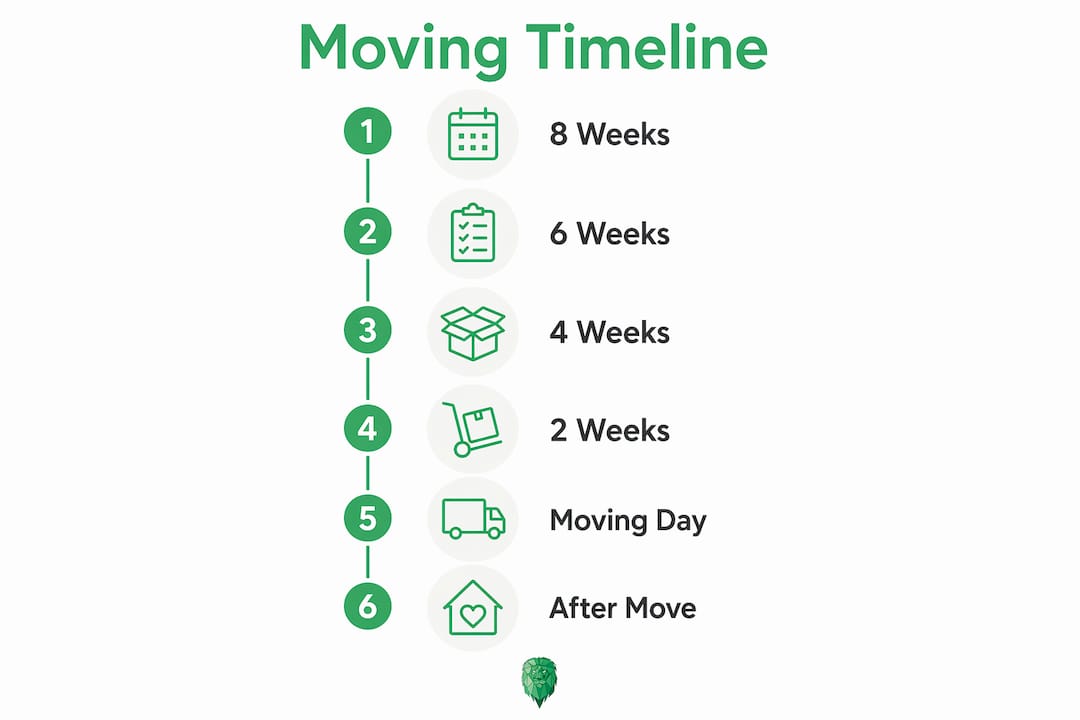
Early checklists prevent rushed decisions and the cognitive overload that comes with leaving everything too late. Here is a practical, week by week breakdown.
Eight weeks out
- Set your moving budget, including a buffer of at least 10% for unexpected costs.
- Research and shortlist removal companies. Get at least three quotes.
- Check your lease or mortgage completion date and confirm your moving day.
- Begin researching your new area: schools, GP surgeries, council tax bands.
- Start a rough moving home checklist covering all tasks, large and small.
Six to eight weeks out
- Start decluttering room by room. Donate, sell, or dispose of items you no longer need.
- Order packing supplies before you need them. Stock up generously.
- Pack items you rarely use: books, seasonal clothes, spare linen, hobby equipment.
- Confirm your chosen removal company and get everything in writing.
Pro Tip: When decluttering, use the “one year rule”: if you haven’t used it in the past twelve months and it holds no genuine sentimental value, it goes. This one decision alone can cut your packing volume by 20% or more.
Four weeks out
- Pack non-essential rooms: spare bedrooms, home office, dining room.
- Notify your utility providers (gas, electricity, broadband) of your moving date.
- Inform your bank, employer, HMRC, and GP of your upcoming address change.
- Arrange childcare and pet care for moving day. Both need planning in advance.
- Confirm parking arrangements at both properties with your removal company.
Two weeks out
According to a staged packing approach, leaving main living areas until two weeks before moving significantly reduces anxiety and keeps your daily routine intact for longer. At this stage:
- Pack the main living areas, keeping only what you genuinely use daily.
- Finalise utility transfer dates. Plan these carefully to avoid paying for overlapping bills or facing a blackout at either property.
- Set up Royal Mail redirection for at least six months. Book it online at the Royal Mail website.
- Prepare an “essentials box” with everything you’ll need on the first night: kettle, mugs, phone charger, toiletries, a change of clothes, and any medication.
Packing well and surviving moving day part off step by step house removal
Moving day is a marathon, not a sprint. The more you’ve done in advance, the calmer the day feels. Here’s how to make the final countdown and the day itself go as smoothly as possible.

Packing by room
Pack room by room and label every box with both the room it belongs in and a brief description of the contents. “Kitchen: mugs and glasses” is far more useful than “Kitchen stuff.” For fragile items, write “FRAGILE” on multiple sides of the box, not just the top.
The best way to remove furniture safely is to disassemble what you can, bag up the screws and bolts in labelled zip-lock bags, and tape those bags to the furniture itself. You’ll thank yourself during reassembly.
Moving day sequence other part off step by step house removal
- Do a final check of your essentials box. Keep it with you, not on the van.
- Keep important documents and valuables on your person throughout the move. Never pack them in a removal box.
- Direct the removal team clearly: which boxes go to which rooms, what gets loaded last (and therefore unloaded first).
- Do a final walkthrough checking all cupboards, drawers, loft hatches, garden sheds, and under-stair storage before leaving.
- Take meter readings at the old property and photograph them.
- Hand over the keys once you’re completely satisfied nothing has been left behind.
“Lift with your legs, not your back, and label absolutely everything.” This is advice from The Guardian’s 2026 moving guide, and it applies just as much to you as it does to the removal team. Back injuries are the most common moving day mishap, and they’re entirely preventable.
Pro Tip: At the new property, take meter readings immediately on arrival and photograph those too. This protects you from being billed for the previous occupant’s usage.
Settling in after the move part off step by step house removal
Arrival at your new home is exciting, but there’s important groundwork to cover before you lose yourself in unpacking.
- Check utilities first: Confirm that gas, electricity, water, and broadband are active and working as expected.
- Change the locks: You don’t know how many copies of the old keys exist. A locksmith visit on day one is money well spent.
- Test smoke and carbon monoxide detectors: Replace batteries if needed and confirm they’re in working order.
- Unpack in priority order: Bedrooms and bathrooms first so you can sleep and function comfortably. Kitchen second. Everything else can wait.
- Update your address with every organisation individually. Royal Mail redirection is a useful safety net but it has an expiry date and does not replace direct notifications to your bank, insurance providers, subscriptions, and the DVLA.
- Check for missing or damaged items: Cross-reference your inventory with what arrives. If you’ve used a professional removal company, report any damage in writing within 24 hours.
- Introduce yourself to neighbours: It sounds old-fashioned, but a quick hello goes a long way, especially if you ever need to ask a favour or report a parcel delivery.
Use the change of address checklist from Van-247delivery to make sure you haven’t missed any organisation that needs your new details.
Common mistakes and how to avoid them
Even well-organised movers make avoidable errors. Here are the ones that cause the most trouble:
- Leaving planning too late: The single biggest cause of moving day chaos. If you’re reading this with less than four weeks to go, start today, not tomorrow.
- Underestimating packing time: Most people underestimate by 50%. Pack more slowly than you think you need to, and you’ll still be surprised how long it takes.
- Not labelling boxes: Unlabelled boxes are a nightmare during unpacking. You’ll be opening twenty boxes to find the one with the coffee mugs. Label every box by room and content without exception.
- Relying on redirection alone: Redirection only forwards mail for the period you’ve paid for. After that, important letters go to your old address. Update every organisation directly.
- Skipping the final walkthrough: It takes ten minutes and saves you the discovery that you’ve left irreplaceable items behind. Make it non-negotiable.
Pro Tip: Book your parking permits and suspension bays well in advance if you’re moving to or from a city. Some councils require up to two weeks’ notice. Leaving this until the last minute can mean the van can’t park anywhere near your front door.
My honest take on moving house
I’ve been around enough house moves, both personally and through Van-247delivery’s fifteen years of helping people relocate across the UK, to know what actually separates a good move from a bad one.
The conventional advice is to “plan ahead,” which is true but useless without specifics. What I’ve found makes the biggest difference is starting the declutter at least eight weeks out and treating it as a separate project from packing. Most people conflate the two. They start packing and simultaneously try to decide what to keep. That approach slows everything down and adds enormous mental load.
The other thing most guides won’t tell you: professional removal companies are worth every penny for the heavy furniture, but the real value is in the liability. If a removal team damages your sofa or your wooden floors, there’s a clear process for compensation. If you rent a van and your friend drops the wardrobe, you’ve lost a friend and a wardrobe.
I’ve also seen people spend enormous energy optimising their packing technique while completely forgetting to notify HMRC of their new address. The admin side of a move is genuinely underrated. Do the how to move house guide and the address update list in parallel, not as an afterthought.
Staying flexible on moving day matters too. Things go sideways. A box gets mislaid, the new boiler needs a quick fix, the previous occupants haven’t fully cleared the garage. Build breathing room into your day, and you’ll navigate these moments with far less stress.
— Claudiu
Make your move easier with Van-247delivery
Moving house doesn’t have to feel this complicated. Van-247delivery has been helping people across the UK with professional, fully insured house removals for over fifteen years, covering everything from studio flats to large family homes.
Whether you need a full removal team with packing support, or a more flexible man and van service for a smaller move, Van-247delivery has options to suit your needs and budget. You can get an instant quote online, with no obligation and no surprises. The team handles the heavy lifting, literally, so you can focus on the exciting part: settling into your new home.
FAQ
When should I start planning a house removal?
Start your house removal checklist at least eight weeks before your moving date. This gives you enough time to budget, book a removal company, declutter, and pack at a manageable pace.
How do I pack efficiently for a house move?
Pack room by room, label every box with the destination room and a brief contents description, and start with items you use least often. Keep an essentials box separate for your first night in the new home.
Is Royal Mail redirection enough after moving?
No. Redirection only forwards mail for the period you’ve paid for and does not notify organisations on your behalf. You need to update your address directly with your bank, DVLA, GP, employer, and any subscriptions.
What should I do on moving day itself?
Do a final walkthrough of every room at the old property, keep valuables and important documents with you personally, take meter readings at both properties, and direct the removal team clearly when unloading at the new home.
How long does a typical house removal take?
It depends on the size of your home and how far you’re moving. A two-bedroom flat typically takes four to six hours from loading to unloading, while a four-bedroom house can take a full day or more. You can find a more detailed breakdown in Van-247delivery’s guide on how long removals take.