Temporary storage between moves: for a lease gap of a few weeks, a box/valet service or a small self-storage unit is usually your best bet. For a full-house move organised by a removals firm, storage in transit (SIT) tends to work out simpler and cheaper. Whichever you pick, check the access hours, confirm who insures your things whilst they’re out of your hands, and get extension and cancellation terms in writing before you sign anything.
TL;DR:
- Short-term self-storage units cost more per week or month, especially for climate-controlled or larger spaces, and require direct booking with fixed access hours.
- Storage in transit offered by removers has strict time limits and requires written agreements on extension, cancellation, insurance, and redelivery procedures.
- Choose storage options based on duration, access needs, item size, and budget, ensuring all terms and insurance details are clarified beforehand.
- Proper packing, labeling, and inventory photos are crucial, especially for fragile or valuable items, to avoid disputes and facilitate claims.
- Rental and move-out timing must align with tenancy agreements, and storage contracts are separate legal arrangements that depend on signed terms rather than housing law.
Table of Contents
- What temporary storage options are available in the UK and how they work
- How to choose the right temporary storage option for your move
- Preparing your items for short-term storage: packing, labelling and special-care items
- How a professional mover handles temporary storage: Van-247delivery’s practical process
- Legal regulations or tenancy rights related to temporary storage during moves in the UK
- Why most storage advice skips the part that actually causes problems
- Get help with storage during your move from Van-247delivery
- Sources
- FAQ
What temporary storage options are available in the UK and how they work, part of temporary storage between moves
Every option below solves the same problem in a slightly different way, so it helps to know how each one actually operates before you commit.
Self-storage units are the most flexible route. You rent a unit by the week or month, usually with 24/7 or extended access, and sizes typically run from small units roughly the size of a large cupboard up to units around the size of a small garage. Drive-up units suit bulky, hardy items you’ll want back quickly; indoor units with climate control suit anything sensitive to damp or temperature swings. SafeStore’s guidance on moving house notes this flexibility is exactly why so many movers use short-term self-storage to bridge a gap.
- Self-storage: you book directly, keep your own key or code, and visit whenever the site allows.
- Storage in transit (SIT): your removal company holds your belongings in its own warehouse, usually for a fixed maximum period, with access restricted until redelivery is arranged. It’s less about you popping in and more about a scheduled handover once your new place is ready.
- Box/valet collection services: a courier collects pre-packed boxes from your door and stores them in a central warehouse, charging per box or suitcase. This suits students, tenants between contracts, or anyone storing a handful of items rather than a houseful.
- Portable container services: a container is dropped at your property, you pack it yourself, and it’s either collected for storage or left on-site. Availability varies by region in the UK, so check local coverage before assuming it’s an option.
- Storing with friends or family: free and simple for a box or two, but weigh up the insurance gap. If something’s damaged in someone’s garage, you likely have no cover at all.
How to choose the right temporary storage option for your move, part of temporary storage between moves
Work through this in order, and the right answer usually becomes obvious fast:
- Estimate the duration. A few days points towards SIT or a valet service; several weeks or months tilts towards self-storage.
- Check access needs. If you’ll need to grab items mid-storage, self-storage wins; SIT and valet services are largely “in, then out.”
- Sort by item type. Bulky furniture suits self-storage or SIT; a handful of boxes suits valet collection.
- Set a budget. Short-term storage almost always costs more per month than a long-term contract, precisely because you’re paying for flexibility rather than a fixed term, according to SafeStore.
- Match delivery and collection. If your mover already offers SIT as part of the removal, it may be simpler and cheaper than arranging separate self-storage.
On cost shapes: expect small self-storage units to run at a weekly or monthly rate that rises for climate-controlled or larger units, whilst SIT is often quoted as a handling fee plus a daily or weekly storage charge, and box/valet services price per item rather than per unit. None of these figures are fixed nationally, so always get a written quote for your specific volume and postcode.
Before booking anything, ask providers:
- How many days of SIT are included before it converts to long-term storage, and what happens after that point?
- What’s the access policy, and how much notice do you need to give?
- Who insures your goods whilst stored, and is it included or an add-on?
- What’s the inventory procedure, and do you get a copy?
- What are the extension and cancellation terms?
Movers should confirm SIT time limits and conversion rules in writing, according to guidance on storage in transit, and that single step avoids most of the disputes that crop up with mover-managed storage.
Pro Tip: If a provider can’t tell you clearly what happens after your SIT allowance runs out, treat that as a warning sign, not a minor detail. Vague answers on conversion terms tend to mean vague invoices later.
Red flags worth walking away from: no written SIT conversion terms, a storage location the company won’t disclose, no meaningful insurance options, or a redelivery process that’s “we’ll call you nearer the time” rather than a scheduled date.
Preparing your items for short-term storage: packing, labelling and special-care items, part of temporary storage between moves
Pack for storage the way you’d pack for a short trip, not a permanent move. Keep a separate bag with you for the gap period: a few days of clothing, toiletries, chargers, important documents, and one set of bedding, so you’re not digging through sealed boxes on night one in temporary accommodation.
- Wrap furniture corners and glass surfaces before stacking anything against them.
- Disassemble beds, wardrobes and large shelving units where possible; flat-packed items travel and store far better than assembled ones.
- Wrap electronics in their original boxes if you kept them, or bubble wrap plus a sturdy outer box if you didn’t.
- Group soft goods (bedding, cushions, clothes) into vacuum bags or clearly labelled boxes rather than bin bags, which tear.
Photograph everything before it goes into storage. A simple inventory list with room-by-room photos matters more than most people realise, because it’s your main evidence if anything’s damaged or missing when it comes back out, as Extra Space Storage’s guide on storing between homes points out.
For antiques, artwork, musical instruments, or anything electrical that’s sensitive to damp, choose climate-controlled storage rather than a standard drive-up unit, and ask about professional crating for genuinely fragile or valuable pieces. Our house moving packing checklist breaks this down room by room if you want a fuller reference before you start boxing things up.

How a professional mover handles temporary storage: Van-247delivery’s practical process, part of temporary storage between moves
Booking mover-managed storage should feel far less mysterious than it often does, and the workflow is fairly consistent once you know what to expect. A pre-move survey establishes what needs storing and for how long. Items are tagged and logged against an inventory, transported under insured cover, held for an agreed SIT window, then redelivered on a scheduled date rather than left open-ended.
A managed storage arrangement only works when the time limit and the redelivery date are agreed upfront, not discovered halfway through. That’s the difference between storage that solves your problem and storage that becomes another thing to chase.
Common scenarios we see include a lease ending before the new property’s ready, a staged move where furniture goes in before the family does, and student moves where a summer gap needs bridging between one tenancy and the next. In each case, the point of insured transport isn’t just cover for accidents in the van. It also means claims are handled against a documented inventory rather than a vague “we think that’s everything” conversation.
Legal regulations or tenancy rights related to temporary storage during moves in the UK, part of temporary storage between moves
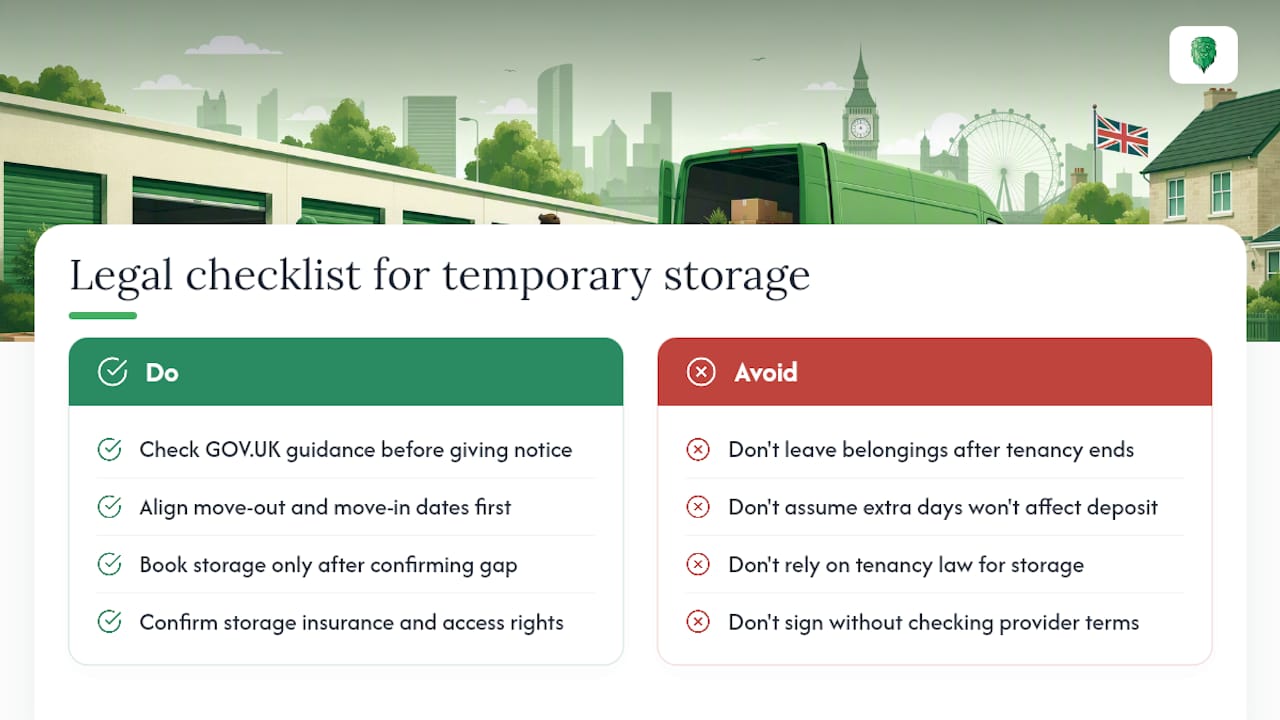
Temporary storage sits alongside your tenancy obligations, not instead of them, and it’s worth knowing where the lines are. Your notice period, move-out date, and any deposit deductions are governed by your tenancy agreement and by Gov, which sets out tenant and landlord responsibilities in England.
A few points matter specifically for the storage gap:
You have no automatic right to leave belongings in a rental property after your tenancy ends, even briefly, without the landlord’s agreement. Doing so can put your deposit at risk if the landlord treats it as a failure to vacate on time. If your moving dates slip, it’s far safer to arrange short-term storage than to assume a few extra days in the old property will go unnoticed.
Storage contracts themselves aren’t covered by tenancy law. They’re a separate commercial agreement between you and the storage provider or mover, governed by their own terms of service rather than housing legislation. That means insurance, access rights, and liability for damage depend entirely on what you sign, not on any statutory tenant protection.
If you’re storing between a rented exit and a rented entry, align your moving dates with your notice period first, then book storage around that confirmed gap rather than the other way round. Checking GOV.UK’s private renting guidance before you give notice avoids the scramble of arranging emergency storage because a move-out date changed at the last minute.
Why most storage advice skips the part that actually causes problems
Most guides on this topic read like a neutral survey of storage types, and that’s exactly where they fall short. The real risk in temporary storage isn’t choosing the wrong category of unit. It’s signing up to mover-managed storage without a written SIT limit, or renting a unit without checking what happens if your moving date slips by a fortnight.
If there’s one thing worth prioritising above all else, it’s asking about conversion terms and redelivery scheduling before you ask about price. A slightly cheaper quote with vague terms on access or SIT limits usually costs more in stress, and sometimes in money, than a marginally pricier option with everything written down. Flexibility to extend at short notice, not the headline rate, tends to be what decides whether short-term storage actually works for you.
Conventional advice also underplays how much tenancy timing matters. Storage isn’t a backup plan for a moving date gone wrong. It should be booked around a confirmed gap, agreed with your landlord and your mover before you’re standing in an empty flat with nowhere for your boxes to go.
— Claudiu
Get help with storage during your move from Van-247delivery
A single point of contact for both the move and the storage gap can simplify the process, avoiding the need to coordinate between a removals firm, separate self-storage booking, and your own transport between the two. Our house removals and storage service covers insured transport, packing, and short-term storage as part of one arranged move, which matters most when your moving dates are tight or still shifting.
When comparing self-storage with mover-managed options, getting an instant quote followed by written confirmation of SIT days, access policies. And insurance coverage is recommended before booking. It is also advisable to inquire about packing and disassembly add-ons. It’s a lot easier to sort out at quote stage than halfway through a move.
For bulkier items that need special handling alongside storage, our furniture and large items page covers what’s involved. And our man and van service suits smaller loads or a quick collection between addresses.
Sources
A few places worth bookmarking whilst you plan your move and storage timeline:
- Gov
- Moving house storage | SafeStore
- Storage in transit (SIT) explained – Moving US Van Lines
- Storage between homes | Extra Space Storage guide
FAQ
How much does it cost to store furniture between moves?
Costs vary by provider, volume, and duration: self-storage is typically priced weekly. Or monthly and rises with unit size or climate control. Whilst mover-managed SIT often combines a handling fee with a daily or weekly storage charge. Always ask for a written quote against your specific inventory rather than relying on a general estimate.
What is a temporary storage unit?
It’s a short-term rented space, usually a self-storage unit. Used to hold belongings between a move-out date and a move-in date. Unlike long-term storage, it’s priced and booked with flexibility to extend. Or end at short notice in mind, as SafeStore explains.
Can you legally live in a storage unit in the UK?
No. Storage units are commercial spaces for goods, not residential accommodation, and providers’ terms of service prohibit living in them. If you need somewhere to stay during a moving gap, that’s a separate housing arrangement, not a storage question.
What are some temporary storage solutions I can use at home?
If you’ve only got a few boxes, a spare room, garage. Or a friend’s loft can work, though you take on the insurance risk yourself. For anything valuable, a box/valet collection service or a small self-storage unit gives you proper cover. And a documented inventory, which home storage generally doesn’t.