Logistics in removals is defined as the full coordination of packing, loading, transit, unloading, and specialist handling to move belongings safely from one premises to another. Whether you are relocating a family home in Manchester or shifting an entire office in London, the role of logistics in removals determines whether your move runs like clockwork or descends into chaos.
The British Association of Removers (BAR) sets accreditation standards that reflect just how much planning, compliance, and operational skill a professional removal actually demands. Think of it less as “hiring a van” and more as commissioning a short-term project with moving parts, deadlines, and real consequences if anything goes wrong.
What are the core responsibilities logistics manages in a removal?
Modern removal companies treat logistics as a project management function, coordinating every stage of the move workflow rather than simply driving goods from A to B. That distinction matters enormously for you as a customer, because it sets the expectation that a professional firm is accountable for outcomes, not just effort.
The operational scope of removal logistics typically covers:
- Pre-move survey: A trained surveyor assesses volume, access points, and any specialist items before a single box is packed. This prevents nasty surprises on moving day.
- Packing with specialist materials: Double-walled boxes, acid-free tissue, furniture blankets, and custom crates protect your belongings during transit. The right materials reduce damage claims significantly.
- Systematic loading and unloading: Efficient loading follows a planned order by room and weight distribution, placing heavy items low and fragile goods last. This maximises vehicle stability and makes unloading at the destination far quicker.
- Secure transport: Route planning, vehicle checks, and load securing are all part of the logistics chain. A well-planned route avoids low bridges, weight-restricted roads, and peak-hour congestion.
- Specialist item handling: Pianos, antiques, and high-value items require dedicated wrapping, bespoke crates, and declared insurance cover. Treating a grand piano like a standard sofa is how expensive mistakes happen.
Sizing, timing, and communication are equally part of the logistics picture. A removal firm that books the right vehicle, confirms access times with your solicitor, and keeps you updated throughout is practising logistics management, even if they never use that term.
Pro Tip: Always ask whether a removal firm is BAR-accredited or holds a similar industry certification. Accredited firms follow defined quality and safety standards, which gives you a clear benchmark for what to expect.
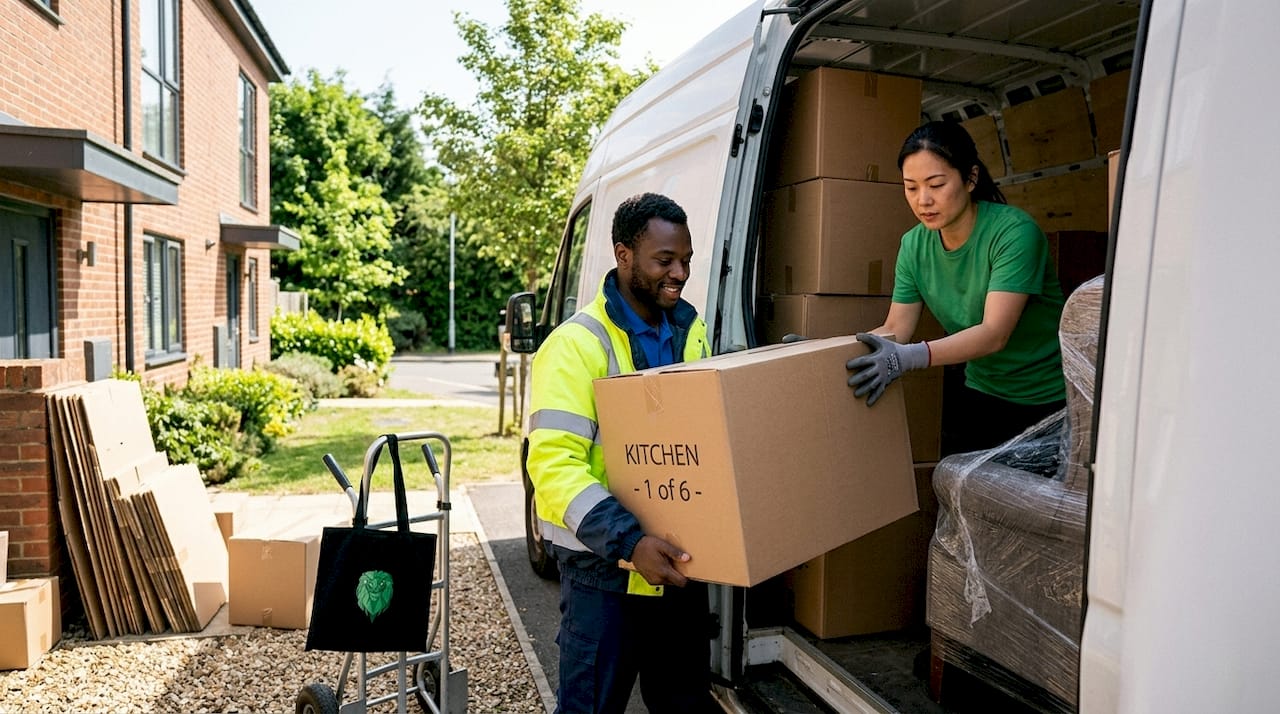
How does logistics protect safety and meet UK compliance rules?
Safety is not an afterthought in removal logistics. It is a regulated responsibility. The UK’s Manual Handling Operations Regulations 1992 require employers to avoid hazardous manual handling wherever reasonably practicable, and to assess and reduce risk when lifting tasks cannot be avoided.
No fixed legal maximum weight limit exists in UK law for lifting. This surprises many people who assume there is a universal “25 kg rule.” The Health and Safety Executive (HSE) instead uses the TILE framework, which stands for Task, Individual, Load, and Environment. Each factor is assessed together to determine the actual risk level for a specific lift in a specific context.
Practical safety logistics in removals follow a clear hierarchy:
- Avoid the hazardous lift entirely. Can the item be disassembled? Can a mechanical aid do the job instead?
- Use mechanical aids. Sack trucks, stair-climbing trolleys, and furniture sliders reduce the physical load on workers and cut injury risk substantially.
- Redesign the workflow. Proper compliance starts with process redesign before relying on training or individual technique. Changing how a task is done beats telling someone to “lift with their knees.”
- Assess residual risk. Once controls are in place, document the remaining risk and communicate it clearly to the team.
- Monitor and review. Conditions change between survey and moving day. Narrow staircases, unexpected furniture, or wet weather all alter the risk profile.
Pro Tip: When booking a removal, tell your firm about every environmental challenge in advance: narrow hallways, steep stairs, low ceilings, or restricted parking. This allows the logistics team to plan the right equipment and crew size, rather than improvising on the day.
In what ways does logistics differ between home and business moves?
The importance of logistics in moving becomes most visible when you compare a residential relocation with a business one. Both require planning and safe transport, but the stakes and complexity are quite different.
| Factor | Home removal | Business relocation |
|---|---|---|
| Primary goal | Convenience and care of personal belongings | Operational continuity and minimal downtime |
| Timing pressure | Completion date set by solicitors | Business hours, staff schedules, IT cutover windows |
| Items involved | Furniture, boxes, personal effects | Workstations, servers, specialist equipment, stock |
| Stakeholders | Homeowner and removal firm | Facilities managers, IT teams, suppliers, staff |
| Risk of delay | Personal inconvenience | Revenue loss and reputational damage |
Logistics in business removals functions like a delivery project with explicit performance targets: items must arrive on time, in the correct condition, and in the right sequence to allow the business to resume operations quickly. SAP defines logistics as managing transportation, storage, and information flow so that goods reach the right place at the right time in the right condition. That definition maps directly onto what a well-run office relocation demands.
Effective coordination with internal and external parties is what separates a smooth business move from a disruptive one. IT teams need to know when servers will be offline. Facilities managers need access confirmed at both sites. Staff need clear timelines so they can plan their own workloads. Logistics management for business relocations treats communication as a deliverable, not an afterthought. You can read more about minimising office move disruption in Van-247delivery’s dedicated guide on the subject.
What processes and tools improve efficiency in removal logistics?
Good logistics management for removals does not rely on guesswork. It uses structured processes and, increasingly, digital tools to improve reliability and reduce cost.
Route planning and vehicle selection are the foundation. Optimising transport routes and vehicle choice reduces cost and improves delivery speed, particularly for long-distance moves across the UK. Choosing a vehicle that is too large wastes fuel and creates access problems; too small means multiple trips and higher overall cost. Getting this right is a logistics decision, not a driving one.
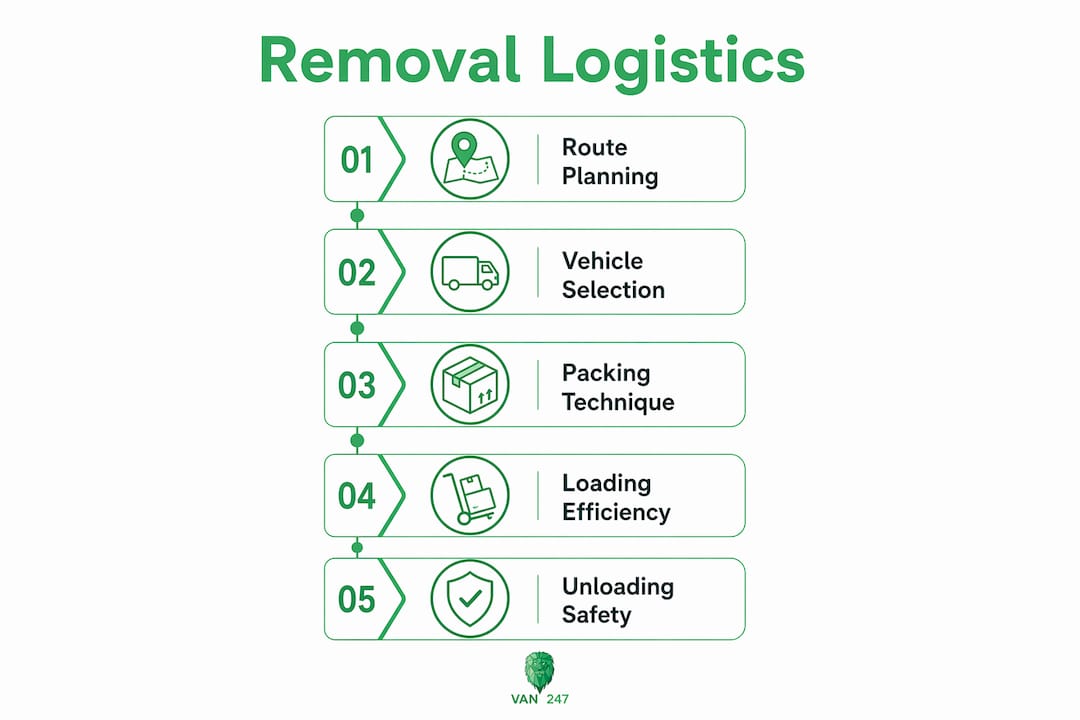
Packing technique and materials directly affect how efficiently a vehicle is loaded and how safely goods travel. Uniform box sizes stack better, fill space more completely, and reduce shifting during transit. Using quality packing materials such as double-walled boxes, packing paper, and furniture wrap is one of the most cost-effective logistics investments you can make. You can also explore Van-247delivery’s advice on packing cases for removals for practical guidance on choosing the right materials.
Tracking and scheduling tools are becoming standard in professional removal logistics. Real-time GPS tracking, digital inventory lists, and scheduling software give both the removal firm and the customer visibility over where items are and when they will arrive. This transparency reduces anxiety and allows for faster problem-solving if delays occur.
Digital inventories are a particularly underrated tool. Labelling every box with a QR code or numbered system linked to a spreadsheet means nothing gets lost in transit and unpacking at the destination becomes far more organised.
- Use colour-coded labels by room to speed up unloading.
- Photograph high-value items before packing as a simple insurance record.
- Confirm vehicle dimensions against your property’s access points before booking.
Pro Tip: If your move-out and move-in dates do not align, integrating storage solutions within your removal logistics plan prevents costly double-handling. Many professional firms offer short-term secure storage as part of the overall service.
Key takeaways
Effective removal logistics coordinates every stage of a move, from pre-move survey to final unloading, making it the single biggest factor in whether your relocation is smooth or stressful.
| Point | Details |
|---|---|
| Logistics is project management | A professional removal covers packing, loading order, transport, and unloading as one coordinated workflow. |
| Safety compliance is structured | UK law uses the TILE framework, not a weight limit, to assess and reduce manual handling risk. |
| Business moves demand more coordination | Office relocations require stakeholder communication and timing precision to protect operational continuity. |
| Vehicle and route choice matter | Selecting the right vehicle size and planned route reduces cost and prevents access problems on the day. |
| Storage bridges timing gaps | Integrating short-term storage into your logistics plan avoids double-handling when dates do not align. |
Why I think most people underestimate what a removal actually involves
People often book a removal the way they book a taxi: tell someone where you are, tell them where you are going, and assume the rest takes care of itself. After years of working in and around the UK moving industry, I can tell you that mindset is the root cause of most moving-day disasters.
The persistent myth of removals as “just a van” ignores the fact that a well-run move is genuinely complex. Weight distribution, access constraints, insurance declarations, manual handling risk assessments, and stakeholder communication all have to happen in the right order. When one element fails, the whole chain suffers.
What I find encouraging is that technology is closing the gap between what customers expect and what firms can deliver. Digital tracking, online inventories, and scheduling tools are making removal logistics more transparent than ever. Customers who once had no idea where their belongings were can now follow progress in real time.
My honest advice: treat your next move as a project, not a transaction. Brief your removal firm thoroughly, ask about their safety procedures, and check their accreditation. The firms that take logistics seriously will ask you better questions, plan more carefully, and deliver a calmer experience on the day. That is not a coincidence. It is the result of treating the role of logistics in removals with the respect it deserves.
— Claudiu
Plan your next move with Van-247delivery
Van-247delivery has over 15 years of experience managing the full logistics of UK home and business moves. From house removals with complete packing and loading services to flexible man and van options for smaller relocations, every service is built around the same principle: your belongings arrive safely, on time, and without unnecessary stress. The team also offers pallet delivery for businesses needing reliable freight solutions alongside their relocation. Whether you are moving a studio flat or an entire office floor, Van-247delivery applies professional logistics management to every job. Get an instant quote today and see how straightforward a well-planned move can be.
FAQ
What is the role of logistics in removals?
Logistics in removals covers the full coordination of packing, loading, transport, and unloading to move goods safely and on time. Professional removal firms treat this as a project management function with defined responsibilities at every stage.
Is there a legal weight limit for lifting during a removal in the UK?
No fixed legal maximum weight limit exists under UK law. The Health and Safety Executive uses the TILE framework to assess risk based on the task, individual, load, and environment rather than a single weight figure.
How does logistics differ between home and office removals?
Home removals focus on the care of personal belongings and convenience, while business relocations prioritise operational continuity, stakeholder coordination, and timing precision to minimise downtime and revenue loss.
What tools improve logistics efficiency in removals?
Route planning software, digital inventory systems, GPS tracking, and scheduling tools all improve reliability and transparency. Colour-coded labelling and pre-move photography also reduce handling errors and support insurance claims if needed.
When should I consider storage as part of my removal logistics?
Storage becomes useful when your move-out and move-in dates do not align. Integrating short-term secure storage into your logistics plan prevents double-handling and protects your belongings during the gap between properties.