Packaging is defined as the primary defence between your belongings and the physical forces of transit, including vibration, compression, and impact. The role of packaging in relocation goes far beyond wrapping things in newspaper. Done correctly, it protects fragile items, speeds up unpacking, controls costs, and keeps you on the right side of insurance requirements.
Whether you are moving a family home or an entire office, materials like anti-static wraps, shock-absorbent foam, and reinforced crates are not optional extras. They are the difference between a smooth move and an expensive one.
How does packaging improve protection and reduce damage?
Protection is the most visible function of packaging in any move. The right materials absorb shock, prevent shifting, and keep fragile items intact from the moment they leave your hands to the moment they arrive at the new address.
The choice of material matters enormously. Bubble wrap, foam padding, and custom crates each serve different purposes. Bubble wrap handles light fragile items like ornaments and picture frames. Foam padding is better for electronics and anything with sharp edges. Custom crates are the correct choice for industrial equipment moves, where packaging quality directly affects whether machinery arrives operational or requires costly repair.
For everyday household goods, the technique is just as important as the material:
- Glassware: Fill the inside of each glass with crumpled packing paper before wrapping the outside. This prevents the glass from collapsing inward under pressure.
- Plates: Pack them vertically, not flat. A plate packed vertically distributes weight along its strongest axis, significantly reducing breakage risk.
- Electronics: Use anti-static wraps before adding foam or bubble wrap. Static discharge can damage circuit boards even when the device looks physically undamaged.
- Heavy items: Always use smaller, reinforced boxes. A large box packed with books will fail at the base, regardless of tape quality.
Pro Tip: Stuff every void inside a box with crumpled paper or foam peanuts. An item that cannot move inside a box cannot break. Empty space is the enemy of a safe move.
In corporate relocations, anti-static wraps and custom crates reduce damage risk and speed up unpacking at the new site. This matters because every hour spent replacing broken equipment or searching for missing components is an hour of lost productivity.
Does packaging affect compliance and liability in moves?
Packaging in international moves is integral to customs compliance and insurance claims, not merely physical protection. This is a point that catches many people off guard, and it can be an expensive lesson.
Incorrect packing or incomplete documentation can hold shipments in customs for weeks. Insurance policies frequently require professional packing as a condition of cover. If you pack your own goods and something breaks, your insurer may decline the claim on the grounds that the packing was inadequate.
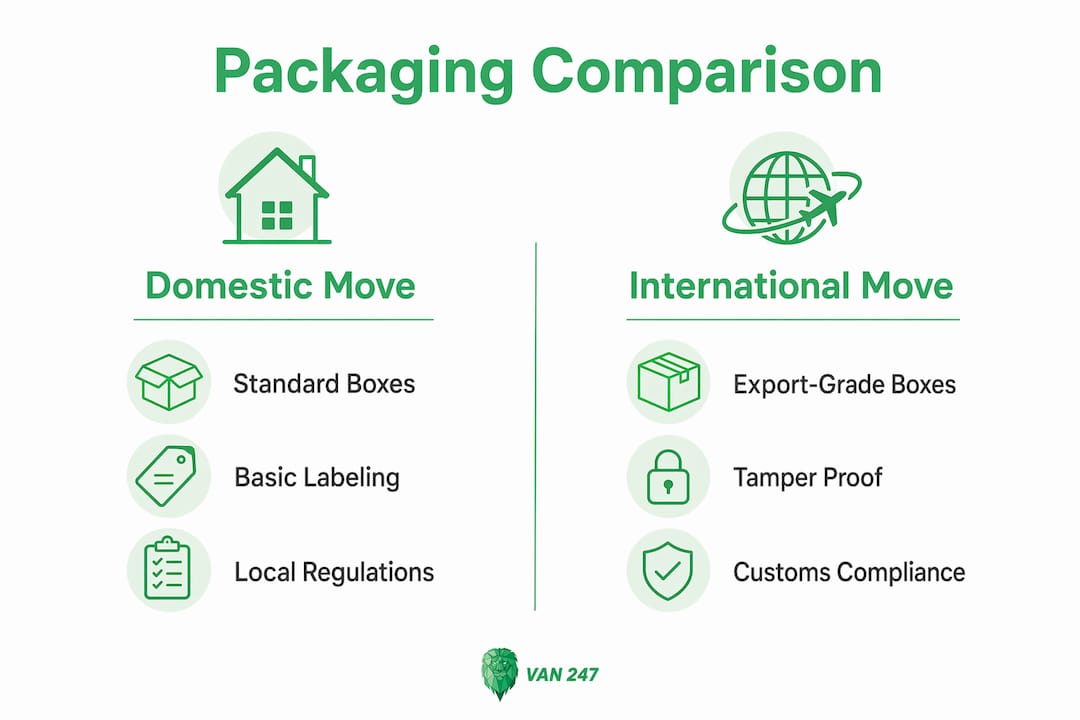
Professional pack-outs create condition-noted inventories and seal cartons to establish chain-of-custody. This means every item is logged, its condition recorded, and the box sealed in a way that shows if it has been opened. That documentation protects you at customs and in any dispute with an insurer.
The table below shows the key differences between domestic and international packing requirements:
| Feature | Domestic Move | International Move |
|---|---|---|
| Box type | Standard double-walled cardboard | Export-grade reinforced cartons or crates |
| Documentation | Basic inventory list | Condition-noted inventory, customs declaration |
| Sealing standard | Packing tape | Tamper-evident seals for chain-of-custody |
| Insurance requirement | Recommended | Often mandatory for cover |
| Handling touchpoints | Low (2–4 transfers) | High (6+ transfers, including port handling) |
| Specialist materials | Bubble wrap, foam | Reinforced pallets and crates for overseas transit |
For international moves, export packaging protects goods, ensures cross-border compliance, and reduces handling costs. The higher number of handling touchpoints in an overseas move means every weak point in your packaging will be found.
How does packaging influence logistical efficiency?
Packaging strategy affects supply chain efficiency by lowering costs, reducing errors, and improving warehouse flow. This principle applies directly to your move, whether you are relocating a two-bedroom flat or a 50-person office.

Packaging logistics covers three levels of function. Primary packaging holds the item directly, such as wrapping a lamp base in foam. Secondary packaging groups primary packages together, such as placing wrapped items into a labelled box. Tertiary packaging handles bulk transport, such as stacking boxes onto a pallet for a lorry. Consistent packaging sizing reduces loading errors and speeds up warehouse and vehicle operations. When every box is a standard size, the removal team can load the van faster and fit more in each trip.
Labelling is where most people lose time. Labels placed only on the top of boxes become invisible the moment boxes are stacked. Side labelling increases visibility during stacked transport and prevents delays during unloading. Colour coding takes this further. Assigning a colour to each room means the removal team can place boxes in the correct room without reading every label. Colour coding can cut unloading time by 50%, which is a significant saving on a large move.
Pro Tip: Label every box on at least two sides, not just the top. When boxes are stacked three or four high in a removal van, the top label is completely hidden. Side labels are always visible.
Well-planned packaging also reduces human error. When boxes are clearly labelled with contents, destination room, and handling instructions such as “fragile” or “this way up,” the removal team handles them correctly without needing to ask. Fewer questions mean faster handling and fewer mistakes.
What are the best practices for packing in different scenarios?
The right approach to packing depends on what you are moving and how far it is going. A DIY house move, a corporate office relocation, and an international shipment each require a different strategy.
For a household move, follow this sequence:
- Start packing 6–8 weeks before moving day. Begin with items you use least, such as seasonal clothing, books, and decorative objects.
- Source your packing materials early. Running out of bubble wrap on packing day is a common and avoidable problem.
- Pack one room at a time and label each box with the room name, a brief contents list, and any handling notes.
- Place heavy items in small boxes. Place light, bulky items in large boxes.
- Use specialist packing cases for items with irregular shapes or high value.
- Seal every box with two strips of heavy-duty tape along the base seam and one strip along the top seam.
- Complete a written inventory as you go. Photograph high-value items before packing them.
For a corporate relocation, the stakes are higher because downtime costs money. Tag every item with an asset number before packing begins. Use anti-static wraps for all IT equipment and pack servers in their original manufacturer packaging where possible. Tagging, logging, and inventory tracking are non-negotiable for operational continuity in office moves.
For industrial equipment, packaging quality directly affects repair risk and operational continuity. Custom-built crates with internal foam bracing are the correct solution for machinery. Never rely on standard cardboard for anything with moving parts or precision calibration.
For eco-conscious moves, reusable plastic crates are a practical alternative to single-use cardboard. Many removal companies offer crate hire, which reduces waste and often provides better protection. Protective packaging like furniture storage bags reduces damage-related waste and preserves usability during long transit and storage periods.
For fragile items like glassware, the detail is in the technique. You can find a thorough walkthrough in this guide on packing glassware safely, which covers wrapping methods, box selection, and cushioning in detail.
Key takeaways
Effective packaging is the single most controllable factor in whether a relocation succeeds or results in damage, delays, and unexpected costs.
| Point | Details |
|---|---|
| Protection starts with materials | Use foam, bubble wrap, and custom crates matched to the item type, not a one-size approach. |
| Compliance requires documentation | International moves need condition-noted inventories and tamper-evident seals to satisfy customs and insurers. |
| Labelling drives efficiency | Side labelling and colour coding reduce unloading time and handling errors on moving day. |
| Start packing 6–8 weeks early | Early preparation allows time to source correct materials and pack methodically without rushing. |
| Corporate moves need asset tracking | Tagging and logging every item before packing protects business continuity and speeds setup at the new site. |
Why most people get packaging wrong (and how to fix it)
After years of working in and around the UK removals industry, the most common mistake I see is treating packaging as an afterthought. People spend weeks planning the logistics of a move and then buy a few rolls of tape and some bin bags the night before. The result is predictable.
The second most common mistake is over-packing large boxes. A box that is too heavy to lift safely will be dropped. When it is dropped, the contents break. The fix is simple: use smaller boxes for anything dense, and fill every remaining void with cushioning material.
What genuinely surprises people is how much packaging affects the speed of unpacking. A well-labelled, colour-coded move can be functionally set up in a new location within hours. A poorly packed move can take days to sort out, which for a business means real financial loss.
Sustainable packaging is also worth taking seriously. Reusable crates, recycled paper padding, and furniture bags reduce waste without compromising protection. The removals industry is moving in this direction, and it is worth choosing materials and providers that reflect that.
My honest advice: treat packaging as part of the move itself, not a separate task. Budget time and money for it properly. The cost of good packing materials is always less than the cost of replacing what breaks.
— Claudiu
How Van-247delivery handles packaging in every move
Van-247delivery has been supporting UK households and businesses with professional removals for over 15 years. Every move handled by the team includes access to quality packing materials, experienced staff who know how to protect fragile and high-value items, and a structured approach to labelling and inventory that keeps your move on track.
For households, the house removals service covers everything from packing materials to full-service loading and transport. For businesses, the office relocation service includes asset tagging, IT equipment packing, and coordination to minimise downtime. Whether you need a man with a van for a small move or a full removal team for a large office, Van-247delivery provides insured, professional transport across the UK.
FAQ
What materials are best for packing fragile items?
Bubble wrap, foam padding, and crumpled packing paper are the most effective materials for fragile items. Plates should be packed vertically and glassware filled with paper before wrapping.
How far in advance should i start packing for a move?
Start packing 6–8 weeks before your moving date, beginning with items you use least. This gives you time to source the right materials and pack each room carefully.
Does packaging affect my insurance cover during a move?
Yes. Many insurance policies require professional or export-grade packing as a condition of cover. Improper packing can result in a declined claim if items are damaged in transit.
What is the difference between domestic and international packing requirements?
International moves require export-grade cartons, condition-noted inventories, and tamper-evident seals to meet customs requirements. Domestic moves have fewer documentation requirements but still benefit from structured labelling and quality materials.
How does labelling improve a move?
Side labelling and colour coding reduce unloading time and prevent boxes from being placed in the wrong room. Colour coding alone can cut unloading time by 50%, making the final stage of a move significantly faster.