A moving quote is a detailed, written estimate of the expected cost and services involved in your relocation, provided upfront so you can plan your budget with confidence. Whether you are moving a three-bedroom house in Manchester or relocating a London office, understanding moving quotes is the single most effective way to avoid nasty surprises on moving day.
This guide explains the types of quotes available, the key cost factors, how to read the fine print, and how to compare estimates side by side. Entities like the move Buddha cost calculator, FMCSA consumer protection rules, and UK-specific services all feature throughout.
What types of moving quotes exist and how do they differ?
Three main estimate types exist in the removals industry: binding estimates, non-binding estimates, and binding not-to-exceed estimates. Each carries a different level of price certainty, and choosing the right one shapes your entire moving experience.

A binding estimate locks the price regardless of how long the job takes or how much your shipment weighs, provided the inventory matches what was agreed. According to binding estimate rules, a binding not-to-exceed estimate goes one step further: it caps the price at the quoted figure but allows you to pay less if your shipment turns out lighter than estimated. That combination of ceiling and flexibility makes it the strongest consumer protection available, yet removals firms rarely offer it proactively. You need to ask for it specifically.
A non-binding estimate is the most common type you will encounter, particularly for longer-distance moves. The final bill can exceed the original quote if your shipment weighs more or the job takes longer. Under the American FMCSA rule 49 CFR 375.407, which serves as a useful consumer benchmark, non-binding estimates are capped at 110% of the original quote at delivery. This means the mover must release your goods on payment of 110%, then bill any remainder over 30 days. UK law does not mirror this rule exactly, but reputable British removals firms apply similar fairness principles in their terms and conditions.
- Binding estimate: Fixed price, no surprises if inventory is accurate
- Non-binding estimate: Price can rise; ask about the firm’s own cap policy
- Binding not-to-exceed: Best of both worlds; price ceiling with potential savings
- Verbal or phone estimate: Unreliable and almost always non-binding
Pro Tip: Always request your estimate in writing after a proper survey. Verbal or rough quotes without an inventory basis are non-binding and frequently cause cost surprises on the day.
What factors influence moving quotes and their overall cost?
Moving cost estimates are driven by a predictable set of variables. Understanding each one helps you spot where a quote is realistic and where it might be cutting corners.
- Distance and shipment weight. Local moves are typically priced by the hour, while long-distance moves are priced by weight and mileage. According to moveBuddha, local move costs range from £500 to £3,500+, and long-distance moves from £1,500 to £8,500+. Those ranges reflect how dramatically distance and volume affect the final bill.
- Property size. A one-bedroom flat requires fewer crew members and a smaller vehicle than a five-bedroom house. Larger properties also mean more labour time, which directly increases the hourly or day-rate charge.
- Additional services. Packing is the most commonly misunderstood add-on. Packing costs average £700 to £1,200 depending on home size and are charged separately from standard transport and labour fees. Many clients assume packing is included by default. It almost never is.
- Accessorial charges. Stair carries, long carries from a property to the vehicle, shuttle services for narrow streets, and lift fees are all charged separately. Accessorial fees can add £75 to £400+ to your final bill based on carrier data. These charges are easy to overlook when scanning a quote.
- Timing. Moving during peak season (June to August), at weekends, or at the end of the month costs more. Booking mid-week in autumn or winter typically secures a lower rate.
- Fuel surcharges and tips. Fuel surcharges fluctuate with market prices and are sometimes buried in the small print. Tips for the crew, while not mandatory, are customary and worth factoring into your overall budget.
A moving cost calculator that uses real market data, including fuel surcharges and seasonality, gives you a reliable baseline before you approach any firm for a formal quote.
How to interpret the details in your moving quote
Reading a moving quote carefully is where most people save or lose money. The difference between an estimate and a quote matters: a quote implies a fixed price, while an estimate signals flexibility. If a document uses both terms interchangeably, ask the firm to clarify in writing which applies.
Here is what to check line by line:
- Inventory basis: Was the quote produced after a physical or virtual survey of your belongings? Quotes based on thorough surveys are far more accurate than those generated from an online form or a phone call. An underestimated inventory leads to re-evaluation and higher costs on the day.
- Included services: Confirm whether packing materials, disassembly, reassembly, and specialist item handling (pianos, artwork, server equipment) are included or listed as extras. Professional packing services are almost always a separate line item.
- Transport method: A dedicated truck means your belongings travel directly to your new address. A shared load (groupage) means your items share space with other customers’ goods and may take longer to arrive. The price difference can be significant.
- Accessorial fees: Check whether stair carries, long carries, or parking permit costs appear in the quote. If they do not, and your property has stairs or restricted access, ask the firm to add them explicitly.
- Warning signs: Vague language like “all-inclusive” without a breakdown, unusually low deposits, and quotes that arrive without any survey are all red flags. A legitimate firm will always itemise its charges.
Pro Tip: Ask every firm the same question: “What would cause this quote to increase?” Their answer tells you exactly what is and is not covered, and it separates transparent firms from those relying on hidden charges.
How to compare moving quotes for informed decision-making
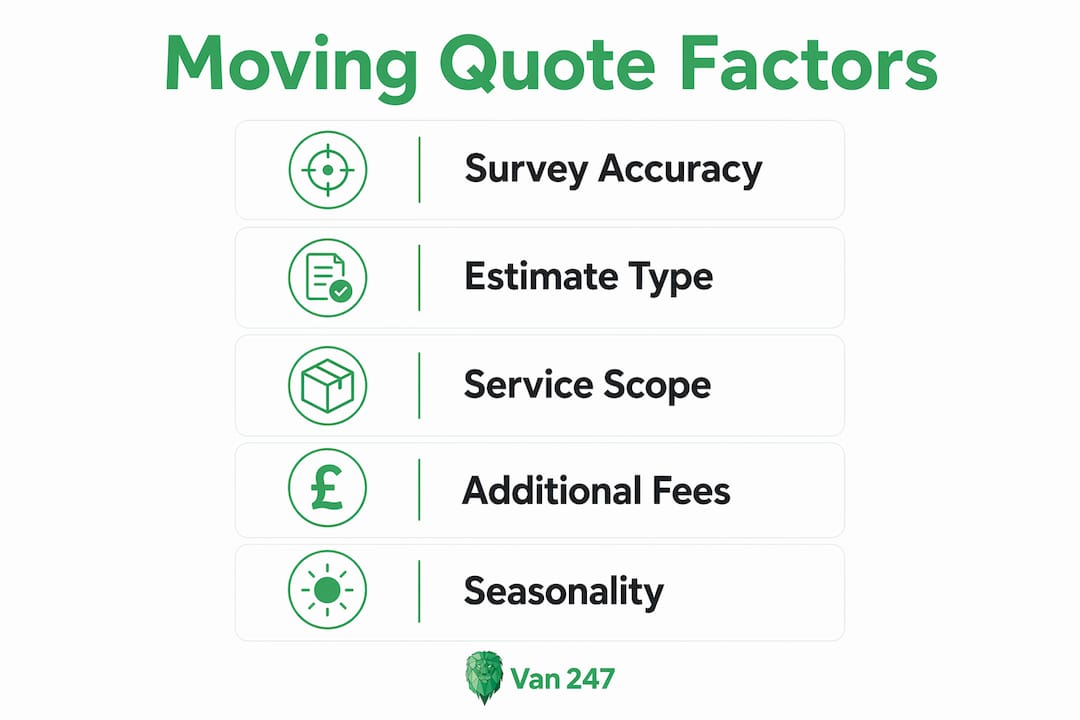
Comparing quotes is only useful when the quotes are genuinely comparable. Collecting three or more estimates is the recommended minimum, and each should be based on the same survey method and scope of services.
Use this table to compare quotes side by side before making a decision:
| Factor | What to check |
|---|---|
| Estimate type | Binding, non-binding, or binding not-to-exceed? |
| Survey method | In-home, virtual, or phone/online form? |
| Services included | Packing, disassembly, specialist items listed? |
| Transport method | Dedicated truck or shared load? |
| Accessorial fees | Stairs, long carry, shuttle, parking permits itemised? |
| Insurance cover | What level of liability is included as standard? |
Once you have your quotes laid out, use a cost calculator baseline to sense-check whether the figures are realistic for your move size and distance. If one quote is significantly lower than the others, it almost certainly excludes services the others include. Industry professionals consistently recommend fixed-price, dedicated truck moves for predictability, even when the initial figure appears higher than a cheaper shared-load option.
Negotiation is also possible. If you have a written quote from one firm, you can use it as leverage with another. Ask whether they can match the price while maintaining the same service scope. Most reputable firms have some flexibility, particularly outside peak season.
Pro Tip: Check that every firm you approach is a member of the British Association of Removers (BAR) or holds equivalent accreditation. Membership signals adherence to a code of practice and gives you a formal complaints route if things go wrong.
Commercial moving quotes vs residential: what changes?
Commercial relocations involve a different set of variables compared to residential moves, and the quote you receive should reflect that complexity.
- Scope of work: Office moves often include IT equipment, server racks, filing systems, and specialist furniture. Each category may require separate handling, specialist packaging, or dedicated transport, all of which appear as separate line items in a commercial quote.
- Timing and access: Businesses frequently need to move outside working hours to minimise downtime. Weekend, evening, or overnight moves carry premium rates, and your quote should state these clearly.
- Contract terms: Commercial quotes often include service level agreements covering liability for business equipment, data security during transit, and guaranteed delivery windows. These terms are rarely present in residential quotes.
- Phased moves: Large office relocations are sometimes completed in phases over several days or weeks. A phased quote will look very different from a single-day residential estimate, with separate costs for each phase.
- Customised logistics: Businesses moving specialist equipment, such as medical devices or manufacturing machinery, need quotes that reflect the specific handling, insurance, and transport requirements involved.
For a detailed breakdown of what a commercial quote should cover, the commercial moving services page at Van-247delivery outlines the typical service components bundled within business relocation estimates. Getting a customised quote rather than a standard residential template is not optional for office moves. It is the only way to get an accurate figure.
Key takeaways
Understanding moving quotes means knowing the estimate type, what services are included, and which charges are likely to appear later as extras.
| Point | Details |
|---|---|
| Know your estimate type | Binding not-to-exceed offers the strongest price protection; always ask for it in writing. |
| Survey quality matters | Quotes based on physical or virtual surveys are far more reliable than phone or online estimates. |
| Packing is rarely included | Packing services are almost always a separate charge; confirm this before signing anything. |
| Accessorial fees add up | Stair carries, long carries, and shuttle fees can add hundreds of pounds to your final bill. |
| Compare like for like | Three or more quotes, all based on the same survey and service scope, are needed for a fair comparison. |
What I have learned from years of watching moves go wrong
The most common mistake I see is people choosing the lowest quote without questioning why it is lower. A quote that excludes packing, uses a shared load, and has no mention of accessorial fees will almost always end up costing more than a slightly higher fixed-price quote that covers everything. The savings are an illusion.
The second mistake is accepting a verbal or phone estimate as a reliable figure. Written, itemised quotes after a proper survey are the only ones worth comparing. Everything else is a rough guess dressed up as a price.
My honest recommendation is to ask for a binding not-to-exceed estimate wherever possible. Most firms do not offer it unless you ask, but it gives you a price ceiling and the chance to pay less if your shipment is lighter than expected. That combination is genuinely the best deal available in the removals market.
Finally, do not skip the question: “What would cause this quote to increase?” Ask it of every firm. The answers will tell you more about a company’s transparency than any review site ever could.
— Claudiu
Ready to get a clear, honest quote for your move?
Van-247delivery has been helping UK households and businesses relocate for over 15 years, with transparent pricing and no hidden charges. Whether you need a full house removal with packing and specialist item handling, an office relocation with out-of-hours access, or a flexible man and van service for a smaller move, the team provides written, itemised quotes based on a proper assessment of your needs.
Every quote from Van-247delivery includes a clear breakdown of services, transport method, and any applicable accessorial charges, so you know exactly what you are paying for before you commit. Request your free quote today and take the guesswork out of planning your move.
FAQ
What is the difference between a moving quote and an estimate?
A quote implies a fixed price, while an estimate suggests the final cost may vary. Always ask the removals firm in writing which applies to your agreement before signing.
How many moving quotes should I get?
Collect at least three quotes, each based on a physical or virtual survey of your belongings. This gives you a reliable basis for comparison and negotiation.
Are packing services included in a standard moving quote?
Packing services are almost always charged separately. Packing costs average £700 to £1,200 depending on home size, so confirm whether they are included or listed as an add-on before agreeing to any quote.
What are accessorial charges in a moving quote?
Accessorial charges cover additional services such as stair carries, long carries, shuttle vehicles for narrow access roads, and lift fees. These fees can add £75 to £400+ to your final bill and are often absent from initial quotes.
How do I know if a moving quote is accurate?
Accuracy depends on the quality of the inventory survey. Quotes produced after an in-home or detailed virtual survey are significantly more reliable than those generated from a phone call or online form, as survey-based quotes account for actual volume, access conditions, and specialist requirements