Understanding piano removal: costs, options and expert tips. Moving a piano is one of those tasks that catches people off guard. You assume it’s just a big, heavy item — surely a few strong helpers and a van will do the job? But upright local moves alone cost £100 to £400, and grand pianos can reach £2,000 or more for complex relocations.
The real shock isn’t just the price. It’s realising that a piano is a precision instrument with thousands of moving parts, and even a short trip across town can cause lasting damage if handled incorrectly. This guide walks you through everything you need to know before booking.
Table of Contents
- What is piano removal and why is it different?
- Key costs and factors in UK piano removal
- Professional versus DIY piano removal
- Finding and choosing the right piano removal service
- Our take: what most people miss about piano removals
- Need specialist piano removal or house moving help?
- Frequently asked questions
Key Takeaways
| Point | Details |
|---|---|
| Specialist care matters | Pianos require expert handling to avoid costly damage and ensure safe arrival. |
| Costs can escalate | Access issues, piano type, and distance significantly affect removal price. |
| DIY has real risks | Amateur moves can end up far more expensive if the instrument is damaged or insurance is bypassed. |
| Choose experience | Qualified piano movers with insurance and the right equipment offer crucial value. |
What is piano removal and why is it different?
Having established the cost and complexity, let’s clarify what piano removal truly involves and why it stands apart from everyday removals.
Piano removal means transporting your instrument safely from one location to another, with its condition fully protected throughout. It is not the same as piano disposal and removal, which typically involves recycling or scrapping an unwanted instrument for a lower fee of around £150 to £500. Disposal services focus on getting the piano out of your space. Specialist removal services focus on getting it somewhere new without causing a single scratch or a single crack in the soundboard.
So why does a piano need such special handling? A few reasons that might surprise you:
- Weight and balance: A standard upright piano weighs between 150 and 250 kg. A concert grand can exceed 600 kg. Both are top-heavy, which makes them genuinely dangerous to tip or manoeuvre on stairs.
- Delicate internal mechanisms: Inside every piano are thousands of felt pads, hammers, strings, and pins under enormous tension. Jolts and tilts can knock these out of alignment, even when no external damage is visible.
- Leg vulnerability: Grand piano legs are bolted on and are not designed to bear lateral stress. Moving a grand without removing the legs is asking for a very expensive repair.
- Flooring and doorframe risk: The sheer mass of a piano can crack tiles, gouge hardwood floors, and splinter doorframes if the right equipment and technique are not used.
“Experts warn against DIY for anything but the simplest ground-floor tasks due to the top-heavy nature and delicate mechanisms involved in piano transport.”
This is worth taking seriously. Many people think a ground-floor move is safe to do themselves, and sometimes it is. But the moment stairs, narrow hallways, a heavy grand, or any kind of incline appear, you are in territory where the wrong move can result in serious injury or a repair bill that dwarfs the cost of professional help. For anyone who wants to understand the full picture, reading expert advice for moving a piano before making a decision is a sensible starting point. When you are ready to act, professional piano removal is the route that removes that risk entirely.
Key costs and factors in UK piano removal
Now that you know what makes piano removal specialised, let’s see what affects the cost and why quotes vary so much.
The UK average cost of moving a piano sits at around £400, but that figure is just a midpoint. The actual price you pay depends on several variables that interact with each other in ways that are not always obvious upfront.
Piano type and size
The bigger and heavier the instrument, the larger the team required and the more specialist equipment involved. Upright pianos typically need two to three movers. Grand pianos require three to five. Baby grands and boudoir grands sit somewhere in between, and concert grands are in a category of their own.

Access conditions
This is often where costs escalate unexpectedly. Stairs, tight landings, low ceilings, and narrow front doors all add time and risk. Each flight of stairs typically adds £30 to £100 to your quote. If the piano needs to go through a window or over a wall due to awkward access, a crane may be required. Crane hire alone ranges from £400 to £1,800 depending on the job.
Distance
Local moves are priced differently from long-distance relocations. For longer journeys, expect to pay an additional £1 to £2.50 per mile on top of the base cost. This adds up quickly for relocations between cities or across regions.
| Job type | Typical cost range |
|---|---|
| Upright piano, local, ground floor | £100 to £250 |
| Upright piano, local, with stairs | £200 to £400 |
| Grand piano, local move | £300 to £800 |
| Grand piano, complex access | £800 to £2,000+ |
| Crane lift (if required) | £400 to £1,800 |
| Long-distance surcharge | £1 to £2.50 per mile |
| UK average across all job types | Around £400 |
Stat: The UK average cost for piano removal is £400, but access difficulties, crane use, and piano type can push the total to over £2,000 for more complex jobs.
Pro Tip: Always ask for an all-in quote that explicitly lists stair charges, crane costs, and mileage. A quote that looks cheap on the surface can balloon quickly once these extras are added. When choosing local piano movers, make sure the breakdown is crystal clear before you commit.
Professional versus DIY piano removal
With a sense of what drives price, the next choice is method: should you go professional or DIY?
Let’s be straightforward here. DIY piano moving is feasible in a very small number of scenarios. If you have a lightweight upright, a completely clear ground-floor path, several capable helpers, a proper piano dolly, and moving straps, a short shift to a neighbouring room or a ground-level van loading might just about work. But that scenario is far narrower than most people assume.
Here is a side-by-side look at what each route really involves:
| Factor | Professional removal | DIY / informal help |
|---|---|---|
| Cost | £100 to £2,000+ depending on job | Potentially lower, but hidden risks |
| Equipment | Specialist dollies, skids, straps, padding | Usually improvised or inadequate |
| Insurance | Typically included | None unless you arrange separately |
| Experience | Trained in balance, access, technique | Generally none |
| Risk of damage | Low | High, especially on stairs or with grands |
| Risk of injury | Managed professionally | Significant, especially for heavy instruments |
| Post-move tuning | Often advised by the team | Easily overlooked |
The cost comparison is where people most often go wrong. They see the professional quote and think, “We can do this ourselves for nothing.” But experts consistently warn against DIY for anything other than basic ground-floor moves, citing the top-heavy design and internal mechanism fragility. One dropped piano or one strained back can turn a “free” move into a very costly mistake.
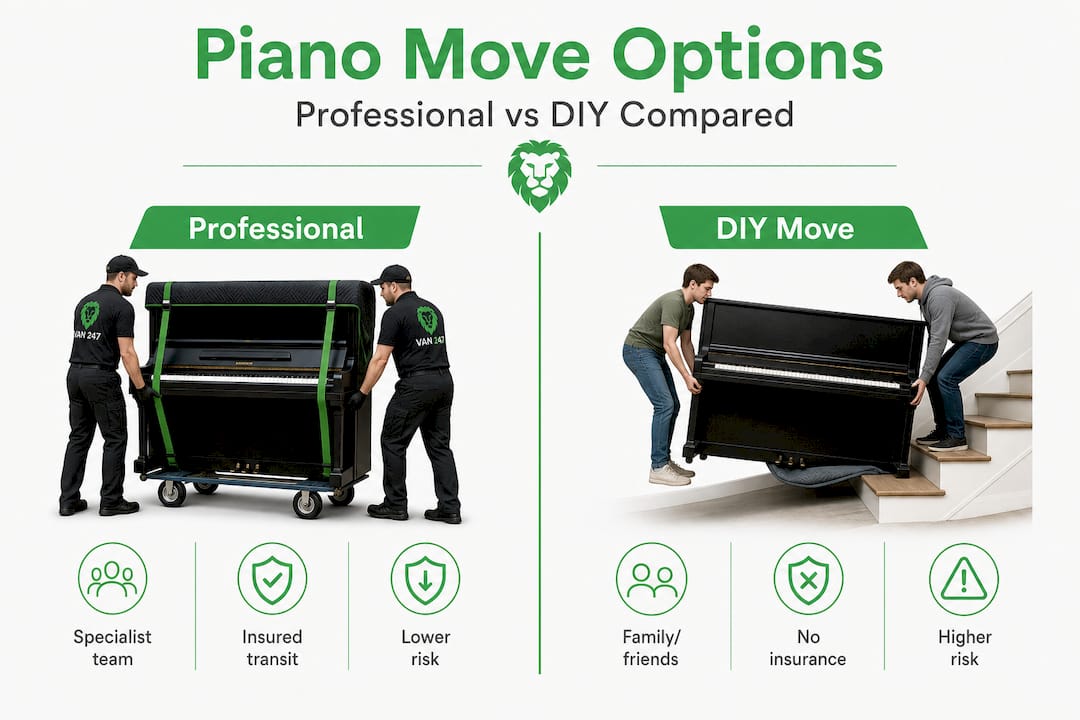
When you are weighing up your options, it helps to look at piano moving top tips from people who handle these instruments professionally every day.
Key benefits of going professional:
- Full insurance cover for the instrument and any property damage during the move
- Specialist equipment including piano skids, padded boards, and lifting straps designed for the job
- Experienced teams who know how to handle tight stairwells, awkward landings, and grand piano disassembly
- Efficiency as what might take a DIY group three hours can take a trained team forty-five minutes
- Peace of mind that your piano will arrive in the same condition it left
Pro Tip: Once your piano reaches its new home, give it at least two to four weeks to acclimatise to the new temperature and humidity before arranging a tuning. Pianos are sensitive to environmental changes, and tuning too early means the pitch may shift again as the instrument settles. This is especially important after long-distance moves between different climate zones.
Finding and choosing the right piano removal service
Once you know which route suits your needs, here is how to ensure you choose a reputable and experienced piano removal specialist.
Not every removal company is equipped to handle a piano. In fact, many general van hire firms will take the booking without mentioning that they lack the right equipment or training. Here is a step-by-step approach to finding someone you can trust:
- Search specifically for piano specialists. Use terms like “piano removal” rather than generic “man with van.” Start at a resource like finding a piano mover to understand what to look for.
- Ask about their experience. How many piano moves have they completed? Do they handle uprights, grands, or both? Do they have references or reviews you can check?
- Confirm insurance. Any reputable specialist will carry public liability insurance and goods-in-transit cover. Ask to see proof or get written confirmation.
- Get at least three detailed quotes. Costs vary significantly by access, type, and distance, so a quote that does not ask about your property layout is already a warning sign.
- Confirm crane use and contracts. If crane access is possible, ask specifically whether the firm coordinates this or whether you need to arrange it separately. Get the scope of work in writing.
- Ask about post-move advice. A good specialist will tell you about acclimatisation and tuning timelines. Those who don’t mention it at all may lack the deeper knowledge you need.
Watch out for these red flags when vetting companies:
- Quoting a price without asking about stairs, access, or piano type
- No mention of insurance when you ask about it directly
- No specialist equipment listed on their website or in their description
- No reviews specifically mentioning piano transport
- Pressure to book quickly without time to compare
Once your instrument is in its new space, think about where it sits. Temperature, humidity, and proximity to radiators or windows all affect piano health long-term. Reading up on piano positioning advice after your move can save you expensive tuning problems down the line.
Our take: what most people miss about piano removals
You’ve got the facts. Now here is what industry insiders wish more customers understood before booking a move.
The most common mistake we see is people treating piano removal as a price-shopping exercise rather than a protection exercise. Yes, the cost matters. But a piano is not just a piece of furniture. It is often a family heirloom, a professional tool, or an instrument that took years of saving to buy. When the focus shifts entirely to finding the cheapest option, protection gets deprioritised.
We have seen moves go wrong because customers booked a general clearance firm that promised to handle “anything large.” What followed was a piano delivered with cracked casing, broken pedals, and an interior so badly jostled that the tuning pins had shifted. The repair bill exceeded the cost of three professional removals. That is an extreme case, but it is not rare.
There is also the acclimatisation issue that almost nobody talks about. When a piano travels long-distance, it moves through different temperature and humidity zones. The wooden soundboard and the pin block absorb moisture changes and can swell or contract. Tuning a piano the day it arrives is almost always wasted money because the instrument needs time to settle, sometimes four to six weeks. This matters most for cross-country piano moves, where climate differences between regions are more pronounced.
The other thing worth saying plainly: skilled piano removal teams earn their fee. The ability to read a staircase, position a dolly at exactly the right angle, and communicate with a three-person team through a 90-degree turn without a word is genuinely hard-won expertise. That is not something you get from a general removal firm or from enthusiastic friends. When you hire well, you are paying for thousands of hours of experience compressed into a single move.
Our honest advice? Stop fixating on saving £50 and start focusing on who will take the best care of your instrument. The right team will cost you less in the long run.
Need specialist piano removal or house moving help?
If this article has helped you understand what a piano removal really involves, the next step is finding a team you can rely on to handle it properly.

At Van 24/7 Delivery, we offer insured, professional transport services backed by over 15 years of experience across the UK.
Whether you need dedicated expert piano transport, full-scale house removals across the UK, or a flexible man with a van service for smaller jobs, we have the right solution for your move. Our teams are trained in specialist handling, our quotes are fully transparent, and our insurance covers your instrument throughout the entire journey. Get in touch today for a no-obligation quote and let us take the stress out of your next move.
Frequently asked questions
How much does piano removal cost in the UK?
The UK average sits at £400, with upright local moves starting from around £100 and grand piano jobs reaching £2,000 or more for complex access or long distances.
Can I move a piano myself?
DIY is only realistic for very basic ground-floor moves; experts warn against it for anything involving stairs, grands, or heavy uprights due to balance risks and potential internal damage.
What’s the difference between piano removal and disposal?
Piano removal focuses on transporting your instrument safely to a new location, while piano disposal involves recycling or scrapping, typically costing £150 to £500 and with no concern for preserving the instrument.
Do I need a crane to move a piano?
Cranes are only needed for very difficult access situations such as moving through upper-floor windows; for most uprights, a trained team with the right equipment is sufficient, as crane use is considered excessive for standard upright moves.
What should I do after a piano is moved?
Allow your piano to acclimatise after moving for at least two to four weeks before arranging tuning, giving the instrument time to adjust to its new environment.