Waiting time charges are fees a removal firm, man‑with‑van operator or courier adds when their crew or vehicle is kept waiting beyond an agreed free period during your move or delivery. They typically kick in once you’ve gone past that free allowance, or the moment the crew arrives and can’t get access. Ask about the hourly rate, the start time for charging, and whether a waiver is available before you book.
TL;DR:
- Waiting time charges typically average around 35 pounds per hour in the UK, with a waiver cost around 95 pounds for a fixed buffer of hours.
- Most firms specify a free waiting allowance in minutes or hours before charges apply, which should be confirmed and documented upfront.
- Waivers buy you a set number of waiting hours at a fixed fee and usually do not cover redelivery or delays extending beyond the cap.
- To minimize costs, confirm the hourly rate, waiting start time, free allowance, and waiver conditions before booking, and have all terms in writing.
- Collect evidence immediately if a delay occurs, including photos, access details, and communication records, to dispute charges if necessary.
Table of Contents
- What are waiting time charges and why do movers apply them?
- How much do waiting time charges typically cost?
- How do waiting time waivers work?
- How can you avoid or reduce waiting time charges?
- What should you do if you’re charged for waiting time?
- Van-247delivery’s approach to waiting time charges
- Get a clear quote with waiting time terms included
- Sources
- FAQ
What are waiting time charges and why do movers apply them?
Waiting time charges exist because a van and crew standing idle still cost money. Wages don’t pause when the lift key hasn’t turned up, and neither does the fuel bill or the finance payment on the vehicle. Every hour a crew waits at your kerb is an hour they’re not earning on the next booking, which is why most firms build a waiting rate into their terms rather than absorbing the loss.
There’s a regulatory angle too, and it’s one homeowners rarely think about. Drivers’ hours rules and the Working Time Regulations limit how long a crew can legally stay on the clock in a single shift. If a delay drags on long enough, the firm may have no choice but to reschedule the job entirely, which creates a knock‑on cost of its own: a second visit, a second set of wages, a second slot pulled from the diary.
That’s the context in which waiting time waivers make sense. Rather than framing them as a penalty dreamed up to catch you out, the Association of Independent Movers explains that waivers exist to cover wages and the unavailability of resources when something outside anyone’s control causes a delay. Think of it less as a fine and more as risk transfer: you pay a small fixed sum upfront so the firm carries the cost of a hold‑up, rather than you carrying it hour by hour on the day. Understood that way, waiting fees stop looking arbitrary. They’re simply the price of keeping a crew and vehicle on standby when your keys, your buyer, or your access hasn’t come through on schedule.
How much do waiting time charges typically cost?
Expect a genuine, itemised line for waiting time on most quotes rather than a vague catch‑all clause. Sampled data from over 1,200 UK moves puts the average waiting time charge at around £35, with a separate late‑key waiver appearing at roughly £95 in cases where it’s offered as an add‑on. Those figures move around depending on the job.
Rates vary by region, crew size, and how the firm structures its pricing. A two‑person van team in a rural area may charge less per hour than a four‑person crew working a tight city schedule where every missed slot has a real opportunity cost. Some firms price waiting time per crew member per hour; others quote a flat hourly rate for the whole job regardless of headcount.
| Fee type | Typical example figure | How it usually appears on a quote |
|---|---|---|
| Waiting time (per hour, after free allowance) | Around £35 | Itemised hourly rate once the free period ends |
| Late‑key waiver | Around £95 | Flat optional extra added at booking |
| Free waiting allowance | Varies by firm | Stated in minutes or hours before charges start |
Waivers, when offered, tend to be presented as a flat sum you pay upfront rather than a variable cost tied to how long the delay actually runs. That’s a deliberate design choice: it gives you price certainty on the one part of a move that’s genuinely unpredictable.
How do waiting time waivers work?
A waiting time waiver is a fixed fee, paid when you book, that covers a set number of waiting hours up to a stated cut‑off. Pay it upfront, and if your keys are late or your buyer’s solicitor drags its feet, you’re not billed hour by hour once the crew arrives and finds nobody home.
The mechanics are simple in principle: the waiver buys you a buffer, not unlimited cover. Most policies specify a cap, say two or three hours, beyond which normal waiting rates resume. The Association of Independent Movers is clear that a waiver will usually prevent extra hourly charges up to that limit, but it very rarely stretches to cover redelivery. If access remains impossible and the job has to be postponed altogether, that’s treated as a separate cost, because deploying a crew and vehicle for a fresh appointment is a genuinely new job, not an extension of the first one.
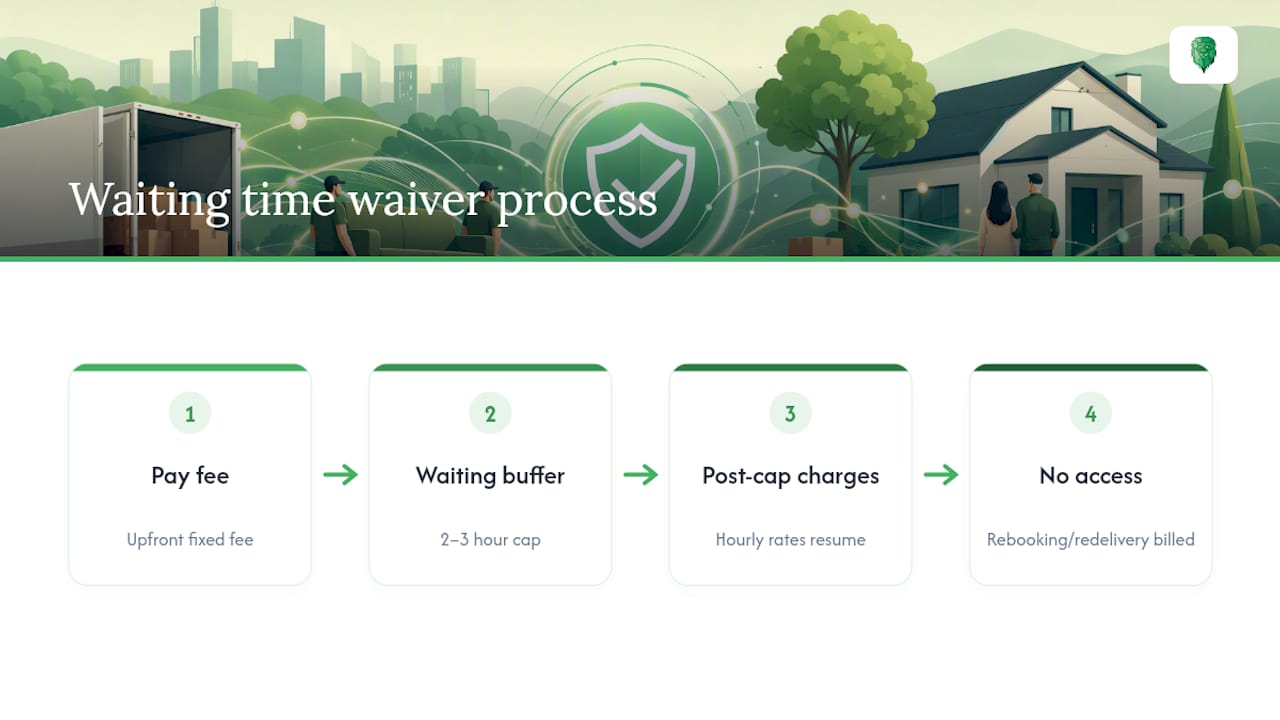
Two everyday scenarios show where the line sits. If your solicitor releases keys forty minutes late and the crew waits in the van outside, a waiver comfortably absorbs that. If a tenant simply isn’t home and doesn’t answer calls for three hours, pushing the visit past the cap, you may face both the waiting charge above the waiver limit and a possible rebooking fee for a second attempt. Multi‑day delays and extended labour beyond the original scope of the job sit outside almost every waiver you’ll be offered, so read the small print rather than assuming full cover.
How can you avoid or reduce waiting time charges?
Most waiting fees are avoidable with a bit of forward planning, and the fix usually starts at the quote stage, not on moving day itself.
- Ask for the exact hourly waiting rate before you confirm the booking.
- Confirm when charging actually starts: on arrival, or after a stated buffer of, say, 15 or 30 minutes.
- Check the free waiting allowance included in the price, and get it in writing.
- Ask about the cut‑off point at which the firm would need to reschedule rather than keep waiting.
- Find out the waiver cost and exactly what it does and doesn’t cover.
These are the same points industry guidance recommends asking outright: what is your hourly rate for waiting time, and when precisely does the clock start. Getting clear answers to both before you book removes most of the guesswork.
On the day itself, small habits make a real difference. Stagger your own arrival slightly ahead of the crew so you’re not the reason for the delay. Leave a spare set of keys with a neighbour as backup, and give the crew a named onsite contact with a working mobile number, not just your own if you’ll be tied up with solicitors or utility companies. Aligning arrival times and confirming access in advance is consistently the simplest way to sidestep completion‑day charges, and it costs nothing.
Pro Tip:
Get every waiting time term, including the waiver cost and cut‑off point, written into your booking confirmation, not just discussed on the phone. A verbal quote is hard to enforce; an emailed one isn’t.
Booking early also helps, since a firm with more flexibility in its schedule has more room to absorb a short delay without penalty. Our guide to when to book movers covers timing in more detail. It’s also worth pairing this with general removal cost saving tips if you’re trying to keep the whole move lean.
What should you do if you’re charged for waiting time?
Start collecting evidence the moment a delay looks likely, not after the invoice lands. A written record beats memory every time a dispute goes back and forth.
- Keep the original quote and any texts or emails confirming access times and the agreed waiting rate.
- Photograph the scene on arrival, including the time on your phone, and note if keys or access genuinely weren’t available.
- Record the names of anyone present, including the crew, in case a witness account is needed later.
- Contact the mover promptly and follow their formal complaints process rather than disputing the charge informally weeks later.
Give the firm a reasonable window to investigate. Realistic outcomes range from a full refund, where the delay was clearly outside your control, to a partial refund or credit towards a future booking. Some charges will stand if the evidence shows the delay was genuinely on your side. If you’ve followed the complaints process and remain unsatisfied, Citizens Advice and Trading Standards are the next step for UK consumers.
Van-247delivery’s approach to waiting time charges
A removal company with extensive experience handling UK house removals, man‑with‑van jobs and insured transport shapes how waiting terms get presented. Waiting rates and optional waivers should be set out clearly at the quote stage, not buried afterwards. Flexible booking and insured cover can help reduce delays turning into disputes.
— Claudiu
Get a clear quote with waiting time terms included
If you’d rather sort waiting time terms out before moving day, not during it, that’s exactly the gap a properly detailed quote closes. When you request a quote, include your expected access times, a named onsite contact with a mobile number, and whether you’d like a waiting time waiver added to the price.

For a house move, the house removals page lets you specify these details upfront so the waiting rate, free allowance and any waiver cost come back written into your quote, not left to be discussed on the day. Booking a smaller job or a single item collection? The man with a van service works the same way. Either route, the principle is the same: confirm your waiver choice, get the terms in writing, and keep that confirmation somewhere you can find it if a query comes up later.
Sources
FAQ
What counts as waiting time in a removal quote?
It’s the time a crew spends idle on site beyond any free allowance agreed at booking. Usually charged at an hourly rate once that allowance runs out.
How much is a typical waiting time charge in the UK?
Sampled UK move data puts the average waiting time charge around £35. Though rates vary by firm, crew size and region.
Does a waiting time waiver cover redelivery?
No. A waiver usually covers waiting hours up to a stated cut‑off. But redelivery and rebooking costs are typically excluded if the job has to be postponed.
What should I ask when getting a quote to avoid waiting fees?
Ask for the hourly waiting rate, the exact start time for charging, the free waiting allowance. And the cost of a waiver, and get the answers in writing before you confirm your booking with a provider such as Van-247delivery.
Can I dispute a waiting time charge after the fact?
Yes. Keep your written quote, timing messages and photos from the day, then raise it through the mover’s formal complaints process. Which can result in a full or partial refund depending on the evidence.