Corporate relocation is far more than booking a removal van and packing up desks. If you work in HR or run a business, understanding what is corporate relocation in its full sense means recognising it as a process that spans tax compliance, employee wellbeing, IT infrastructure, legal obligations, and strategic workforce planning.
Done poorly, it disrupts productivity and damages morale. Done well, it positions your organisation for growth and gives your people confidence through every step. This guide covers everything you need to manage it properly.
Table of Contents
- Key takeaways
- What corporate relocation actually means
- Key challenges and risks in corporate relocation
- How corporate relocation works: the process
- Tax implications and financial planning in 2026
- Best practices for managing corporate relocations
- My honest take on corporate relocation
- How Van-247delivery supports your corporate move
- FAQ
Key takeaways
| Point | Details |
|---|---|
| Relocation is strategic, not logistical | Corporate relocation affects tax, compliance, HR, and business continuity, not just physical moving. |
| Planning timelines matter enormously | A 10 to 12 week runway for midsize moves prevents costly delays, fines, and operational downtime. |
| Tax changes affect 2026 relocations | Employer-paid relocation benefits are now taxable income, making tax gross-up provisions worth negotiating. |
| Written policies reduce surprises | Companies with documented relocation policies avoid cost inconsistencies and employee dissatisfaction. |
| Cross-functional coordination is non-negotiable | HR, IT, finance, legal, and facilities must work together to avoid day-zero disruption. |
What corporate relocation actually means
The corporate relocation definition goes well beyond moving boxes from one building to another. At its core, corporate relocation refers to the organised process of moving employees, offices, or entire business operations to a new location, whether across town or across the country. It covers both individual employee relocations and full company or department transitions.
Employee mobility management should be viewed as a strategic business transformation rather than a transactional moving event. That framing matters, because it changes who owns the process and how much resource you allocate to it.
Corporate relocation typically includes several key components:
- Relocation policy: A documented framework defining which costs the company covers, who qualifies, and what the repayment terms are if an employee leaves shortly after moving.
- Financial support: Reimbursement for moving costs, temporary accommodation, travel, and sometimes mortgage or home sale assistance.
- Logistical support: Engagement of corporate relocation services including removal companies, storage, and IT infrastructure moves.
- Legal and compliance support: Handling visa or work permit requirements, local employment law changes, and tax obligations.
- Employee wellbeing: Orientation support, spousal employment assistance, and school search help for families.
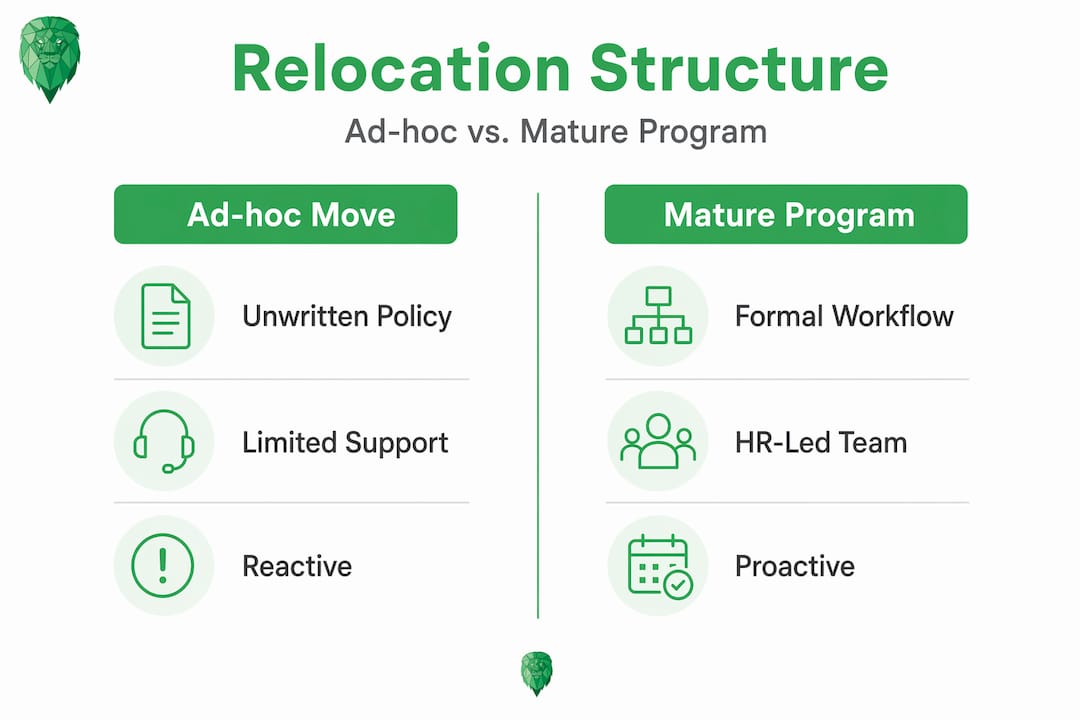
The difference between a one-off move and a mature corporate relocation programme is structure. Companies without written relocation policies experience cost inconsistencies, employee dissatisfaction, and financial surprises. A properly managed programme treats each relocation as part of a repeatable system with documented workflows, governance, and measurable outcomes.
Key challenges and risks in corporate relocation
Knowing the risks upfront saves you from the kind of surprises that derail even well-intentioned moves. Corporate relocation challenges tend to cluster around four areas: planning failures, tax complexity, employee disruption, and poor communication.
Here are the most common pitfalls to watch for:
- No single owner for the process. When HR, facilities, and finance each assume someone else is leading, critical steps get missed. Appoint a relocation project lead before anything else.
- Inadequate timeline planning. One in four relocations ends in significant delays and fines due to failure to follow a structured timeline. For midsize moves, you need at least 10 to 12 weeks of planning runway.
- Tax nexus triggered unexpectedly. Moving employees or offices into a new region can immediately create local tax liabilities including property tax, payroll withholding, and sales tax obligations. These can create multi-year cash outflows if not identified early.
- Employee resistance and productivity loss. Employees worry about commutes, seating arrangements, family disruption, and housing costs. If those concerns go unaddressed, you risk turnover at the worst possible time.
- Last-minute IT cutover misalignment. Failing to synchronise IT infrastructure changes with the physical move date causes productivity gaps on day one and beyond.
Pro Tip: Assign a relocation steering committee that includes at least one representative from HR, finance, IT, legal, and facilities. Hold weekly check-ins against a shared milestone tracker from the day you confirm the move.
Good communication is the single biggest lever you can pull to reduce employee disruption. Keeping employees uninformed until the last minute creates chaos and directly affects productivity. Set a communication cadence from week one and stick to it.
How corporate relocation works: the process
Understanding how corporate relocation works is easiest when you break it into distinct phases. Each phase has clear owners and outputs, which makes the whole thing manageable.
The typical corporate relocation process looks like this:
- Phase 1: Strategy and decision (weeks 1 to 2). Define the rationale, budget envelope, and scope. Confirm whether it is an office move, employee relocation, or both. Assign the project lead and steering committee.
- Phase 2: Policy and legal review (weeks 2 to 4). Review or create your relocation policy. Engage legal and tax advisers to identify nexus risks, payroll obligations, and any visa or employment law changes in the destination location.
- Phase 3: Vendor selection (weeks 3 to 6). Choose your corporate relocation services providers. This includes a removal company for physical logistics, IT infrastructure specialists for server and equipment moves, and HR consultants if needed for employee support packages.
- Phase 4: Employee communication and support (weeks 4 to 8). Brief all affected employees with clear information on timelines, what is covered, and who to contact. Roll out home sale, mortgage, and temporary housing support if applicable.
- Phase 5: Operational coordination (weeks 6 to 12). Align IT cutovers, facilities preparation, and physical moving dates. Decision gates across departments reduce last-minute disruption risk significantly.
- Phase 6: Move execution and post-move review. Execute the move, confirm all systems are live, and hold a structured debrief within two weeks to document lessons learned.
The roles involved are broad. HR manages policy, employee communication, and wellbeing. Finance handles budgeting, cost tracking, and tax gross-up planning. IT coordinates infrastructure cutover. Legal manages compliance. Facilities oversees the physical space. When these teams work from the same timeline, integrated cross-functional decision-making prevents the gaps that cause operational disruptions on move day.
Pro Tip: Use your office move checklist as the backbone of your project plan. A documented workflow is far easier to hand over if your lead changes mid-process.

Tax implications and financial planning in 2026
The financial side of corporate relocation in 2026 is more complex than it was even two years ago, and several changes directly affect what you budget and what you communicate to employees.
| Financial area | What you need to know |
|---|---|
| Relocation benefit taxation | The One Big Beautiful Bill Act eliminated federal moving expense deductions, making employer-paid relocation benefits taxable supplemental wages at 22% plus FICA taxes. |
| Tax gross-up provisions | Without gross-up, employees bear an unexpected tax bill on top of their move. Tax gross-up assistance offsets this liability and significantly affects willingness to relocate. |
| Local tax nexus | Moving into a new region triggers immediate obligations. Nexus risks now extend to remote employees, creating payroll withholding and unemployment tax obligations in new jurisdictions. |
| Hidden budget items | Relocation budgets frequently overlook business licence fees, technology downtime costs, insurance changes, and tenant improvement allowances. Structured planning reduces cost deviation to under 10%. |
| Home sale and mortgage support | Low-rate mortgage lock-in effects mean many employees resist relocating. Enhanced home sale assistance and mortgage differential programmes help overcome this resistance. |
Pro Tip: Do not wait for employees to raise tax questions. Brief them upfront on what their relocation package means for their tax position, and make it clear whether gross-up is included. Clarity here builds trust far more effectively than any financial gesture added later.
The financial planning conversation needs to happen in weeks two to four of your process, not after the move date is confirmed. Early engagement with your tax advisers gives you time to build gross-up costs into the budget and avoid executive surprises.
Best practices for managing corporate relocations
The difference between a smooth relocation and a painful one usually comes down to preparation, not budget size. These practices consistently improve outcomes across both employee moves and full office transitions.
- Document your relocation policy before anything else. Define what is covered, what the repayment terms are, and how exceptions will be handled. This prevents costly negotiation inconsistencies later and ensures fair treatment across all employees.
- Communicate early and often. Share a move timeline with employees as soon as it is confirmed. Update them at least fortnightly. Employees who feel informed stay productive. Those kept in the dark start looking for other jobs.
- Align IT and facilities with your physical move date. The risks of IT misalignment on move day are underestimated almost universally. Confirm server migrations, connectivity, and hardware setup at least two weeks before the physical move.
- Offer meaningful employee support packages. In 2026, this means going beyond covering removal costs. Think about temporary housing, spousal career support, school search assistance, and mortgage differential programmes for homeowners facing rate increases.
- Use checklists and repeat them. Every corporate relocation has the same core components. Documented workflows mean your next move builds on lessons from the last one rather than starting from scratch. Check out practical office move tips to build yours.
- Review and debrief after every move. A structured post-move review within two weeks captures what went well and what did not, while it is still fresh. This is how organisations build genuine competency in corporate mobility management.
Corporate relocation best practices are not complicated. They require discipline and early ownership, not extraordinary resources.
My honest take on corporate relocation
I have seen a lot of corporate moves, and the ones that go wrong share a common thread. Someone in a senior role decided the move was an operational task to be delegated downward rather than a business decision requiring leadership attention.
The companies that handle relocation well treat it as a genuine transformation moment. A move is a chance to reset your workspace design, your IT infrastructure, and even your culture. The physical act of relocating is the smallest part of the challenge. The harder work is in communicating clearly, supporting employees through real personal disruption, and managing the tax and compliance complexity that most organisations discover too late.
What I have learned is that employee retention during relocation depends almost entirely on how well you communicate and how substantive your support package is. An employee who feels seen and supported through a move becomes more loyal. An employee who feels like an afterthought starts updating their CV before the boxes are unpacked.
My strongest advice: get your relocation lead appointed, your policy written, and your tax adviser briefed before you tell anyone a move is happening. Everything becomes easier from that point.
— Claudiu
How Van-247delivery supports your corporate move
Planning a corporate relocation is one thing. Having the right logistics partner on the ground is another. Van-247delivery has over 15 years of experience supporting businesses through office relocations across the UK, from single department moves to full company transitions involving sensitive equipment and large teams.
Whether you need a full-service office removal with insured transport and professional handling, or flexible support like man and van services for smaller assets and overflow items, Van-247delivery can fit around your schedule and your budget. The team also handles server relocation and physical IT equipment transport, which takes one major headache off your coordination list. For employee relocations involving household moves, Van-247delivery’s house removals service offers a reliable, stress-free option for staff making the transition. Get in touch for an instant quote and see how the team can help your next move run on time.
Frequently asked questions
What is the corporate relocation definition?
Corporate relocation refers to the organised process of moving employees, business operations, or entire offices to a new location, encompassing logistical, financial, legal, and HR considerations. It is a strategic process, not simply a physical move.
How does corporate relocation work step by step?
Corporate relocation follows a phased process: strategy and scoping, policy and legal review, vendor selection, employee communication, operational coordination across IT and facilities, and post-move review. A 10 to 12 week timeline is recommended for midsize moves.
What are the main challenges of corporate relocation?
The most common challenges include inadequate planning timelines, unexpected local tax nexus obligations, poor employee communication causing productivity loss, and IT infrastructure misalignment on move day.
Are relocation benefits taxable in 2026?
Yes. Following the One Big Beautiful Bill Act, employer-paid relocation benefits are treated as taxable supplemental wages subject to a 22% federal withholding rate plus FICA taxes. Tax gross-up provisions are worth negotiating to protect employees from unexpected tax burdens.
Why do companies use corporate relocation services?
Companies use corporate relocation services to manage the complexity of coordinating physical logistics, compliance, employee support, and IT infrastructure changes simultaneously. Professional providers reduce downtime, cost overruns, and employee disruption.