Most people assume house clearance is just a fancy term for getting rid of rubbish. It isn’t. What is house clearance, really? It’s an organised process of removing unwanted household items from a property, sorting them responsibly, and making sure as much as possible is reused, donated, or recycled rather than sent to landfill.
People turn to house clearance services for all sorts of reasons: moving home, downsizing, clearing a loved one’s estate after bereavement, or simply reclaiming space. This guide walks you through every part of the process, from what it involves and what it costs, to how to prepare and what good looks like.
Table of Contents
- Key takeaways
- What house clearance really involves
- Cost of house clearance in the UK
- Preparing for a house clearance
- Environmental and ethical side of clearance
- My honest take on house clearance
- Ready to tackle your clearance with confidence?
- FAQ
Key takeaways
| Point | Details |
|---|---|
| More than rubbish removal | House clearance involves sorting, donating, recycling, and responsible disposal rather than simply skipping everything. |
| Costs vary widely | UK clearance costs typically range from £175 for a small flat to £595 or more for a large house, with probate cases costing significantly more. |
| Preparation saves money | Sorting items into keep, donate, sell, and dispose piles before clearance day avoids costly on-site delays. |
| Environmental responsibility matters | Reputable providers follow the waste hierarchy and commonly achieve 60 to 90% recycling rates. |
| Specialist cases need specialist help | Probate and hoarding clearances require different procedures, more time, and higher budgets than standard jobs. |
What house clearance really involves
The term “house clearance” covers a broader range of tasks than most people expect. At its core, it means removing unwanted items such as furniture, appliances, clothing, books, and personal belongings from a property to prepare it for sale, letting, or a move. Everything gets sorted rather than treated as one big pile for the skip.
The typical clearance process
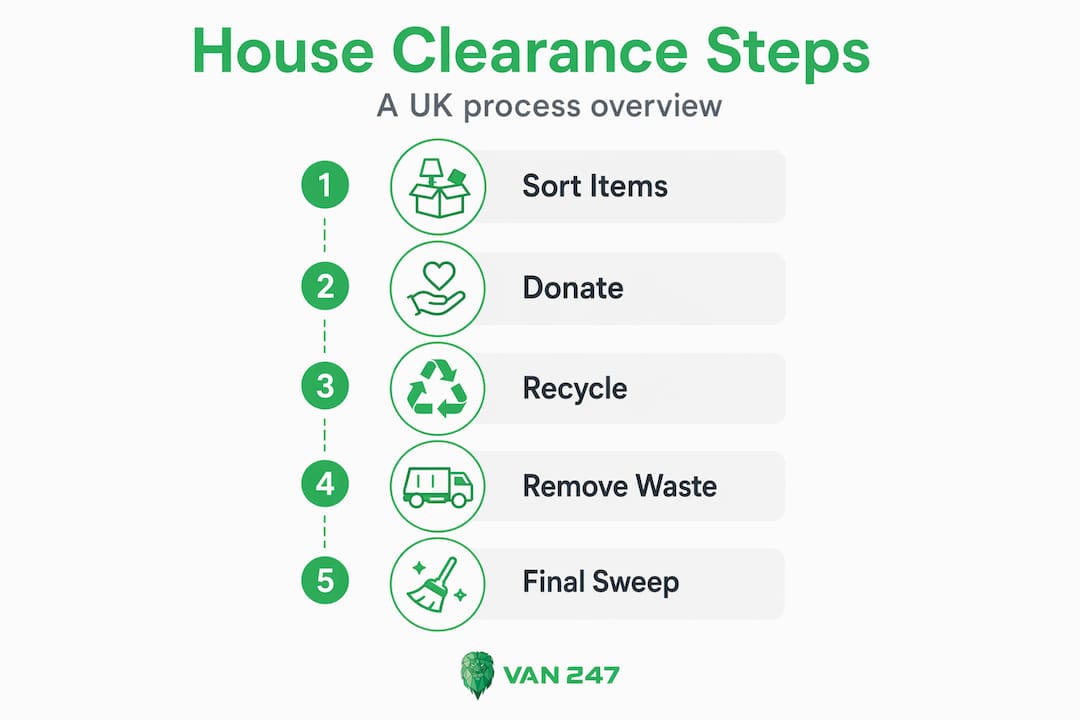
A professional house clearance follows a clear sequence:
- Initial assessment and quote: Most reputable companies offer a free quote, either by visiting the property or reviewing photos and room counts. This step sets expectations around volume, access, and timing.
- Sorting on the day: The team works through each room, placing items into streams: things to keep, items suitable for donation or resale, materials for recycling, and genuine waste for disposal.
- Removal in order: Clearance teams prioritise large, heavy items first, such as sofas, wardrobes, and beds, before moving to smaller pieces and boxes. This is both practical and safe.
- Responsible disposal: Usable furniture and household goods go to charity shops, auction houses, or resale platforms. Electricals are handled as WEEE (Waste Electrical and Electronic Equipment) and sent to licensed processors. Scrap metal goes to approved yards.
- Optional cleaning: Many services include a basic clean of the property once it’s cleared, which is especially useful when preparing a home for sale or handover.
In terms of timing, an average furnished property typically completes its on-site clearance in a single day with a team of two to four people, though the full process from quote to cleared property often spans about a week.
Pro Tip: Ask your clearance company for a written breakdown of where items will go before you agree to anything. A responsible provider will be happy to explain their recycling and donation routes.
Cost of house clearance in the UK
Understanding the cost of house clearance before you book removes a lot of stress. Prices vary depending on the size of the property, the volume of items, and the complexity of the job.

Typical price ranges by property size
| Property type | Approximate cost |
|---|---|
| Small flat or bedsit | £175 to £325 |
| 2 to 3 bedroom house | £325 to £595 |
| Large house (4+ bedrooms) | £595 and above |
| Probate clearance (3-bed) | £500 to £900 |
| Hoarding property | £1,500 to £3,000+ |
UK clearance costs are often structured around van load size, from a quarter load upwards to a full van, which is a useful way to compare quotes across providers. A small bedsit might need just a quarter van, while a fully furnished family home could require two full loads.
What drives costs up
Several factors push the price beyond the standard range. Volume is the most obvious one: more items simply means more time and more disposal costs. Item type matters too, since specialist handling is required for electronics, fridges containing refrigerants, and hazardous materials, all of which carry additional processing fees.
Probate and hoarding clearances sit in a different category altogether. Probate cases for a three-bedroom property typically cost between £500 and £900, while hoarding properties can reach £1,500 to £3,000 or more. The extra cost reflects specialist procedures, personal protective equipment, containment measures, and significantly more time on site.
Access also affects pricing. A ground-floor terrace is far easier to clear than a fourth-floor flat with no lift. Parking restrictions, long carry distances, and tight staircases all add time, and therefore cost.
Pro Tip: Always request an itemised quote and mark items you intend to keep clearly before the team arrives. An itemised quote prevents disputes and keeps everyone on the same page.
Preparing for a house clearance
Good preparation is the single most effective thing you can do to control costs and keep the day running smoothly. Here’s how to approach it:
- Walk through the property room by room. Assess what needs to go, what you want to keep, and what could realistically be sold or donated. Write it down. This step often surfaces items people have forgotten about entirely.
- Sort into four clear piles. Keep, donate, sell, and dispose. Sorting before clearance day saves significant time because workers don’t have to pause and ask about every item they encounter. On-site delays add up quickly.
- Label everything clearly. Use coloured stickers or signs on rooms and boxes. Anything you absolutely don’t want removed should be labelled in an unmistakable way. Mistakes during clearance are rare, but prevention is simple.
- Separate valuables and important documents. Passports, financial records, jewellery, and sentimental keepsakes should be physically moved out of the clearance area the night before. Don’t leave this to the day itself.
- Sort out access and logistics. Good access arrangements make a real difference. Confirm key handover, parking for the clearance vehicle, and whether any areas are off-limits. If it’s a flat, check lift availability. If it’s a probate property, confirm who has authority to grant access.
- Be present or appoint someone you trust. Having a point of contact on site means decisions get made quickly and nothing gets taken in error.
If you’re clearing a family member’s home after a bereavement, give yourself permission to take this slowly. Charity-led clearances offer a gentler approach, managing the packing, clearance, and redistribution of belongings with care and dignity, which many families find far less overwhelming than handling it alone.
Our house moving hacks guide has further practical tips for managing the logistics around your clearance date.
Environmental and ethical side of clearance
One of the least appreciated benefits of house clearance done properly is its environmental impact. Reputable UK providers don’t just pile everything into a van and head to the tip. They follow the waste hierarchy: reuse first, then recycling, then energy recovery, with landfill as the absolute last resort.
In practice, this means:
- Furniture in good condition goes to charity shops, furniture banks, or auction houses rather than skips.
- Electricals are handled as WEEE and processed by licensed recyclers, keeping harmful materials out of landfill.
- Clothing and textiles go to charitable redistribution networks.
- Scrap metal is separated and sent to approved facilities.
- Professional companies categorise items into reusable goods, WEEE, scrap metal, and general waste, each following a distinct disposal route.
The numbers are genuinely encouraging. Reputable clearance providers routinely achieve recycling and reuse rates of 60 to 90%, meaning the vast majority of what they collect does not end up in landfill. That’s a meaningful outcome for your community and the environment.
“A house clearance done responsibly isn’t just emptying a home. It’s redistributing a lifetime’s worth of useful goods back into the community.”
There’s also a legal dimension worth knowing. Clearance companies in the UK must be registered as licensed waste carriers. If you’re tempted by an unlicensed operator offering a suspiciously low price, be aware that fly-tipping fines can be traced back to the property owner if your waste is disposed of illegally. Always ask to see a waste carrier licence before booking.
My honest take on house clearance
I’ve seen a lot of clearances, and the single biggest mistake people make is underestimating how much preparation matters. Not in a vague “be organised” way. Specifically: failing to mark items clearly before the team arrives. It sounds minor, but it causes real delays. A four-person team standing around while someone makes phone calls to confirm whether the dining table stays or goes is expensive for everyone.
The emotional side catches people off guard too. Clearing a parent’s home after they’ve passed is one of the most exhausting things I’ve witnessed clients go through. Charity-led services for bereavement genuinely ease that burden in a way a standard clearance company often can’t.
Hoarding cases deserve a special mention. I’ve seen people book a standard clearance for what turns out to be a hoarding situation, and the job either stalls on the day or the quote triples. If there’s any chance the property falls into that category, say so upfront. A specialist team will actually handle it more efficiently and humanely.
My honest recommendation: treat your preparation time as an investment. Two hours sorting and labelling the day before can save you more in avoided delays than the price of a Sunday afternoon.
— Claudiu
Ready to tackle your clearance with confidence?
Whether you’re clearing a property before a move, managing a probate estate, or simply reclaiming space at home, having the right team makes the difference between a stressful day and a smooth one.
Van-247delivery has over 15 years of experience helping UK families and individuals move, clear, and settle into new spaces without the chaos. From full house removals across the UK to flexible man and van services for smaller loads, the team is ready to help you plan a clearance that fits your timeline and budget. Get in touch for a no-obligation quote and take the first step towards a cleared, clutter-free property.
FAQ
What is house clearance in the UK?
House clearance is the organised removal of unwanted items from a property, including furniture, appliances, and personal belongings. It differs from rubbish collection by including sorting for donation, recycling, and responsible disposal.
How much does a typical house clearance cost?
Costs range from around £175 for a small flat to £595 or more for a larger house. Probate and hoarding clearances are significantly more expensive, often running from £500 up to £3,000 or more depending on complexity.
How long does a house clearance take?
A standard furnished home is typically cleared on site in a single day by a team of two to four people, with the full process from quote to completion usually taking about a week.
Do house clearance companies donate items to charity?
Yes. Reputable clearance companies send usable furniture, clothing, and goods to charity shops, furniture banks, or resale channels rather than disposing of everything. Many achieve reuse and recycling rates of 60 to 90%.
Do I need to be present during a house clearance?
It’s not always required, but having someone on site or reachable by phone is strongly recommended. Clear labelling of items to keep and a designated contact helps avoid mistakes and keeps the job on schedule.