Moving insurance is a policy that financially protects your belongings against loss, damage, or theft during a house or office relocation. Most people assume their removal company covers everything. The reality is quite different. Standard carrier liability, known in the industry as valuation coverage, offers far less protection than a genuine insurance policy.
Understanding what moving insurance is, how it works, and which type suits your move can save you significant money and stress when things go wrong.
What is moving insurance and how does it differ from carrier liability?
Moving insurance is a separately regulated financial product that compensates you for loss or damage to your possessions during transit. It is distinct from the valuation coverage that removal companies offer by default. Carrier valuation and third-party insurance have fundamentally different regulatory frameworks and claims processes, which significantly affects the quality of protection you receive.
The key confusion arises because movers often say they are “fully insured”, but this typically refers only to their valuation liability limits. Those limits offer minimal protection unless you actively upgrade them. True moving insurance is a separate policy, purchased either through a licensed insurer or a specialist moving insurance provider, and it is regulated independently of the removal company.

What types of moving insurance exist?
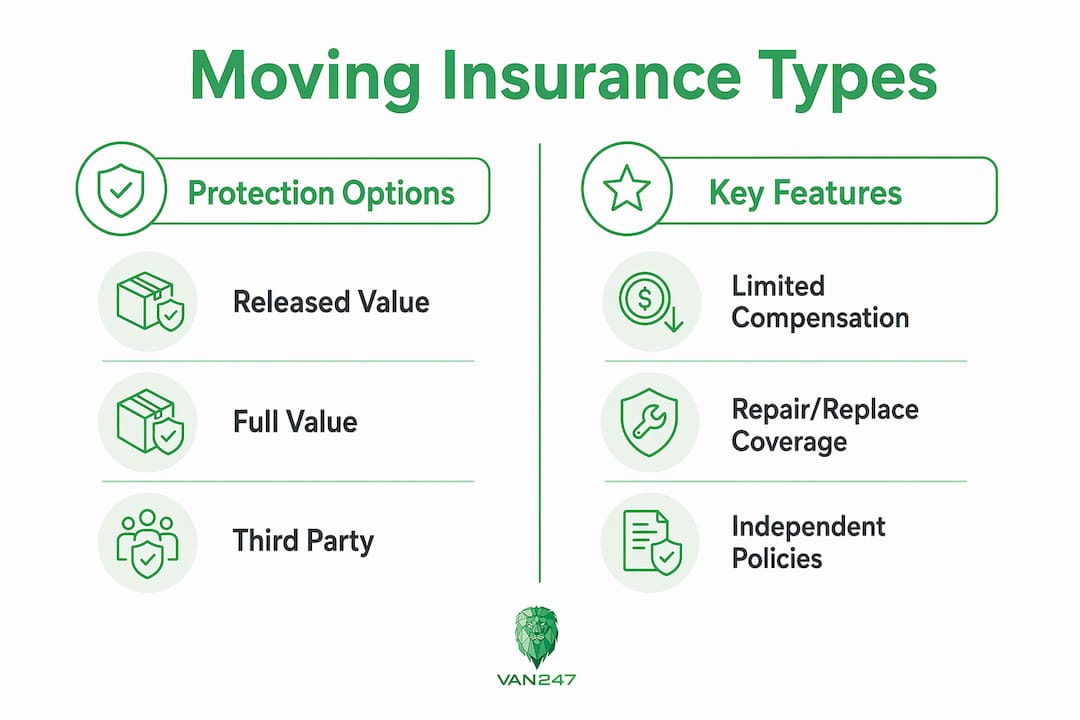
Under federal law, interstate movers must offer two liability coverage options: Released Value Protection and Full Value Protection. In the UK, equivalent carrier valuation options operate on similar principles, though they are not governed by the same federal rules. Third-party moving insurance sits entirely outside the carrier’s liability framework.
| Feature | Released Value Protection | Full Value Protection | Third-Party Insurance |
|---|---|---|---|
| Provider | Removal company | Removal company | Licensed insurer |
| Regulation | Carrier liability rules | Carrier liability rules | State or financial regulator |
| Typical cost | Free | 1–2% of declared value | 1–3% of declared value |
| Compensation basis | Weight-based payout | Repair, replace, or market value | Policy terms, often replacement cost |
| Claims process | Through the mover | Through the mover | Through the insurer |
| Covers owner-packed boxes | Rarely | Sometimes | Often, with conditions |
Released Value Protection is the default option. It limits compensation to around £0.60 per pound per item, which means a £2,000 television weighing 50 pounds would receive only a £30 payout if destroyed. That figure illustrates exactly why the default option is rarely adequate for a modern household.
Full Value Protection is an upgrade offered by the removal company. It covers repair, replacement, or current market value, subject to deductibles and the declared value you set. Third-party moving insurance operates independently of the mover’s liability coverage and typically covers gaps that carrier options do not.
What does moving insurance cover and exclude?
Moving insurance coverage generally includes loss, theft, and physical damage to your belongings during loading, transit, and unloading. Third-party policies often go further, covering scenarios that carrier valuation ignores entirely.
Typical coverage includes:
- Physical damage caused by dropping, crushing, or collision during transit
- Loss or theft of items from the removal vehicle
- Repair costs or full replacement value, depending on the policy
- Pairs-and-sets coverage, which allows replacement of an entire matching furniture set if one piece is damaged, avoiding partial compensation pitfalls
- Some policies cover electronics mechanical failures caused by transit, even without visible external damage
Common exclusions to watch for:
- Mechanical or electrical failure of appliances or electronics without visible external damage. This is one of the most common causes of denied claims for expensive electronics
- Items packed by the owner, unless the policy specifically includes them
- Jewellery, cash, or documents unless declared and listed separately
- Damage caused by inadequate packing on your part
- Pre-existing damage or wear and tear
Pro Tip: Read the exclusions section of any policy before signing. The exclusions page tells you more about a policy’s real value than the headline coverage amount does.
Deductibles also affect your out-of-pocket costs. Choosing a higher deductible reduces your premium but increases what you pay personally when you make a claim. Match your deductible to what you could comfortably absorb if something went wrong.
How much does moving insurance cost?
Moving insurance costs vary depending on the type of coverage, the declared value of your goods, and the distance of your move.
| Coverage type | Typical cost | Compensation basis | Best suited for |
|---|---|---|---|
| Released Value Protection | Free | Weight-based (minimal) | Low-value, short moves |
| Full Value Protection | 1–2% of declared value | Repair, replace, or market value | Mid-range household moves |
| Third-party insurance | 1–3% of declared value | Policy terms, often replacement cost | High-value or long-distance moves |
Third-party moving insurance typically costs between 1% and 3% of the declared coverage value. On a declared value of £20,000, that means a premium of £200 to £600. That cost is modest when weighed against replacing a damaged sofa, a broken television, or a scratched antique.
Full Value Protection from the carrier sits at roughly 1–2% of declared value. The key difference from third-party insurance is the claims process: with Full Value Protection, you deal with the removal company directly, which can create a conflict of interest. With a third-party insurer, your claim is handled independently.
Distance and the nature of your goods also affect pricing. Long-distance and cross-country moves carry higher transit risks, which insurers price accordingly. Fragile items, antiques, and high-value electronics typically attract higher premiums or require separate declarations.
When should you consider using moving insurance?
Moving insurance is worth considering for almost any move, but it becomes genuinely necessary in specific situations.
- You own high-value items. Antiques, artwork, designer furniture, and high-end electronics are expensive to replace. Released Value Protection would pay almost nothing for them.
- You are moving long distance. The longer the journey, the more handling your goods receive and the greater the risk of damage or loss.
- You are moving fragile or irreplaceable items. Sentimental items cannot be replaced at any price, but financial compensation at least covers what can be replaced.
- You are packing your own boxes. Owner-packed boxes are often excluded from carrier liability. A third-party policy may cover them, but check the terms carefully.
- You are relocating for work or on a tight timeline. Delays caused by damaged goods are costly. Insurance speeds up resolution and reduces financial disruption.
Industry experts recommend moving insurance particularly for high-value and fragile items on long-distance moves, where transit risks increase significantly. The financial and emotional cost of an uninsured loss on a major move far outweighs the cost of a policy.
Most homeowners or renters insurance policies offer limited coverage for belongings during transit and often exclude items handled by third-party movers. Check your existing policy before assuming you are covered.
Pro Tip: Call your home insurance provider before your move date and ask specifically whether your policy covers goods in transit handled by a removal company. Get the answer in writing.
How to purchase and manage moving insurance
Getting the right coverage is straightforward if you follow a clear process.
- Confirm the carrier’s valuation options in writing. Ask your removal company to confirm whether they offer Released Value or Full Value Protection, and get the terms in writing before moving day.
- Declare an accurate value for your goods. Undervaluing your shipment to reduce premiums is counterproductive. If you claim, the payout will be proportionally reduced.
- Research third-party insurers independently. Look for policies from licensed insurers that specifically cover household goods in transit. Compare exclusions, not just headline coverage amounts.
- Create a detailed inventory before the move. Photograph every item, note serial numbers for electronics, and keep receipts where possible. This documentation supports any future claim.
- Understand the claims timeline. Most insurers require you to report damage within a set period, often 30 to 60 days. Check this before signing.
- Pack carefully to protect your coverage. Proper packing reduces damage risk and protects your right to claim. Many policies void coverage if damage results from inadequate packing.
An insured moving company is more likely to handle your goods with care, because their liability and reputation depend on it. Choosing an insured mover is itself a layer of protection before any policy comes into play.
Key takeaways
Moving insurance is the most reliable way to protect your belongings financially during a relocation, and the default carrier option rarely provides adequate compensation.
| Point | Details |
|---|---|
| Default coverage is minimal | Released Value Protection pays by weight, not value, leaving expensive items severely undercompensated. |
| Third-party insurance is separate | It is regulated independently of the mover and often covers exclusions that carrier valuation ignores. |
| Cost is proportional to declared value | Third-party policies typically cost 1–3% of declared value, a modest sum against potential losses. |
| Existing home insurance may not apply | Most home or renters policies exclude goods handled by third-party movers during transit. |
| Documentation supports claims | A detailed inventory with photographs is the single most useful thing you can prepare before moving day. |
My honest view on moving insurance
People consistently underestimate the gap between what a removal company’s liability covers and what they actually need. I have spoken to countless people who assumed “the movers are insured” meant their belongings were fully protected. They were not. The mover’s insurance protects the mover, not you.
The most common mistake is skipping third-party insurance to save money, then discovering after a claim that the carrier’s payout covers a fraction of the actual loss. A £1,500 television weighing 30 pounds would receive £18 under Released Value Protection. That is not a safety net. That is a token gesture.
My recommendation is to treat carrier valuation as a baseline and always layer a third-party policy on top for any move involving goods worth more than a few hundred pounds. The cost is genuinely small relative to the protection. Moving insurance should be part of your moving plan from the start, not an afterthought on moving day.
One more thing: do not wait until the removal van arrives to think about this. Policies need to be in place before transit begins. Book your insurance at the same time you book your movers.
— Claudiu
Move with confidence using Van-247delivery
Van-247delivery has been providing professional, insured moving services across the UK for over 15 years. Whether you are planning a house removal or a full commercial relocation, every booking includes insurance coverage options designed to protect your belongings from collection to delivery. Transparent pricing, flexible booking, and experienced crews mean you are never left guessing about what is covered. Get an instant quote today and move with the reassurance that your possessions are in safe hands.
FAQ
What is the difference between moving insurance and carrier valuation?
Moving insurance is a separately regulated policy purchased from a licensed insurer. Carrier valuation is a liability limit set by the removal company, not a true insurance product.
Does my home insurance cover my belongings during a move?
Most home and renters insurance policies offer limited or no coverage for goods handled by third-party movers during transit. Always check with your provider before moving day.
How much does Full Value Protection cost?
Full Value Protection typically costs 1–2% of the declared value of your goods. The exact premium depends on the declared value, deductible chosen, and the removal company’s pricing.
What items are commonly excluded from moving insurance?
Mechanical or electrical failures without visible external damage, owner-packed boxes, jewellery, cash, and pre-existing damage are the most common exclusions across both carrier valuation and third-party policies.
When should I buy third-party moving insurance?
Buy third-party insurance whenever you are moving high-value, fragile, or irreplaceable items, or undertaking a long-distance move where transit risks are higher and carrier valuation payouts would be inadequate.