White glove delivery meaning is a premium last-mile service that goes beyond doorstep drop-off to include careful in-home placement, unpacking, and often light installation. According to Inbound Logistics, it shifts the tasks of assembly and cleanup from the customer to the delivery team, making it the highest-care tier in logistics. You need it when your item is fragile, oversized, or high-value, or when professional setup and debris removal are part of the job. In the UK, scope varies considerably by provider, so what counts as “white glove” in one company’s brochure may not match another’s, and the accessorials you assume are included often are not.
Key takeaways
White glove delivery is the highest last-mile service tier, and its value depends entirely on matching the booked scope to the actual job requirements.
| Point | Details |
|---|---|
| Confirm scope in writing | “White glove” is not a regulated standard; always get a written list of inclusions and exclusions before booking. |
| Check accessorials upfront | Stairs, long carries, and debris removal are frequently charged separately, even by providers who use the white glove label. |
| Choose it when risk justifies the premium | White glove reduces damage claims and return rates for fragile, high-value, or complex items, often lowering total cost. |
| Insurance matters | Declare the full replacement value at booking and confirm the carrier’s liability limit covers it under UK carriage law. |
| Van-247delivery covers the full checklist | In-home placement, assembly, debris removal, and insured transport are available UK-wide with instant online quotes. |
Table of Contents
- What does white glove delivery typically include?
- Who uses white glove delivery in the UK?
- How does white glove differ from standard and curbside delivery?
- How much does white glove delivery cost in the UK?
- What should you check before booking white glove delivery?
- What might not be included even if a provider says ‘white glove’?
- Where does the term ‘white glove’ come from?
- How do UK providers typically describe white glove services?
- How a UK mover prepares and executes a white glove delivery
- Why the last mile is where brands win or lose
- Van-247delivery handles the full white glove checklist for UK customers
- Sources
- FAQ
What does white glove delivery typically include?
Think of it as a full-service handover rather than a simple drop-off. Smartroutes describes white glove as the highest last-mile service level, designed for bulky, fragile, or complex items, and the checklist of typical inclusions reflects that.
Standard components you should expect:
- A scheduled appointment window (usually a two-hour slot agreed in advance)
- Two-person handling throughout the job
- Room-of-choice placement, not just inside the front door
- Stair and lift navigation, subject to access conditions
- Unpacking and removal of outer packaging
- Light assembly or installation (flat-pack furniture, appliance positioning)
- Removal of all packing debris
- Final positioning confirmed with the customer
- Proof of delivery: a signature and, increasingly, photographs
Common optional add-ons include full appliance hook-up, calibration, disposal of old items, and bespoke installation requiring specialist tools. These are often booked as accessorials and priced separately. Lazr notes that stairs, long carries, and narrow access are the most frequently itemised extras, so never assume they are bundled.
Picture a three-piece sofa being delivered to a first-floor living room: the crew carries each section up the stairs, unwraps the fabric, positions the pieces to the customer’s preference, removes every scrap of packaging, and asks the customer to confirm placement before signing off. That is white glove in practice. A standard delivery would leave the boxes at the kerb.

Pro Tip: Always request an itemised service description before confirming a booking. Ask the provider to list exactly which tasks are included and which are accessorials with separate charges.
Who uses white glove delivery in the UK?
The short answer: anyone whose item is too valuable, too heavy, or too complex to hand off at the front door.
Furniture retailers use it as a standard offering for sofas, beds, and dining sets, where the alternative is a customer wrestling a 90 kg frame up a narrow staircase. Appliance suppliers rely on it for American-style fridge-freezers and range cookers that need precise positioning. Medical equipment installers book it for hospital beds, imaging units, and mobility aids, where placement accuracy and debris removal are non-negotiable. Art shippers and auction houses use it for framed works and sculptures, where handling standards are as much about liability as care. Luxury goods sellers, from watch brands to bespoke furniture makers, use it to mirror the in-store experience at the point of delivery.
On the B2C side, individuals often choose white glove for practical reasons: no one available to help lift, difficult access (narrow hallways, no lift, tight stairwells), or simply the peace of mind that a trained crew will handle everything. B2B customers tend to have additional requirements: site access procedures, pre-booked loading bays, insurance certificates, and tighter appointment windows. ShipBob highlights that carrying items upstairs and assembling on site reduces both damage risk and customer effort, which is why businesses offering high-margin products often include white glove as a brand differentiator rather than an optional extra.
For businesses, the calculation is straightforward: a damaged or poorly placed item generates a return, a complaint, and a redelivery cost that far exceeds the premium for white glove in the first place.
How does white glove differ from standard and curbside delivery?
There are four broadly recognised service levels in last-mile delivery, and understanding where each stops is the fastest way to choose the right one.
| Feature | Curbside | Threshold | Inside delivery | White glove |
|---|---|---|---|---|
| Drop location | Kerb or driveway | Just inside entrance | Ground floor or reception | Room of choice |
| Unpacking | No | No | No | Yes |
| Assembly | No | No | No | Light assembly included |
| Debris removal | No | No | No | Yes |
| Crew size | 1 | 1 | 1–2 | 2 (minimum) |
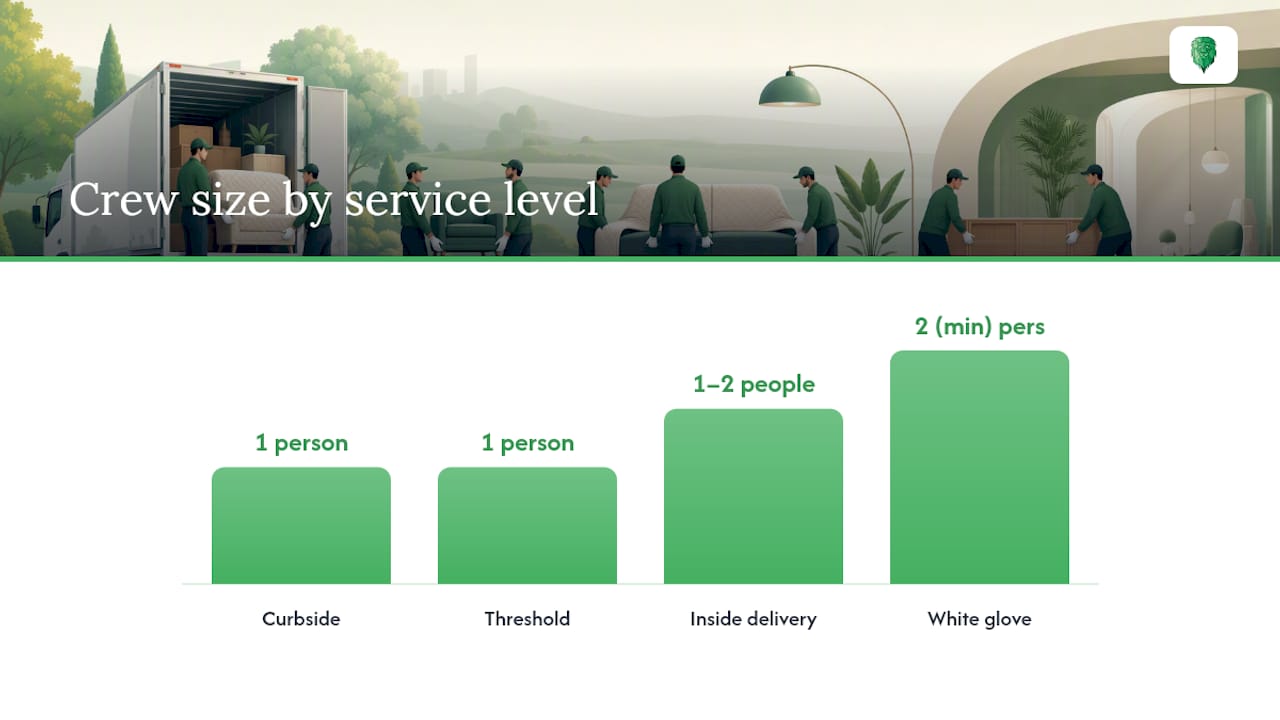
The operational differences matter beyond the table. White glove crews carry specialist equipment (furniture dollies, floor runners, door protectors), spend significantly longer per stop, and are trained in handling fragile or high-value goods. Liability and insurance treatment also differ: white glove providers typically carry higher declared-value coverage and have a clearer claims process than standard couriers.
Lazr draws a useful distinction between inside delivery and white glove: inside delivery means placing an item just inside the entrance or reception area, whereas white glove means taking it to the room of choice and, usually, unpacking and removing the debris. That difference is the tipping point for customers who cannot safely move freight themselves once it is inside.
How much does white glove delivery cost in the UK?
There is no single price list, and that is by design. Providers build quotes from a combination of variables, and understanding them helps you compare like-for-like.
Core cost drivers:
- Item size and weight: a two-seater sofa costs less to handle than a grand piano or a commercial fridge
- Distance and zone: urban deliveries within a city are priced differently from rural or remote addresses
- Number of handlers: two-person crews are standard; specialist items may require three or more
- Access difficulty: stairs, narrow hallways, no lift, and long carries from the vehicle are the most common accessorials
- Specialist equipment: hoists, craning, or tail-lift vehicles add to the base rate
- Assembly time: light flat-pack assembly is often included; complex installation is usually priced separately
- Appointment tightness: a guaranteed two-hour window costs more than a flexible all-day slot
- Debris removal: sometimes bundled, sometimes a separate line item
Pro Tip: Ask for an itemised quote that separates the base delivery rate from each accessorial. Also request a time estimate for the stop, as this tells you whether the crew has been allocated enough time to do the job properly.
When comparing quotes, check whether stairs, long carries, and assembly are included or listed as extras. Two quotes that look similar on headline price can differ substantially once accessorials are added.
What should you check before booking white glove delivery?
This is where most problems start: a vague booking, an assumed scope, and a crew that arrives without the right tools or time. Use this checklist before confirming any white glove job.
- Confirm the delivery window and ask what happens if the crew is late or needs to reschedule.
- Ask whether stairs and long carries are included or charged as accessorials, and give the provider accurate access details upfront.
- Confirm unpacking is included and clarify whether that means outer packaging only or full unpacking to the product level.
- Verify assembly scope: light flat-pack or full installation? Ask for the line in writing.
- Confirm debris removal and ask where packaging waste goes (some providers take it away; others leave it bagged at the kerb).
- Check the crew size and tools to be used, especially for heavy or awkward items.
- Ask about insurance and liability limits: what is the declared value limit, and what is the claims process if something is damaged?
- Request proof-of-delivery procedures: do they photograph final placement? Do you sign a delivery note?
- Ask for a written service description that lists inclusions and exclusions explicitly.
Red flags to watch for: a provider who uses the phrase “white glove” without a written service list; quotes with no itemised accessorials; no mention of crew training or insurance; and no clear damage claims process. Lazr flags the most common pitfall as assuming white glove means the same scope across providers. It does not. Our guide to booking a professional courier covers how to evaluate service levels in more detail.
What might not be included even if a provider says ‘white glove’?
“White glove” is a marketing term, not a regulated standard. Providers define it differently, and some use it loosely. Knowing the common exclusions protects you from a nasty surprise on delivery day.
Typical exclusions:
- Full electrical or plumbing hook-up (connecting a washing machine to a water supply, for example)
- Gas appliance installation (requires a Gas Safe registered engineer)
- Heavy demolition or removal of existing fixtures
- Bespoke carpentry or wall-mounting beyond basic picture hooks
- Removal of old items unless explicitly agreed and priced
- Calibration or certification of specialist equipment
- Multi-stop moves where each stop has its own access complexity
Stairs, long carries, narrow access, confined spaces, and multi-floor buildings are the most frequently treated as accessorials rather than inclusions. A provider may describe their service as white glove but price stairs separately on every job.
Pro Tip: Get a written list of exclusions and accessorial fees before confirming the booking. If a provider cannot or will not provide this in writing, that is a red flag in itself.
Where does the term ‘white glove’ come from?
The phrase has a straightforward origin. Historically, staff handling delicate or high-value items, from fine art to silverware, wore literal white cotton gloves to prevent fingerprints, scratches, and contamination. The gloves were a visible signal of care, cleanliness, and formality. Inbound Logistics traces the modern logistics use of the term to this same signal: a commitment to meticulous handling that goes beyond the ordinary.
Today, no one is literally wearing white gloves to deliver your sofa. The term has become shorthand for a premium, attentive customer experience, covering both the physical handling (careful placement, trained crews) and the experiential elements (scheduled appointments, proof of delivery, concierge-style communication).
The question of whether the term carries any racial connotation comes up occasionally in online searches. In the logistics and service industry context, “white glove” refers exclusively to the historical practice of wearing white gloves as a mark of care and formality. There is no established consensus that the phrase is racially coded in this context, though some organisations prefer alternatives such as “premium delivery” or “premium handling service” for clarity and inclusivity. If you are writing service descriptions for a diverse audience, “premium delivery” or “high-care delivery” communicates the same service level without ambiguity.
How do UK providers typically describe white glove services?
A handful of established names in UK logistics and retail delivery use the term, each with a slightly different framing. The examples below are illustrative paraphrases of how providers typically present the service; always check the provider’s own written terms for the definitive scope.
DHL positions white glove handling within its luxury logistics offer, pairing premium last-mile delivery with environment-controlled storage and branded customer touchpoints to mirror the in-store experience for high-value goods.
ShipBob (operating in the UK) describes white glove delivery as a service that includes carrying items upstairs, unpacking, and light on-site assembly, with the explicit benefit of reducing damage risk and customer effort compared with standard delivery.
Bishopsgate is referenced in UK logistics literature as a provider offering specialist handling for high-value and fragile items, with scheduled appointments and trained crews as standard features of their premium service tier.
eCourier appears in UK provider discussions as a same-day and specialist courier that can accommodate premium handling requirements for time-sensitive or high-value consignments.
The key point across all of these: the written service description is what matters, not the label. Ask each provider for their specific white glove checklist before comparing quotes.
How a UK mover prepares and executes a white glove delivery
Understanding the operational steps helps you prepare your property and set realistic expectations. Here is how a well-run white glove job typically unfolds from booking to completion.
- Booking and site survey: the customer provides access details, measurements of doorways and stairwells, and photographs if requested. The provider confirms crew size, tools, and any accessorials.
- Scope confirmation: a written service description is issued, listing inclusions, exclusions, and accessorial charges. Declared value and insurance cover are confirmed at this stage.
- Pre-booked appointment window: the customer receives a confirmed slot (typically two hours) and a contact number for the crew.
- Arrival and protective measures: the crew lays floor runners, fits door protectors, and assesses access before moving anything. This step prevents the majority of property damage claims.
- Two-person handling: items are moved using appropriate equipment (dollies, straps, furniture sliders) with one person guiding and one supporting at all times.
- Unpacking and assembly: packaging is removed carefully, the item is assembled or positioned as agreed, and the customer confirms placement.
- Photographic proof and sign-off: the crew photographs the item in its final position and the customer signs a delivery note. Getcho notes that branded proof-of-delivery photos are increasingly used by premium providers to keep the delivery experience on-brand.
- Debris removal and invoice reconciliation: all packaging is removed from the property, and any accessorials are confirmed against the original quote before the crew departs.
Pro Tip: Before the crew arrives, measure your doorways, hallways, and stairwell width and share these with the provider. A crew that arrives without this information may not have the right equipment, which delays the job and can lead to damage.
For high-value items, always declare the full replacement value when booking and check that the carrier’s liability limit covers it. UK consumer protection law provides a baseline, but carrier liability limits can be lower than the item’s value unless you declare and insure accordingly. Our guide to safely transporting large items covers protective measures in more detail.
Why the last mile is where brands win or lose
An editorial perspective
Most businesses spend heavily on product quality, packaging design, and marketing, then hand the final customer touchpoint to a courier who treats every parcel the same. That disconnect is where brand value leaks.
White glove delivery is not just a logistics upgrade. For a furniture brand, a luxury retailer, or a medical equipment supplier, the delivery moment is often the first time the customer physically experiences the product in their own space. A crew that arrives on time, handles the item with visible care, positions it correctly, and removes the packaging leaves the customer feeling that the brand kept its promise. A crew that leaves a box at the kerb does the opposite, regardless of how good the product inside is.
The business case is straightforward: lower return rates, fewer damage claims, and a customer experience that supports repeat purchases and referrals. Lazr makes the point well: the premium value of white glove often shows up as a reduction in total cost of ownership rather than a line item on a delivery invoice. Fewer returns and damage claims can more than offset the higher delivery cost.
The one thing that undermines all of this is a mismatch between promised scope and contracted scope. If your marketing says “white glove delivery” but your provider’s contract excludes stairs and debris removal, you are setting a customer expectation you cannot meet. Get the scope in writing, every time.
Van-247delivery handles the full white glove checklist for UK customers
If you have read through the checklist above and want a provider that covers it without the guesswork, Van-247delivery offers exactly that across the UK. The service includes in-home placement, furniture assembly and disassembly, debris removal, and insured transport for large, fragile, and high-value items, with instant online quotes so you know the cost before you commit.
Whether you need a house removals service that handles your furniture with full care from collection to final placement, or a man and van crew for a single large item, bespoke packages are available for complex or oversized jobs. Get an instant quote today and confirm your scope in writing before the crew arrives.
Sources
The following sources were used in preparing this article and are worth reading for additional detail on white glove delivery definitions, provider scope, and logistics best practice.
- White glove delivery: meaning, benefits, and drawbacks — Inbound Logistics
- White glove delivery: what it includes and when to use it — Lazr
- White glove delivery | Glossary — Smartroutes
- What is White Glove Delivery Service? Benefits & When to Use It — ShipBob (UK)
- Luxury logistics and white glove services — DHL
- Delivery for luxury brands — Getcho
For scope details specific to any provider, always prioritise their written service page and terms of carriage over marketing descriptions.
FAQ
What does white glove delivery mean?
White glove delivery is a premium last-mile service that includes in-home placement, unpacking, light assembly, and debris removal, carried out by a trained two-person crew. It is the highest service tier in last-mile logistics, designed for fragile, bulky, or high-value items.
What does ‘white glove’ stand for in a service context?
The term comes from the literal white cotton gloves historically worn by staff handling delicate or valuable items, signalling care, cleanliness, and formality. Today it is shorthand for a premium, attentive service standard rather than a literal uniform requirement.
Is ‘white glove’ a racist term?
In the logistics and service industry, “white glove” refers to the historical practice of wearing white gloves as a mark of care and formality, with no established racial connotation in this context. Some organisations prefer alternatives such as “premium delivery” or “high-care delivery” for clarity and inclusivity.
What is Costco white glove delivery?
Costco offers a white glove delivery option for selected large items such as furniture and appliances, which typically includes in-home delivery, room-of-choice placement, and removal of packaging. The exact scope varies by product and delivery partner, so checking the specific item’s delivery details at checkout is advisable.
How do I know if I need white glove delivery?
Choose white glove delivery when your item is too heavy, fragile, or complex for a standard drop-off, or when you need professional assembly, room-of-choice placement, or debris removal as part of the handover.