A piano looks solid and sturdy from the outside. That’s exactly what makes it so easy to underestimate. The truth is, pianos are among the most structurally complex items you’ll ever need to move, and understanding. Why pack pianos professionally is the right question to ask before touching one.
Wrap it wrong, skip the right equipment, or leave it unsecured in a van, and you could return home to a warped soundboard, fractured pinblock, or an instrument that will never hold its tuning again. This guide explains what’s really at risk and what professionals do differently.
Table of Contents
- Key takeaways
- Why pack pianos professionally: the structural truth
- What professional piano packing actually involves
- Team size, equipment, and piano type
- Risks from improper packing and how professionals prevent them
- Post-move care and the acclimation period
- My honest take on why this matters so much
- Move your piano safely with Van-247delivery
- FAQ
Key takeaways
| Point | Details |
|---|---|
| Pianos are internally fragile | Over 230 tuning pins under tension mean even small jolts can cause lasting tuning damage. |
| Professional packing is specific | Partial disassembly, skid boards, padded wraps, and ratchet straps all work together to protect the instrument. |
| Team size matters by piano type | Grand pianos require 4 to 6 experienced movers with specialised equipment to move safely. |
| DIY moves risk serious damage | Common outcomes include soundboard cracks, broken legs, and finish scratches that are costly to repair. |
| Post-move acclimation is critical | Allow 2 to 4 weeks before tuning to let the instrument settle in its new environment. |
Why pack pianos professionally: the structural truth
Most people think the challenge of moving a piano is its weight. That is only half the story. The real challenge lies in its internal tensioned structure, a delicate network of components that can be permanently damaged by forces you cannot even see.
Here is what sits inside a typical piano:
- Tuning pins: A piano contains over 230 tuning pins under significant tension. A sharp jolt during loading or transport can loosen them, causing immediate tuning instability.
- Pinblock: This wooden block holds every tuning pin in place. Even a minor impact can cause the pinblock to fracture, which compromises tuning stability permanently. A fractured pinblock often requires expensive rebuilding or full replacement.
- Soundboard: Spanning the entire body of the instrument, the soundboard is a thin sheet of tonewoods that amplifies vibration. It is sensitive to both mechanical stress and humidity changes, and cracks quickly if the piano shifts or flexes during transport.
- Strings, bridges, and hammers: These components are calibrated with extraordinary precision. Mishandling can knock them out of alignment, producing buzzing, dead notes, or uneven tone.
The importance of packing pianos properly becomes very clear when you see this list. Ordinary furniture wrapping treats a piano like a wardrobe. It is not. A wardrobe does not have 230 tension points waiting to be disrupted.
Pro Tip: If you are planning a house move that includes a piano, treat the instrument as a separate logistics challenge, not a piece of furniture on the general removals list. It needs its own plan.
What professional piano packing actually involves good question for why pack pianos professionally
So what do trained movers do differently? The answer lies in a methodical process that combines partial disassembly, specialised materials, and deliberate securing techniques.
Here is how a professional piano packing job typically unfolds:
- Initial assessment: The mover evaluates the piano type, size, weight, and the route through the building. Doorways, staircases, and floor surfaces all factor into the plan before anything is lifted.
- Partial disassembly for grand pianos: The legs, lid, and pedal lyre are removed carefully. This reduces the profile, lowers the centre of gravity, and eliminates the most breakage-prone parts from the equation during the move.
- Securing to a skid board: Legs-off and secured to a skid board ensures even weight distribution when the instrument is transported horizontally. Without this, the body can flex and stress internal components.
- Wrapping with specialised materials: Moving blankets, padded wraps, and corner guards are applied systematically. The goal is to prevent scratches, absorb vibration, and protect protruding edges and the finish.
- Securing with ratchet straps: Once inside the vehicle, the piano is strapped firmly to anchor points. It should not move at all during transit, not even slight shifts on corners.
- Climate-controlled conditions: Temperature and humidity fluctuations are a significant risk, particularly for long-distance moves or storage. Professional services use appropriately conditioned environments to prevent wood swelling, glue joint failure, and string corrosion.
Here is a quick comparison to show how professional packing differs from DIY approaches:
| Aspect | DIY packing | Professional packing |
|---|---|---|
| Disassembly | Rarely attempted | Standard for grands |
| Wrapping materials | Household blankets | Padded moving wraps, corner guards |
| Securing method | Rope or bungee cords | Ratchet straps, anchor points |
| Weight distribution | Often uneven | Skid board used for even support |
| Environmental control | None | Climate-appropriate transport |
Pro Tip: Ask your piano mover specifically whether they use a skid board for grand pianos. If they are not familiar with the term, that tells you something important about their experience level.
Team size, equipment, and piano type answers to know why pack pianos professionally
Getting the team size right is one of the most practical aspects of safe piano transport. Too few people creates dangerous strain and increases the chance of the instrument being dropped or knocked.
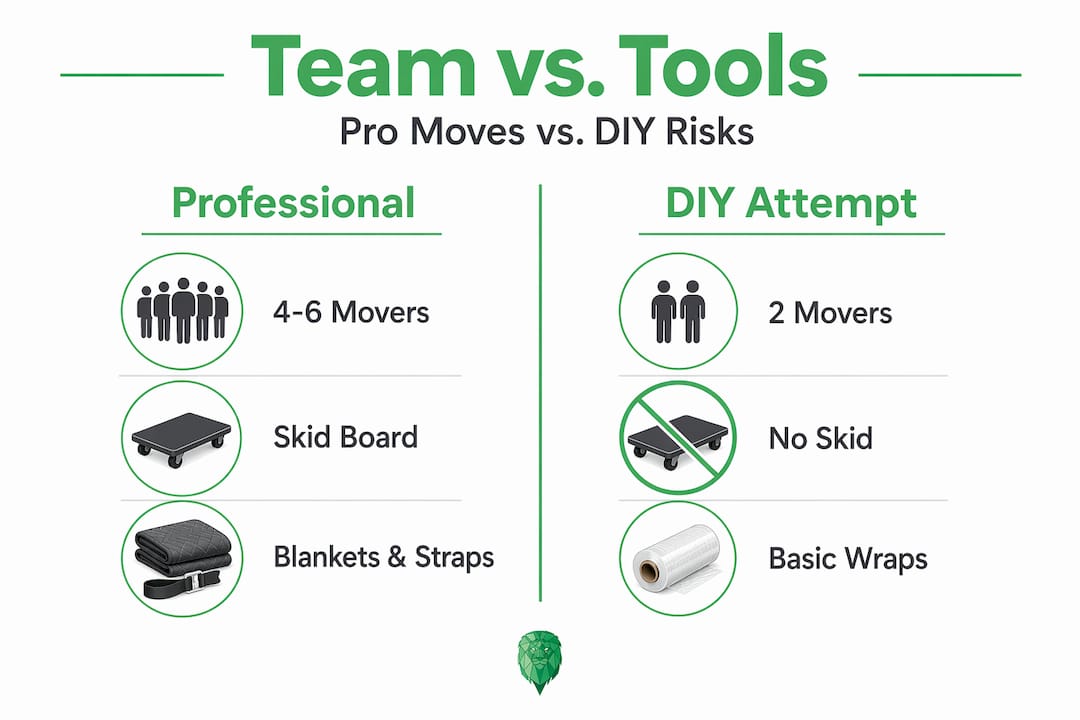
| Piano type | Recommended team size | Key equipment needed |
|---|---|---|
| Digital or keyboard piano | 1 to 2 people | Padded carry straps, blankets |
| Upright or studio piano | Minimum 3 people | Dolly, ramp, blankets, straps |
| Baby grand or grand piano | 4 to 6 people | Piano dolly, skid board, ratchet straps |
Why does experience matter beyond just numbers? Because expert movers reduce risk through proper lifting points, clear team communication, and knowing when to pause and reassess. A team of six untrained people is actually more dangerous than three trained professionals who know exactly what they are doing.
The DIY pitfalls are well documented. Common mistakes include:
- Using a standard furniture dolly that cannot bear the concentrated weight safely
- Failing to remove piano legs before attempting to navigate stairs or doorways
- Wrapping too loosely, allowing the piano to shift inside the vehicle during transit
- Moving too quickly, which removes the precision that this type of job demands
If you are considering moving a piano yourself, an upright piano in a single-storey move with wide doorways and a flat surface to the van is arguably the only scenario where self-moving carries a low risk. Anything else, particularly grands or multi-storey moves, is best left to those who specialise in piano moving.
Risks from improper packing and how professionals prevent them other part off why pack pianos professionally
When packing and transport go wrong, the damage is rarely cosmetic. It tends to go straight to the heart of the instrument. Knowing what is at stake makes the benefits of professional piano packing much easier to appreciate.
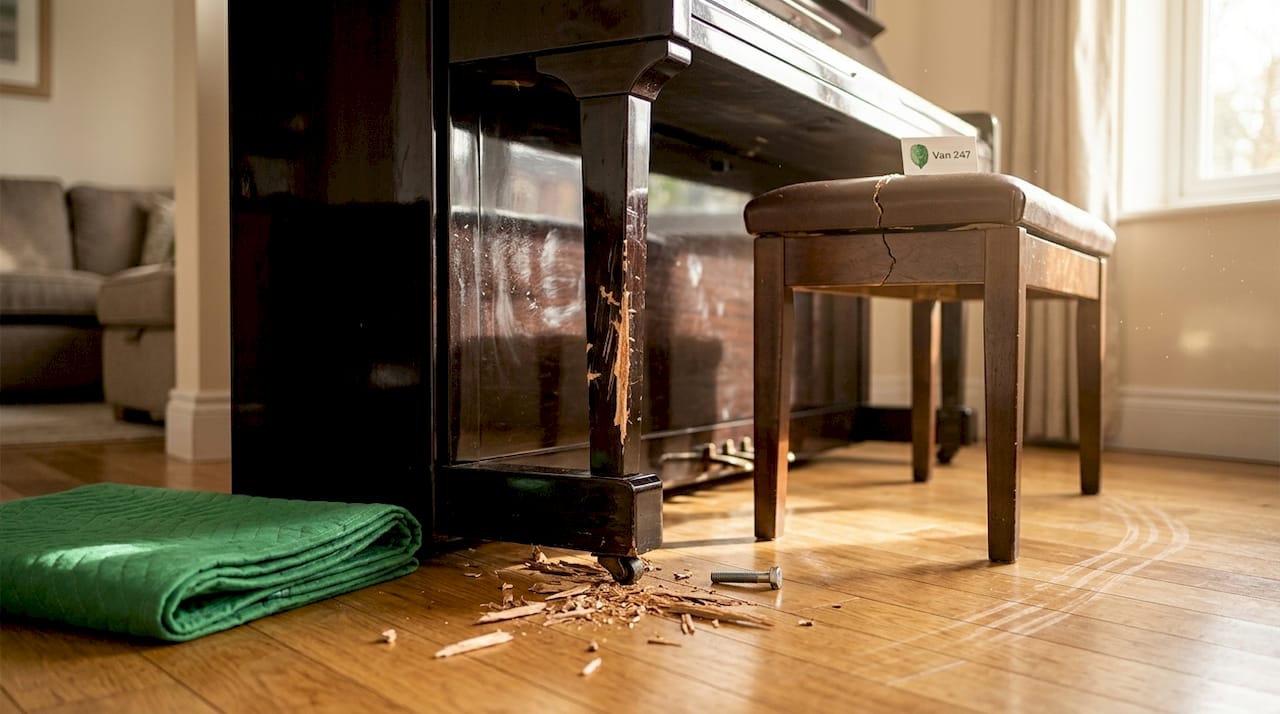
Common damages from poor packing include soundboard cracks, broken legs, loosened tuning pins, and surface scratches. Each one of those costs money to fix, and some, such as a cracked soundboard or fractured pinblock, may not be fully repairable.
Here is what can go wrong at each stage:
- During loading: Dropping or tilting the piano without support causes shocks that loosen tuning pins and stress the pinblock. A single hard knock can shift internal components that took a skilled technician hours to calibrate.
- During transit: Without proper strapping, even gentle braking causes the piano to slide or rotate inside the van. That constant small movement adds up over a long journey.
- During unloading: Rushing at the end of a tiring move is when most accidents happen. Corners clip doorframes, legs crack under uneven weight, and finishes are scratched by careless contact with walls.
- After the move: Poor acclimation conditions, such as placing the piano next to a radiator or in a cold, damp room, can undo a perfectly well-executed transport by causing the wood to swell, contract, or warp.
“The piano is not just heavy furniture. Every component inside is under tension and calibrated to a fraction of a millimetre. Treat a move carelessly and you are not just risking the finish. You are risking the instrument’s entire future.”
Post-move care and the acclimation period part off why pack pianos professionally
Once your piano arrives safely in its new location, the work is not quite finished. The instrument needs time to settle before you should attempt tuning or heavy use.
Pianos need 2 to 4 weeks to acclimate after any move involving environmental change. Here is why this matters and what you can do:
- Wood and strings settle gradually: Temperature and humidity shifts affect the wood frame, soundboard, and strings. Tuning too soon means the strings will continue to settle and drift after the technician leaves.
- Avoid extreme environments: Do not place the piano next to a radiator, under an air conditioning unit, or in direct sunlight. These cause rapid, uneven wood movement that creates cracking risks.
- Use a humidity control device: A piano-specific humidity system, fitted inside the instrument, helps maintain a consistent moisture level during and after the acclimation period.
- Ask your movers for advice: Post-move environment plays a critical role even when packing has been done perfectly. Good professional movers will advise you on placement and conditions before they leave.
Once the acclimation period is complete, schedule a professional tuning. Most technicians recommend two tunings in the first year after a move to allow the piano to stabilise fully.
My honest take on why this matters so much
I’ve seen what happens when piano owners treat a move as just another logistics task and save a bit of money by going with general movers or doing it themselves. The outcomes are rarely good. Scratches on the cabinet are the best-case scenario. Fractured pinblocks, cracked soundboards, and broken legs are the reality I have seen documented far too often.
What strikes me most is how the cost calculus almost never works in the DIY mover’s favour. A professional piano packing and moving service costs a fraction of what a single soundboard repair costs. And yet people hesitate, because the damage feels unlikely until it happens.
The other thing I would say is this: the overlooked complexity of piano structure genuinely surprises even careful, intelligent people. You are not failing to appreciate something obvious. Pianos are genuinely deceptive. They look like something you could wrap in a blanket and move with a van. The internal tension, the calibration, the sensitivity to humidity. None of that is visible from the outside.
My advice is simple. Look for movers who specifically mention piano transport on their service list, who can tell you exactly how many people they will bring and what equipment they will use, and who carry insurance that covers the full replacement value of the instrument. Those three things tell you almost everything you need to know about whether a mover is the right fit.
— Claudiu
Move your piano safely with Van-247delivery
If you are planning a move and need your piano transported with the care it deserves, Van-247delivery has the experience to handle it properly. With over 15 years in the UK moving industry, the team understands exactly what is at stake when a high-value instrument is involved.

Van-247delivery offers professional house removal services with the equipment, team size, and handling procedures that piano moves require. Whether you need a grand piano disassembled and transported across the country or a studio upright moved to a new flat, the team brings the right people and the right tools. Professional insurance coverage is included, so your instrument is protected throughout the move. You can also arrange a man and van service for more straightforward relocations that still need expert handling. Get in touch for a free quote and let Van-247delivery take the worry out of moving your piano.
Frequently asked questions
Why do pianos need professional packing?
Pianos contain over 230 tensioned tuning pins, a sensitive soundboard, and a precisely calibrated pinblock. Improper packing risks cracks, broken components, and permanent tuning instability that standard furniture wrapping cannot prevent.
How many people does it take to move a grand piano?
Grand pianos require a team of 4 to 6 experienced movers with specialised equipment including a piano dolly, skid board, and ratchet straps to transport safely without damage.
What materials are used in professional piano packing?
Professionals use moving blankets, padded wraps, corner guards, and ratchet straps, combined with a skid board for grands, to protect the instrument from scratches, shocks, and movement during transit.
How long should a piano sit before tuning after a move?
Allow 2 to 4 weeks for the piano to acclimate to its new environment before scheduling a tuning. Tuning too soon means strings and wood are still settling and the instrument will drift out of tune quickly.
Is it safe to pack and move a piano yourself?
For a digital keyboard or a straightforward upright piano move on a single floor with wide access, the risk is lower. For anything involving stairs, tight spaces, or grand pianos, hiring specialist piano movers is strongly advised to avoid costly and often irreparable damage.