Picture this: moving day, a beautiful upright piano being shuffled through a narrow hallway, and then a sickening crack. A broken leg, a gouged wall, and a repair bill that quickly overshadows everything else about the move. It happens more often than you might think, and almost always because of poor planning.
Pianos are among the most challenging items to move in any home. They are heavy, awkward, and genuinely valuable, both financially and emotionally. This guide walks you through exactly how professional piano removal works, so you can protect your instrument and your home every step of the way.
Table of Contents
- Assessing your piano and planning the move
- Essential preparations before removal
- The safe step-by-step piano removal process
- Aftercare: Inspection, tuning, and damage checks
- Why trusting professionals beats the DIY approach
- Book expert piano removal for complete peace of mind
- Frequently asked questions
Key Takeaways
| Point | Details |
|---|---|
| Plan your move | Assess your piano and home environment to avoid surprises on moving day. |
| Use the right tools | Gather moving straps, padding and enough helping hands to ensure safety. |
| Prepare your home | Secure floors, protect the piano and clear access routes before removal. |
| Follow expert steps | Moving a piano safely takes sequential action, teamwork, and care. |
| Trust professionals | Specialist movers have the kit, insurance and experience to protect your instrument investment. |
Assessing your piano and planning the move
Before you move any piano, detailed planning is crucial. Let’s start with the basics.
The first thing you need to do is identify exactly what type of piano you have. An upright piano typically weighs between 140 and 270 kilograms. A grand piano can weigh anywhere from 150 to over 600 kilograms depending on its size.
A digital piano is considerably lighter, but can still be awkward to manoeuvre. Knowing the weight and dimensions before anything else shapes every decision that follows.
Next, walk the entire route from the piano’s current position to the removal vehicle. Note every obstacle you encounter:
- Doorway widths: Standard UK interior doors are around 762mm. Many pianos will not clear this without careful angling.
- Stair configurations: Spiral staircases and tight landings require specialist equipment and additional personnel.
- Flooring types: Hardwood, tiles, and carpets each present different risks of scratching or slipping during the move.
- Garden paths or kerbs: Any external route between your front door and the vehicle needs to be checked for surface quality and width.
Established specialist piano movers will ask these questions before they even quote you. In fact, Trustpilot reviews for PianoSpeed highlight that firms such as PianoSpeed (rated 4.8/5 across 63 reviews), Piano Removal Services (a remarkable 5/5 across 574 reviews). And Piano Move Team (over 30,000 moves since 2009) consistently earn praise for their meticulous pre-move assessments, particularly on challenging staircases.
Here is a quick reference to help you plan based on piano type:
| Piano type | Typical weight | People needed | Key obstacles |
|---|---|---|---|
| Upright | 140 to 270 kg | 3 to 4 | Doorways, stairs, tight hallways |
| Baby grand | 150 to 300 kg | 4 to 5 | Leg removal, wide turns, floor protection |
| Full grand | 300 to 600+ kg | 5 to 6 | Structural floor checks, specialist skid boards |
| Digital piano | 20 to 80 kg | 2 to 3 | Cable management, fragile electronics |
You will also need the right equipment gathered before the job begins. A quality piano skid board, heavy duty moving straps, furniture blankets, corner protectors, and a purpose-built piano trolley are all standard kit for a professional team. If you are exploring your options, it is worth reading up on piano disposal options too, in case the move reveals that a full replacement might be a more practical route.
Pro Tip: Take photographs of your access route, including all doorways, staircases, and tight corners, and send them to your removal team before the move date. This single step can prevent last-minute surprises and speed up the whole process considerably.
Essential preparations before removal, step by step piano removal
Once you have assessed your piano and obstacles, ensuring proper preparation is your next step.
Start by clearing the path completely. Move furniture, rugs, ornaments, and anything else that lines the route from the piano to the exit. You want a clean, unobstructed corridor before lifting begins. This sounds obvious, but it is one of the most commonly skipped steps in DIY attempts.
Protecting the piano itself involves several distinct actions:
- Lid: Lock or secure the keyboard lid to prevent it from swinging open mid-move. For grands, remove the music desk and prop lid before disassembly.
- Pedals: Wrap the pedal lyre on an upright piano with thick blankets or foam padding. On a grand, this component is removed separately.
- Legs: Grand piano legs are removed before the instrument is tilted onto a skid board. Each leg should be wrapped individually and transported separately.
- Exterior surfaces: Use thick moving blankets secured with packing tape or stretch wrap over every surface of the piano body.
Protecting your home is equally important. Lay floor runners or plywood sheets along the entire route. Fit corner protectors to every doorframe and wall corner the piano will pass. If you have underfloor heating or delicate tiles, make sure your team is aware before any equipment is set down.
“Secure strapping is not optional. A piano that shifts during transport, even slightly, can suffer internal damage to the soundboard or strings that is difficult to spot and expensive to repair. Every piano should be fully immobilised before the vehicle moves an inch.”
Filling in what piano movers need to know ahead of time means your team can arrive fully prepared with the right straps and padding for your specific instrument. If you are planning a full house move alongside the piano, explore whether piano recycling services might suit any older instruments you no longer wish to keep.
Pro Tip: Check your home insurance policy specifically for accidental damage cover before moving day. Some policies cover damage caused during a move; others explicitly exclude it. Knowing this in advance could save you a significant headache.
The safe step-by-step piano removal process
With preparations complete, you are ready for the actual removal process. Here is how to do it right.
1. Position your team and equipment. Before touching the piano, assign roles: one person leads, one or two manage each side, and one dedicated person handles the trolley or skid board. Everyone should understand the route in advance.
2. Prepare the piano for lifting. For upright pianos, tilt the piano carefully onto the skid board. For grand pianos, remove the legs first, then lower the body onto the padded board with everyone lifting in unison.
3. Secure the piano to the board. Use heavy duty ratchet straps to fix the piano firmly to the skid board before moving it anywhere. Double-check all connections before proceeding.
4. Move along the cleared route. Two people guide the piano on the trolley while one walks ahead checking for obstacles. Move slowly and communicate constantly. No rushing.
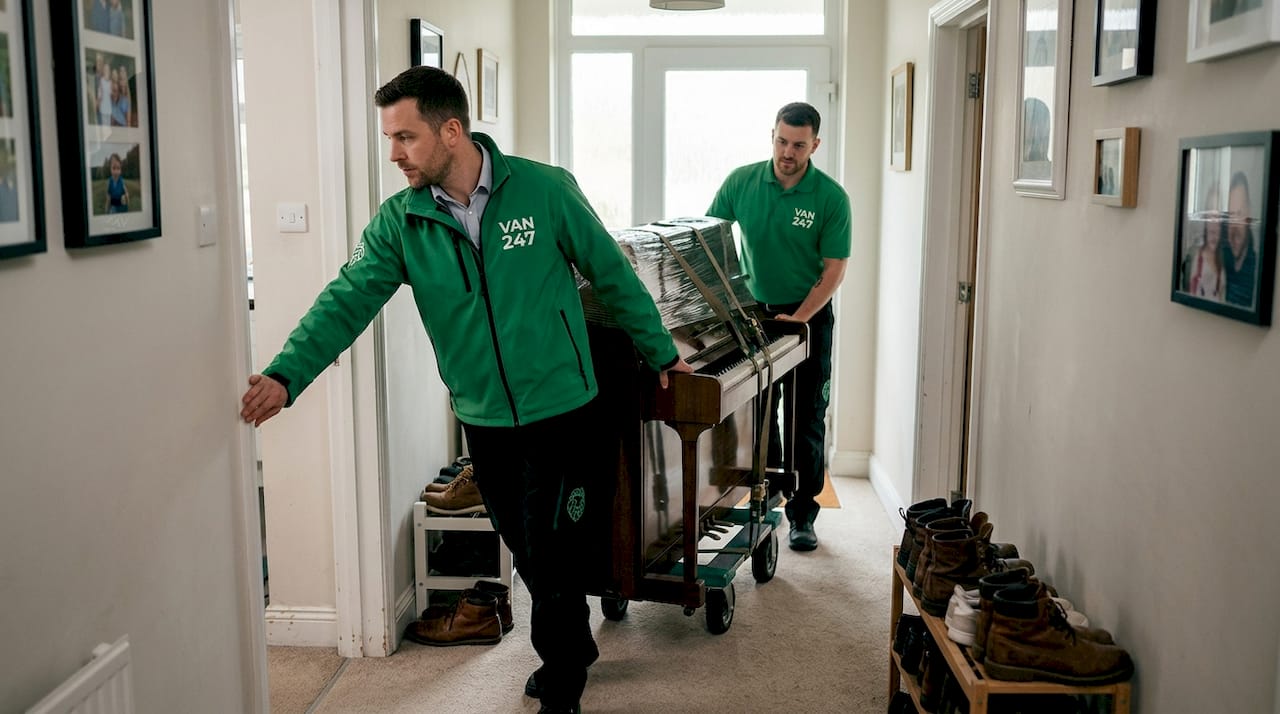
5. Tackle stairs with care. Going up or down stairs with a piano requires a stair-climbing trolley or dedicated stair sliders. Tilt the piano at the correct angle and ensure someone is always on the lower side as a safety anchor.
6. Load into the vehicle. Use a tail lift or ramp to load the piano. Never attempt to lift a piano directly into a vehicle without mechanical assistance. Secure it to the vehicle walls using straps before closing the doors.
7. Unload and reassemble. Reverse the process at the destination. Reinstall grand piano legs on a clean, padded floor before standing the instrument upright.
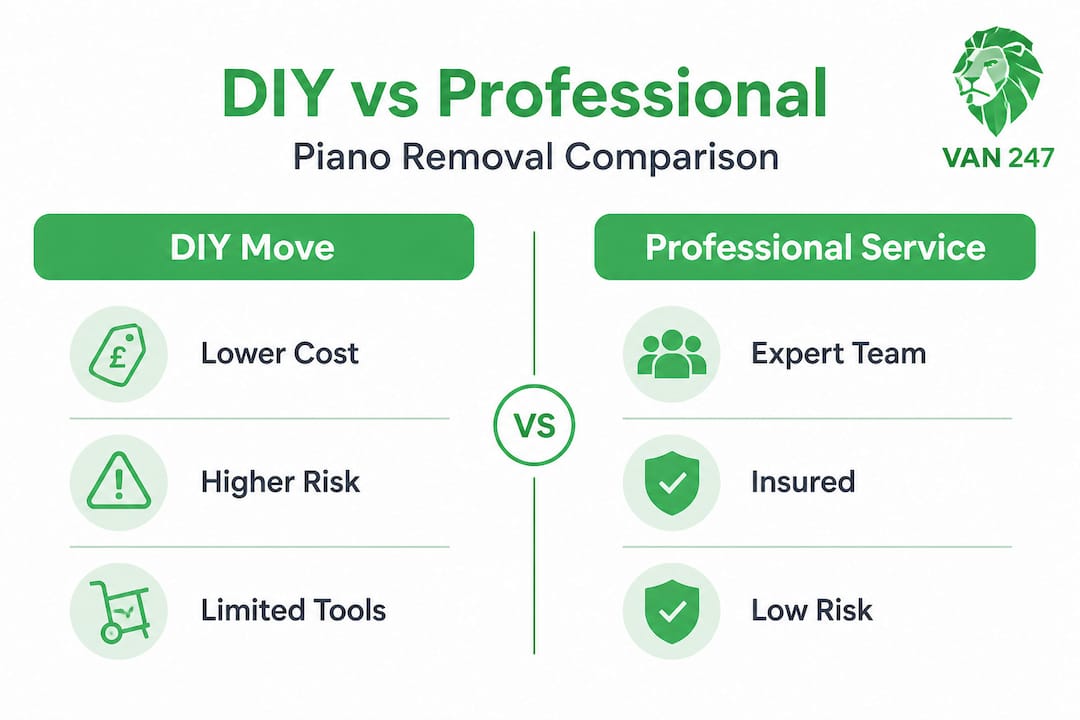
Here is a clear comparison to help you weigh your options:
| Factor | DIY move | Professional service |
|---|---|---|
| Cost | Lower upfront | Higher upfront, lower total risk |
| Equipment | Often improvised | Specialist, purpose-built tools |
| Insurance | Rarely covered | Typically included |
| Physical risk | High injury risk | Managed professionally |
| Piano damage risk | Significantly higher | Significantly lower |
| Time | Longer, more stressful | Efficient and streamlined |
Pianos on Trustpilot reviews for PianoSpeed show that Piano Service North London earns particular praise for navigating tricky staircases, something that requires years of practice to master safely.
If you are specifically working with a larger instrument, read our guide on moving grand pianos for additional detail. And if you are weighing up quotes, understanding the piano removal cost factors helps you see exactly where the value lies.
Pro Tip: Always use three or more people for manual lifting, regardless of piano size. Even a lightweight upright requires coordinated effort to prevent sudden shifts that can cause serious back injuries or drop the instrument.
Aftercare: Inspection, tuning, and damage checks part of step by step piano removal
Once your piano is in its new place, it is important to carry out a few final checks for peace of mind.
Start with a thorough visual inspection as soon as the piano is positioned. Work through this checklist:
- Exterior surfaces: Look for new scratches, dents, or chips in the lacquer or wood finish.
- Legs and pedals: Check that all reinstalled components are firmly attached and level.
- Keys: Press each key slowly to check for sticking, silence, or unusual resistance.
- Lid and hinges: Open and close every lid section to ensure nothing has shifted or cracked.
- Internal inspection: If you are comfortable doing so, look inside the body for any visible damage to strings, hammers, or the soundboard.
Do not rush to tune the piano immediately after a move. Pianos are sensitive to temperature and humidity changes. Moving from one building to another exposes the instrument to a new environment, and the wood needs time to settle. Most piano technicians recommend waiting two to four weeks before scheduling a tuning appointment.
Trustpilot reviews for PianoSpeed confirm that customers who use established specialists such as Piano Removal Services, with its outstanding 5/5 rating across hundreds of reviews, report fewer post-move issues requiring emergency tuning or repairs. This speaks directly to the value of careful handling throughout the entire process.
When you do book a tuning, mention that the piano has recently been moved. This gives the technician context and allows them to check for any internal issues that might not be visible externally. For ongoing guidance on keeping your piano safe throughout its life, there is plenty of useful advice available.
Pro Tip: Take dated photographs of your piano immediately after it arrives in its new location, both inside and out. These images are invaluable if you need to make an insurance claim, or if you ever decide to sell the instrument in future.
Why trusting professionals beats the DIY approach
Here is an uncomfortable truth that most DIY guides will not tell you: the majority of piano damage does not happen because of dramatic accidents. It happens quietly. A too-sharp turn that stresses the internal frame. A missing blanket that allows a single scratch to run the full length of a polished surface. Straps applied incorrectly that allow micro-movement during transit, slowly loosening pin block screws or cracking a soundboard.
Most people who attempt a DIY piano move do it to save money. That is completely understandable. But the actual cost calculation rarely includes the full picture. A professional repolish of a grand piano can cost several hundred pounds. Soundboard repairs can run into the thousands. And that is before you factor in any personal injury that might occur during lifting.
“A 5/5 Trustpilot rating across 574 reviews does not happen by accident. It is built on consistent, careful work carried out by people who move pianos every single day.”
Professional removalists bring three things that no amount of careful DIY can fully replicate: experience, insurance, and specialist equipment. The Trustpilot reviews for PianoSpeed we have referenced throughout this guide exist because firms like Piano Move Team have completed over 30,000 moves. That is 30,000 problems encountered, solved, and learned from. You simply cannot replicate that on a single moving day.
Local piano mover solutions are more accessible than many people realise, and often more affordable when you weigh the full risk. Before you dismiss professional help on cost grounds alone, take a look at the actual cost of hiring piano removalists and compare it honestly against the potential price of a damaged instrument.
The smart move is the safe move. Every time.
Book expert piano removal for complete peace of mind with step by step piano removal
You have done the research. You understand what a proper piano removal looks like. Now it is time to make sure yours goes exactly as planned.

At Van 247 Delivery, we have been helping UK customers move pianos safely for over 15 years. Whether you need book expert piano removal for a single instrument or a full household relocation including your piano, we have the specialist team and equipment to handle it.
We offer free instant quotes, full insurance cover, and flexible booking across the UK. If you need nationwide piano transport or are combining your piano move with trusted house removals, we can coordinate everything seamlessly. Get your free quote today and move with confidence.
Frequently asked questions
How much does piano removal cost in the UK?
Costs vary depending on piano type, access challenges, and distance, but you can generally expect to pay between £150 and £400 or more for professional removal.
For a more detailed breakdown, Trustpilot reviews for PianoSpeed and similar specialists often display pricing guides alongside their customer feedback.
Can I move a piano without professionals?
It is technically possible with several people and proper equipment, but most experts strongly advise against it due to the very real risk of injury and costly damage to the instrument. Professionals bring experience and insurance that a DIY approach simply cannot match.
What should I do to prepare my piano before a move?
Secure all loose parts including the lid and pedals, clear the entire route from piano to exit, protect floors and doorframes, and send photographs of your access points to your removal team in advance.
How soon after moving should I get my piano tuned?
Allow the piano to settle in its new environment for two to four weeks before booking a tuning appointment. This acclimatisation period lets the wood stabilise and gives you a more accurate and lasting result.
Are piano removal firms insured?
All reputable UK piano removal specialists carry insurance covering damage and public liability. Firms highlighted in Trustpilot reviews for PianoSpeed, such as Piano Removal Services with its 5/5 rating, are clear examples of professionals who operate with full insurance as standard.