How to insure transported items? Goods in transit (GIT) insurance is the right cover for protecting items while they are being moved in the UK. Buy it as a standalone GIT policy, an extension to your van or commercial vehicle policy, or a per-shipment cargo policy for one-off consignments. For exports or multimodal shipments, marine cargo cover is the appropriate route. Here is what to do right now:
- Declare the full replacement value of everything being transported before loading.
- Check who the contracting carrier is — your insurer needs to know whether you are the shipper, the carrier, or both.
- Obtain a Certificate of Insurance (COI) or confirm your policy includes the specific transit leg.
- Read the loading and unloading wording in your policy — cover often starts and stops at those exact points.
- Contact your insurer or broker first, then confirm arrangements with your carrier. If you want a fully insured removal handled for you, Van-247delivery offers insured house removals with instant online quotes.
Table of Contents
- What goods in transit insurance is and how it differs from related covers
- Who actually needs transit cover?
- What transit cover typically includes and when it applies
- Common exclusions and limits you need to know about
- Special cases: high-value items, fragile goods and perishables
- Single-trip vs annual policies and other key terms
- How to buy cover in the UK and what drives the premium
- What to do if goods are lost, damaged, or stolen
- Worked example: insuring a household move with Van-247delivery
- Pre-loading checklist: do this before goods leave
- Key takeaways
- Why professional insured transport is worth it
- Get an instant quote for insured transport
- Useful sources and next steps
- FAQ
What goods in transit insurance is and how it differs from related covers part of how to insure transported items
Goods in transit (GIT) insurance, sometimes called property in transit, protects business or personal property from the moment it is loaded onto a vehicle until it is unloaded at its destination. Standard property insurance covers goods sitting in a building; standard motor insurance covers the vehicle. GIT fills the gap between the two.
The terminology varies depending on the market and policy type. You may see it labelled as motor truck cargo, trip transit, or freight liability depending on the insurer. In the UK, “goods in transit” is the most common term for road-based domestic cover.
| Policy type | Best for | Key distinction |
|---|---|---|
| Standalone GIT | Couriers, hauliers, removals businesses | Dedicated transit cover; broadest options |
| Van/commercial policy extension | Tradespeople, small businesses | Added to existing motor policy; limits may be lower |
| Motor truck cargo / haulage liability | Freight carriers, logistics operators | Covers carrier’s legal liability for third-party goods |
| Marine cargo | Exporters, importers, multimodal shipments | Covers ocean, air and inland legs internationally |
GIT is not a legal requirement in the UK, but it is frequently required by contract. Many shipper agreements and freight broker packets specify minimum GIT limits before a carrier can be engaged. If you are moving your own goods, no law compels you to buy cover, but the financial risk of going uninsured is real.
For a broader look at moving insurance options, the type of policy you need depends primarily on who owns the goods and who is doing the driving.
Who actually needs transit cover important for how to insure transported items?
Almost anyone moving goods of meaningful value should consider some form of transit insurance. The question is which type fits your situation.
Businesses that commonly need standalone GIT or haulage liability:
- Couriers and same-day delivery operators
- Haulage and freight companies carrying third-party goods
- Removal companies (household and office)
- Tradespeople transporting tools and equipment between sites
- Online retailers shipping high-value stock
- Wholesalers and distributors moving palletised goods
Consumers and individuals who benefit from cover:
- Anyone arranging a household move, whether DIY or through a removal firm
- People shipping high-value items such as art, antiques, or musical instruments
- Small businesses moving office equipment or IT hardware
A quick spot-check: if your contract with a carrier or freight broker contains a clause requiring proof of insurance, you need a COI before the job starts. Many commercial shipper agreements and warehouse contracts include this requirement as standard.
Pro Tip: If you are hiring a removal company, ask specifically whether their GIT policy covers your goods as the owner, or only their liability as the carrier. These are different things, and the gap between them can be significant.

What transit cover typically includes and when it applies
GIT cover typically protects against theft, collision damage, fire, weather events, and loading or unloading accidents. The cover runs from the point goods are loaded onto the vehicle to the point they are unloaded at the destination.
Common perils covered:
- Theft from a vehicle (subject to security warranties)
- Accidental damage during transit, including road traffic collisions
- Fire and explosion
- Storm, flood, and weather damage
- Damage during loading and unloading operations
When cover starts and stops is one of the most important things to check in any policy. A typical clause reads: “cover attaches from the time goods are loaded onto the vehicle and ceases upon completion of unloading at the destination.” Overnight storage in a vehicle is often excluded or subject to a separate warranty requiring the vehicle to be parked in a locked, secure location.
| Phase | Typically covered? | Common condition |
|---|---|---|
| Loading onto vehicle | Yes | Goods must be properly packed and secured |
| In transit on road | Yes | Driver must hold a valid licence; vehicle roadworthy |
| Overnight in vehicle | Often excluded or restricted | Secure, locked premises may be required |
| Unloading at destination | Yes | Goods must be received and signed for |
| Storage at destination | Usually not | Separate storage or property policy needed |
For international or multimodal shipments, all-risk cargo insurance covers damage, loss, or theft across ocean, air, and inland transport legs. Domestic UK road cover does not extend to sea or air freight without a specific endorsement or a separate marine cargo policy.
For guidance on insuring large item courier shipments specifically, the handling and documentation requirements are similar but the policy type may differ.
Common exclusions and limits you need to know about
Policy exclusions are where most claim disputes begin. Knowing them in advance lets you ask the right questions before you buy.
Frequent exclusions in UK GIT policies:
- Poor or inadequate packaging — if an insurer decides goods were not packed to a reasonable standard, the claim can be declined outright.
- Unattended vehicle — many policies exclude theft from a vehicle left unattended unless it was in a locked, alarmed building or secure compound.
- Employee dishonesty — theft by the driver or crew is often excluded unless a specific endorsement is added.
- Wear and tear and inherent defect — gradual deterioration or a pre-existing fault is never covered.
- Delay losses — financial loss caused by late delivery is almost universally excluded.
- Temperature spoilage — perishable goods damaged by temperature change are excluded unless a refrigerated cargo endorsement is in place.
- Livestock — live animals require specialist cover and are excluded from standard GIT policies.
How declared value and per-weight limits work: most GIT policies pay out based on the declared value you stated at inception. If you under-declare, you may receive a proportionally reduced settlement. Some older or lower-cost policies use a per-weight limit (for example, a set amount per kilogram), which can produce very low payouts for light, high-value items. Always check whether your policy pays on declared value or weight.
Pro Tip: Read the unattended vehicle warranty carefully. “Unattended” sometimes means the driver stepped away for five minutes at a motorway services. If your route involves overnight stops, confirm in writing that your insurer accepts the specific parking arrangements you plan to use.
Special cases: high-value items, fragile goods and perishables part of how to insure transported items
Some goods need more than a standard GIT policy. Knowing when to ask for extra cover can save a very expensive argument later.
High-value and fragile items such as pianos, antiques, fine art, and electronics often require a declared value or agreed valuation endorsement. Without it, the insurer may apply a standard market-value calculation that falls short of replacement cost. Packing evidence matters enormously here: photographs of the item before packing, a professional valuation certificate, and a record of the packing method used all strengthen a claim. Van-247delivery’s guidance on piano transport insurance illustrates exactly why specialist handling and documented cover are worth the extra step for instruments.
Worked example: moving a grand piano. A grand piano needs a declared value endorsement on the policy, especially if it is a high-value item. The mover should photograph the instrument before wrapping, use specialist piano boards and straps, and obtain a COI confirming the declared value matches the instrument’s insured worth. If the piano is damaged in transit and the declared value was not confirmed in writing, the insurer may settle on a depreciated basis rather than full replacement.
Perishable and refrigerated cargo requires a continuous temperature log and a specific refrigerated cargo endorsement. All-risk underwriters often require evidence of pre-loading temperature checks and secure parking procedures before they will accept this type of cargo.
For oversized or unusually shaped items, the oversized item transport guide covers the additional packing and documentation steps that support a smooth claim.
Single-trip vs annual policies and other key terms
Choosing the right policy structure depends on how often you ship and the value involved.
| Term | What it means | Best for |
|---|---|---|
| Single-trip / per-shipment | Cover for one specific consignment | Occasional shippers, one-off high-value moves |
| Annual / open policy | Covers all shipments within a policy year up to a limit | Regular shippers, businesses with frequent runs |
| Named-peril | Pays only for causes of loss listed in the policy | Lower-cost option; narrower protection |
| All-risk | Pays unless an exclusion applies | Broadest cover; preferred for high-value goods |
| Declared value | The value you state at inception; basis for settlement | Must be accurate — under-declaration reduces payout |
| Excess (deductible) | Amount you pay on each claim before insurer pays | Higher excess = lower premium; weigh against claim frequency |
Per-shipment platforms offer instant certificate generation and are useful for one-off consignments. Annual policies underwritten for regular carriers tend to offer broader theft conditions and fewer commodity restrictions. If you ship frequently, an annual policy almost always works out more cost-efficient than buying cover shipment by shipment.
Named-peril policies only pay for causes of loss that are explicitly listed. All-risk policies pay unless an exclusion applies. Read the exclusions and warranties first on any all-risk policy — the breadth of cover is only as good as the exclusions are narrow.
For a broader view of UK freight delivery types and how they affect policy choice, the mode of transport (road, rail, sea, air) changes which policy type is most appropriate.
How to buy cover in the UK and what drives the premium important for how to insure transported items
Getting a quote quickly is straightforward if you have the right information ready. Here is the step-by-step process:
- Identify your role— are you the shipper (goods owner), the carrier (transporting for others), or both? This determines whether you need cargo insurance, GIT/motor truck cargo, or haulage liability.
- List the commodity— describe what you are transporting accurately. Insurers price differently for electronics, furniture, food, machinery, and hazardous goods.
- State the value basis — use full replacement value, not book value or purchase price. Under-declaring is the most common mistake.
- Define the route and mode — UK domestic road, international road, sea freight, air freight, or a combination. Each mode carries different risk and pricing.
-
Confirm packaging method — professional packing, original manufacturer’s packaging, or owner-packed? This affects both the premium and the validity of a claim.
- Provide driver records — for commercial policies, insurers ask for Motor Vehicle Records (MVRs) and any at-fault incidents in the past three to five years.
- Disclose loss history — previous claims in the last three to five years must be declared. Undisclosed losses can void a policy.
- Confirm security measures — vehicle alarms, GPS tracking, secure overnight parking, and load-securing equipment all reduce the premium.
- Request a COI — once cover is bound, ask for a Certificate of Insurance immediately. Check that the certificate holder name and limit match exactly what your shipper or broker requires. Small errors in COI wording are a frequent operational blocker.
Primary cost drivers: declared value is the single biggest factor. After that, commodity type, route risk, driver records, loss history, and security measures all move the premium. Underwriters price on the combination of these factors, not on any single one in isolation. Premiums for simple consignments can start from around 0.3% of declared cargo value on per-shipment platforms, though complex or high-value cargo will cost more.
For a full guide to the moving insurance buying process, including what documentation to prepare, the Van-247delivery resource covers the steps in detail.
What to do if goods are lost, damaged, or stolen
The first 24 hours after discovering a loss are the most important. Claims are often decided on documentation and the speed of your initial response.
Immediate actions:
- Photograph all damage to packaging and goods before moving anything.
- Retain all original packaging until the claim is fully settled.
- Obtain a signed delivery receipt noting the damage (or refusal to sign if goods are clearly damaged).
- For theft, file a police report immediately and obtain the crime reference number.
- For temperature-sensitive cargo, preserve all temperature logs and records.
Claim workflow:
- Notify your insurer or broker in writing as soon as possible, ideally within 24 hours.
- Submit the Bill of Lading (BOL), Proof of Delivery (POD), commercial invoice, and photographs.
- Co-operate with any survey or inspection the insurer requests.
- Mitigate further loss where possible — move undamaged goods to safe storage, arrange salvage.
- Keep records of all mitigation costs, as these are usually recoverable.
Carrier liability vs cargo insurance: a carrier’s legal liability is limited by contract and, in some cases, by statute. Under standard UK road haulage conditions, a carrier’s liability may be capped at a relatively low per-kilogram rate. Your own cargo insurance pays on the declared value of the goods regardless of whether the carrier is found at fault. The insurer then pursues subrogation against the carrier separately. This is why cargo insurance and carrier liability are not the same thing, and why relying solely on the carrier’s liability cover can leave you significantly out of pocket.
Fleet collision repair processes also affect how quickly a damaged vehicle and its cargo can be assessed. Understanding how fleet collision handling works can help logistics managers anticipate the timeline for a combined vehicle and cargo claim.
Worked example: insuring a household move with Van-247delivery
Here is how the insurance process works in practice for a typical UK household move.
The scenario: a family is moving a three-bedroom house from Manchester to London. The total declared value of contents should be accurately documented, including any noteworthy items such as a vintage upright piano with separately stated value.

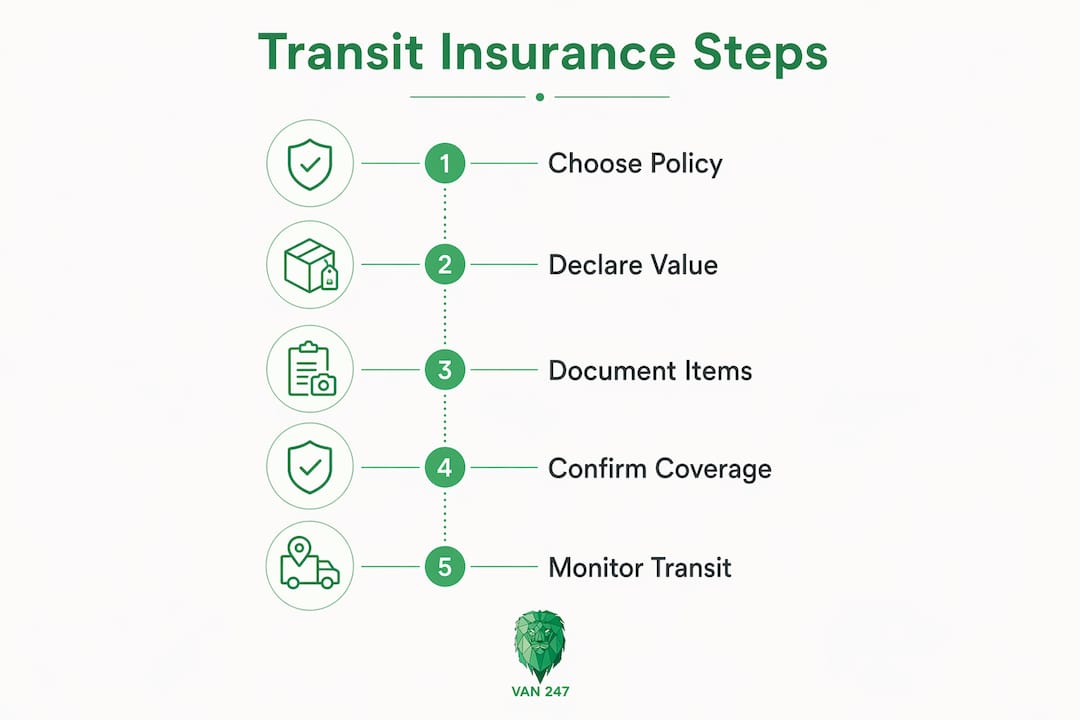
Step 1: Choose the policy type. Because the family is hiring Van-247delivery as their carrier, they confirm that Van-247delivery’s insured removal service includes GIT cover. They also check whether the piano requires a separate declared value endorsement given its value.
Step 2: Declare accurate values. The family prepares a room-by-room inventory with replacement values, not purchase prices. The piano is listed separately with a written valuation from a specialist.
Step 3: Document before loading. Photographs of all rooms, furniture, and the piano are taken the morning of the move. Serial numbers for electronics are recorded. The piano is photographed before wrapping to document its condition.
Step 4: Confirm the COI. The family receives written confirmation of the insured service before the van arrives. They check that the cover limit matches the declared value.
Step 5: Timing. Cover starts at loading. The family does not leave any items in the van overnight before the move date, avoiding the unattended vehicle exclusion.
Step 6: If something goes wrong. If a piece of furniture arrives damaged, the family photographs it immediately, notes it on the delivery receipt, and contacts Van-247delivery within 24 hours. The BOL, inventory list, and photographs form the basis of the claim.
For more detail on protecting instruments specifically, the advantages of insured piano delivery guide covers the documentation and handling steps that matter most.
Mover checklist for customers using Van-247delivery when ask how to insure transported items:
- Prepare a written inventory with replacement values for every room.
- Photograph all items before packing, especially fragile and high-value pieces.
- Obtain written confirmation of insured cover before the move date.
- Declare high-value items separately and ask for a declared value endorsement if needed.
- Keep the inventory and photographs accessible on move day.
Pre-loading checklist: do this before goods leave part of how to insure transported items
Run through this list before anything goes on the van:
- [ ] Declare accurate replacement values for all items, not purchase prices.
- [ ] Confirm your policy is active and covers the specific transit leg.
- [ ] Obtain your COI and check the certificate holder name and limit are correct.
- [ ] Photograph all goods, packaging, and the vehicle before loading.
- [ ] Record serial numbers for electronics, appliances, and instruments.
- [ ] Check the vehicle has working locks, an alarm, and GPS tracking.
- [ ] Confirm the driver’s details and licence are on record.
- [ ] Verify overnight parking arrangements comply with your policy’s unattended vehicle warranty.
- [ ] Pack goods to a professional standard or use original manufacturer’s packaging where possible.
- [ ] Keep a copy of the inventory and photographs accessible during transit.
For guidance on packing fragile and valuable goods to the standard insurers expect, the packing valuable goods guide is worth reading before loading day.
Key takeaways
Goods in transit insurance protects your items from loading to unloading, and the right policy type depends on who is transporting the goods, the declared value, and whether the shipment is domestic or international.
| Point | Details |
|---|---|
| Choose the right policy type | Standalone GIT, van policy extension, or per-shipment cargo cover depending on your role and shipment frequency. |
| Declare full replacement value | Under-declaring reduces your payout; always use replacement cost, not purchase price or book value. |
| Cover starts and stops at loading/unloading | Overnight storage in a vehicle is often excluded; confirm your policy’s exact wording before the move. |
| Documentation wins claims | BOL, POD, photographs, and a police report for theft are the evidence insurers need within 24 hours. |
| Van-247delivery | Offers insured removals, piano transport, and pallet delivery with instant online quotes across the UK. |
Why professional insured transport is worth it
There is a version of this conversation that goes: “I’ll just rely on the carrier’s liability cover and hope for the best.” Having seen what that looks like when something goes wrong, it is not a position worth defending.
Carrier liability under standard UK road haulage conditions is capped, often at a per-kilogram rate that bears no relation to the actual value of what was lost. A laptop, a piano, a box of antique china — none of these are well served by a weight-based settlement. Your own cargo or GIT policy pays on declared value, full stop.
The other thing that catches people out is timing. Cover that starts “in transit” but excludes loading and unloading is cover with two large holes in it. Those are precisely the moments when most damage happens. Reading the wording before you book, not after something breaks, is the single most useful thing you can do.
Van-247delivery has been handling insured removals across the UK for over 15 years. The service includes GIT cover, professional packing options, specialist piano and large-item transport, and real-time tracking. Customers who book an insured removal get written confirmation of cover before the van arrives, not a verbal reassurance on the doorstep.
Get an instant quote for insured transport or for how to insure transported items
If you would rather hand the whole thing to a professional and know your goods are covered from the moment they leave your door, Van-247delivery makes that straightforward.
The service covers house removals, man with a van jobs, pallet delivery, and specialist piano transport, all with insured options and instant online quotes. There are no lengthy forms or waiting for a call back. You enter your details, get a price, and confirm the booking. Cover is confirmed in writing before your move date.
To get started, head to the Van-247delivery quote page, have your collection and delivery postcodes ready along with a rough inventory of what you are moving, and you will have a price in minutes. For larger or more complex moves, the team can advise on declared value and any additional cover you might need for high-value items.
Useful sources and next steps for how to insure transported items
External references:
- Goods in transit insurance explained | MoneySuperMarket — a clear consumer-facing overview of whether you need GIT cover and how extensions work.
- Property in transit coverage explained | Insureon — detailed breakdown of what GIT covers and the perils typically included.
- How to get cargo insurance | LogRock — practical step-by-step buying guide with documentation and claims advice.
- Trucking transportation services guide | Premier Fleet Repair — useful background on fleet and cargo handling controls relevant to risk management.
Van-247delivery resources:
- Moving insurance explained: your complete guide — the full internal guide to moving insurance options and booking steps.
- The role of insurance in piano transport — specialist guidance for high-value, fragile instruments.
- How to protect your piano in transit — practical packing and handling steps for instruments.
- UK freight shipping guide — high-level overview of UK freight processes and responsibilities.
FAQ
What insurance do I need to transport goods in the UK?
A standalone goods in transit (GIT) policy is the most appropriate cover for transporting goods by road in the UK, whether you are a business carrier or an individual arranging a removal. Some commercial vehicle policies include GIT as an extension, but check the limit and wording carefully, as extensions are often lower than standalone cover.
How much does goods in transit insurance cost?
Premiums depend on declared value, commodity type, route, and loss history. Per-shipment cover for simple consignments can start from around 0.3% of the declared cargo value, though complex or high-value shipments cost more. Annual policies for regular carriers are usually more cost-efficient than buying per-shipment cover each time.
Who is liable if goods are damaged in transit?
The carrier is legally liable for loss or damage that occurs during transport, but their liability is typically capped under standard haulage conditions. Your own cargo or GIT insurance pays on the declared value of the goods regardless of fault, with the insurer pursuing the carrier separately if applicable.
How do I insure an item for a single move or shipment?
Declare the full replacement value of the item, choose a per-shipment or single-trip policy, and obtain a COI before loading. For high-value or fragile items, ask for a declared value endorsement and photograph the item before it is packed. Van-247delivery’s insured removal service covers this process end to end for household and specialist moves.