Book lift for removals: to book a lift for your move, contact your building’s managing agent or concierge as soon as you have a moving date. Ask for the service lift (or goods lift) in writing, and send them your removal company’s insurance and risk paperwork. If there is no usable lift, you may need an external furniture lift, which is a different job with its own permissions. Below we explain both routes, step by step, so moving day feels calm instead of chaotic.
TL;DR
- Internal lift: book it through the building manager or concierge, not through your removal company. Do it as soon as your date is fixed.
- Paperwork: managed blocks often want a risk assessment and method statement (RAMS) and proof of public liability insurance. Ask your removal firm for these early.
- External furniture lift: if equipment sits on or over a public road, your council may require a highways licence, and some need around 20 working days’ notice.
- Parking: a lift slot is no use if the van cannot get close. Sort the bay or suspension at the same time.
- Timing: give your movers the exact lift slot and floor details so they can plan crew size and running order.
Table of Contents
- Two kinds of lift, two different bookings
- Booking the building’s service lift
- Why the lift slot should drive your whole timetable
- When you need an external furniture lift
- Don’t forget the parking
- A simple timeline you can copy
- Our view: the lift is part of the move, not an afterthought
- Let us handle the planning with you
- Common mistakes to avoid
- FAQ
- Sources
Two kinds of lift, two different bookings, part of book lift for removals
When people search for how to book a lift for removals, they usually mean one of two things. It helps to know which one you need before you pick up the phone.
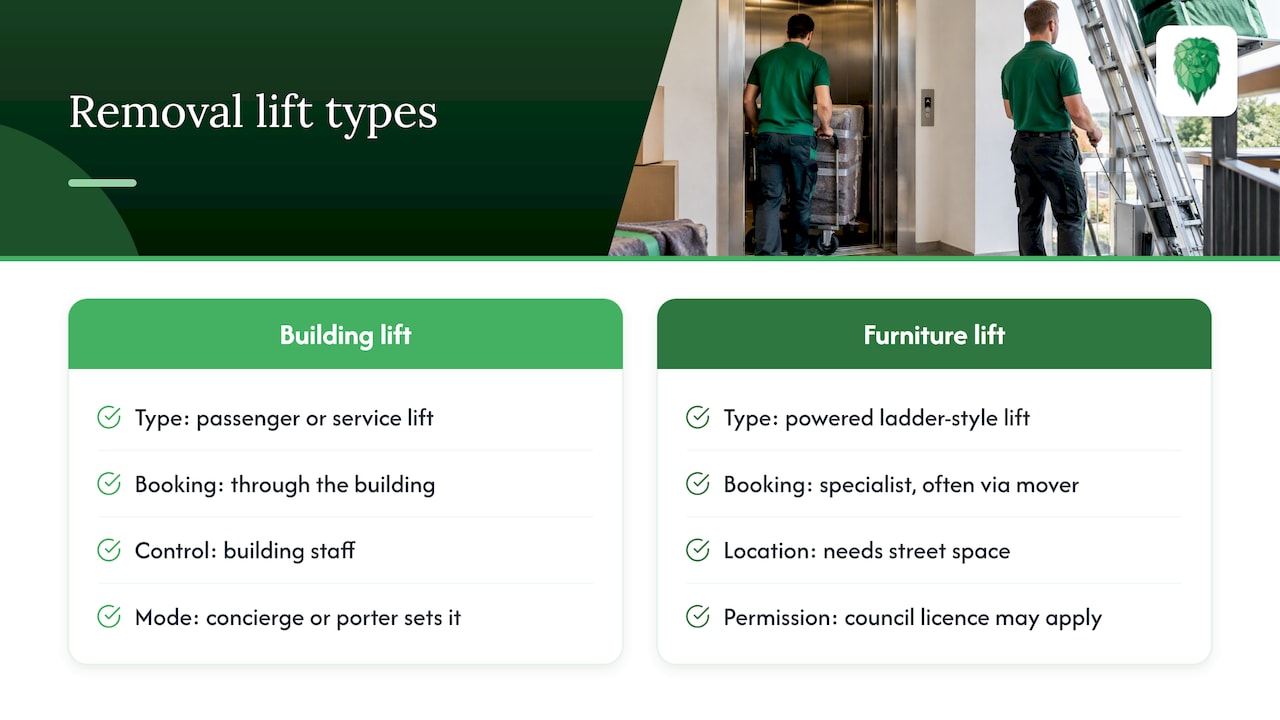
1. The building’s own lift. Flats, apartment blocks, offices and some retirement developments have a passenger lift, and often a larger service or goods lift. The building controls it. You (or your agent) reserve a slot, and the concierge or porter puts the lift into a dedicated mode so it stays with your movers.
2. An external furniture lift. This is a powered ladder-style lift that carries furniture up the outside of a building to a window or balcony. It is the answer when stairs are too tight, a sofa will not turn the corner, or there is no lift at all. It is hired through a specialist and usually arranged with your removal company.
The first is mostly a matter of asking the right person in good time. The second adds equipment, space on the street and sometimes council permission. We cover both below.
Booking the building’s service lift, part of book lift for removals
In many managed buildings you simply cannot turn up and hope for the best. One Manchester removals guide describes lifts in large apartment blocks as the lifeblood of the move, and says most managed blocks require a dedicated service lift booking. The same applies in plenty of London, Birmingham and Leeds developments.
Step by step
- Find the right contact. Check your lease, tenancy pack or the building’s resident portal. It is usually the managing agent, concierge desk or site manager. If you rent, your landlord or letting agent can point you there.
- Ask about the moving policy. Many buildings limit moves to certain days and hours, to protect neighbours from noise. Some charge a fee or a refundable deposit for lift protection. Ask for the policy in writing.
- Request your slot as soon as the date is fixed. Popular days, such as Fridays and the end of the month, go first. A weekday mid-month slot is often easier to get.
- Share the paperwork. Many managed buildings expect a formal RAMS and proof of public liability insurance from your removal company. It is standard practice to request these from your moving firm and pass them to building management at least 10 to 14 days ahead.
- Get the slot confirmed in writing. Note the date, start and end time, which lift, which entrance and where the van may load.
- Send the details to your removal team. They need the lift size, the floors, the loading route and the time window.
What to ask the building
- Is there a separate goods lift, or only the passenger lift?
- What are the internal lift dimensions and weight limit?
- Do the lift and corridors need protective covering, and who supplies it?
- Is there a deposit, and when is it returned?
- Where can the van load, and is there a loading bay with height restrictions?
- Can two moves happen at once, or is the lift reserved for one resident at a time?
That list takes five minutes to send as an email and can save an hour of waiting on the day.
Why the lift slot should drive your whole timetable, part of book lift for removals
A lift booking is a window, not an open-ended loan. If the slot is 10am to 2pm, everything has to fit inside it: loading, carrying, unloading, and a bit of breathing room for the unexpected.
Here is how that changes the plan:
- Pack early. Boxes sealed and labelled the night before move faster than boxes still being filled when the crew arrives.
- Stage items near the lift. Put large furniture by the door, and disassemble beds and wardrobes beforehand if you can. If you would rather not, our team can handle furniture assembly and disassembly as part of the job.
- Think about both ends. If you are leaving one flat and entering another, you may need two lift bookings that do not clash. Leave a gap for the drive between them.
- Allow for waiting. If a slot starts late because the lift is busy, crews are standing by. Our published waiting time rate is £24 per hour per man, so a late-starting lift has a real cost. Booking the right window and confirming it the day before keeps that from happening.
When you need an external furniture lift, part of book lift for removals
Sometimes a lift booking is not the answer because there is no lift, or the lift is too small for a wardrobe, a large sofa or a piano. A furniture lift, hoist or crane can raise items to an upper window or balcony instead.
Typical reasons people use one:
- Tight, winding or spiral stairs
- Large items that will not fit the lift door
- A top-floor flat with no lift
- Fragile or heavy items you would rather not carry down several flights
- Listed or older buildings where scraping the stairwell is a worry
Your removal company arranges this alongside the move, so tell them early about any item you are worried about. For a piano, we have a dedicated piano removal service, and for bulky items our furniture and large items service covers the route planning.
Do you need council permission? Part of book lift for removals
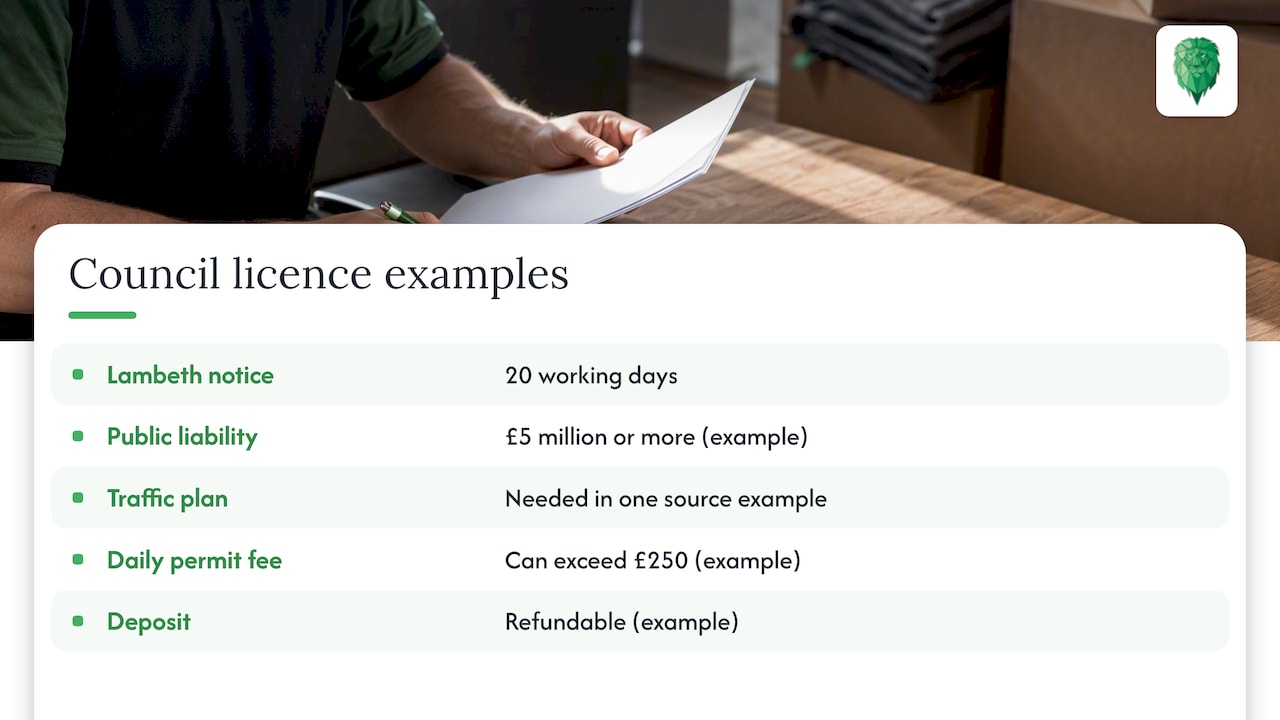
Possibly, and this surprises many people. If the equipment sits on or oversails a public road or pavement, your local council may need to license it. For example, Lambeth Council’s highways licence application asks for 20 working days’ notice. Other boroughs set their own rules: Enfield says companies with cranes, scaffolding or projections on or over public roads and pavements require a licence, and Transport for London publishes guidance on highway licences for the roads it manages.
One London source we reviewed describes such applications as needing public liability cover of £5 million or more, a traffic management plan and daily permit fees that can exceed £250, plus a refundable deposit. Treat those figures as one council’s example, not a national rule. Your own council’s page is the one that counts, so check it for your postcode.
If the lift stays entirely on private land, such as a private drive or forecourt, a road licence may not apply. Your removal company or the lift operator will tell you which situation you are in once they know the address.
Don’t forget the parking, part of book lift for removals
A perfectly booked lift slot falls apart if the van is parked two streets away. Before you finalise anything:
- Ask whether the building has a loading bay, and what height and length it takes.
- Check whether the street has restrictions, resident bays or permit-only hours.
- If you need a bay suspended outside the property, many councils need notice. Our guide to moving day with no parking explains why some councils ask for 10 working days.
- On tight or one-way streets, read our two-week plan for narrow street access so you avoid fines and blocked-in vans.
A good rule: book the lift, the parking and the removal date together, then confirm all three a few days before.
A simple timeline you can copy
| When | What to do |
|---|---|
| As soon as your date is fixed | Contact the building manager, ask for the moving policy and request your lift slot |
| 4 to 6 weeks before | Tell your removal company about the lift, floor numbers, bulky items and any external lift need |
| At least 20 working days before (if a road licence may apply) | Check your council’s highways licence page and apply if needed |
| 10 to 14 days before | Send RAMS and insurance proof to the building |
| 1 week before | Confirm the lift slot, parking and arrival time in writing |
| The day before | Reconfirm with the concierge, clear the loading route, finish packing |
| Moving day | Meet the crew, walk them through the route, keep the lift booking details to hand |
If you want a longer checklist of documents, our removal day paperwork guide covers timings in more detail.
Our view: the lift is part of the move, not an afterthought, part of book lift for removals
We have been doing removals across the UK for over 15 years, and the same pattern comes up again and again. The furniture is rarely the problem. The access is.
A sofa can be carried by two people. A lift that has not been booked, a bay that is blocked, or a building manager who never got the insurance certificate can stop a whole crew in its tracks. When that happens, the customer pays in time and stress.
So our advice is simple:
- Tell us about the lift when you ask for a quote. Floors, lift size, loading distance and any restrictions all change how we plan the crew and the van.
- Ask the building early, and ask for the rules in writing. It is dull work, but it prevents surprises.
- Do not wait to mention awkward items. A piano, a large wardrobe or a glass dining table can change the whole approach.
- Keep a small buffer in the slot. Lifts get busy, neighbours move too, and moving day is a marathon, not a sprint.
Calm moves are planned moves. A few emails two or three weeks ahead usually save the whole day.
— Claudiu
Let us handle the planning with you
If you are moving to or from a flat, tell us about the lift when you ask for your instant quote. We are insured, we can pack, disassemble and reassemble furniture, and we will plan the crew around your lift slot. Start with our house removals service, or if you are moving an office, see our office relocation service, where we can also relocate servers and reinstall Wi-Fi and video conferencing.
Common mistakes to avoid, part of book lift for removals
- Booking the lift through the wrong person. A removal company cannot usually reserve a building’s lift for you. The building manager or concierge does that, though we will supply the documents they need.
- Assuming a passenger lift is fine. Residents’ lifts often have weight, size and time limits for moves. Ask whether a service lift exists.
- Leaving protective covers to chance. Some buildings insist on lift padding and floor protection. Check who provides it.
- Forgetting the second address. The lift at the new place needs booking too, and the two slots must fit a realistic drive time.
- Ignoring the deposit. If the building asks for one, find out how and when it is returned, and photograph the lift and corridors before you start.
- Booking too late for a road licence. If an external lift needs one, 20 working days can arrive faster than you expect.
FAQ
Who books the lift for my removal, me or the removal company?
Usually you do. The lift belongs to the building, so the booking goes through the managing agent, concierge or site manager. Your removal company should supply the insurance and risk paperwork they ask for, and needs the confirmed time slot from you.
How far ahead should I book a lift for a move?
As soon as your moving date is fixed. Many buildings ask for the paperwork 10 to 14 days before, and popular days fill up early. If an external lift might need a road licence, check your council’s notice period straight away, as one London council asks for 20 working days.
Do I need a lift booking if I only have a few boxes?
It depends on the building. Some blocks require every move, large or small, to use a booked slot, while others only mind big furniture. A quick message to the concierge settles it and costs nothing.
Is a furniture lift the same as a service lift?
No. A service lift is inside the building and is controlled by the building. A furniture lift is external equipment that raises items to a window or balcony. It is arranged with your removal company and may need council permission if it sits over a public road or pavement.
What happens if my lift slot runs over?
That depends on the building’s rules, so ask about extensions when you book. On our side, waiting time is charged at £24 per hour per man, so it pays to keep a buffer and have everything packed and staged before the crew arrives.
Sources
- Manchester apartment move specialist: service lift and concierge requirements
- Apply for a highways licence, Lambeth Council
- Cranes, scaffolding, hoarding and projection, Enfield Council
- Highway licences, Transport for London