Business move notifications UK: when a UK business moves premises, you need to tell HMRC, Companies House (if you are a limited company), the body that handles your business rates, your energy supplier, and then your insurers, banks, customers and suppliers. Some of these have legal deadlines and some simply save you money. None of them is hard on its own. The trick is doing them in the right order, so nothing is left to the chaos of moving day.
Take a breath: this is very doable. Below you will find who to notify, what to have ready, what changes between England, Scotland and Northern Ireland, and a timeline you can copy into your own plan.
TL;DR
- Tell HMRC about a new trading or correspondence address. VAT-registered businesses must do it within 30 days.
- Limited companies must update the registered office address and registered email address with Companies House.
- Report the move to the Valuation Office (England and Wales) and close your energy account at the old site, or you could pay for someone else’s use.
- Then work through insurers, banks, customers and suppliers, using a single master contact list.
- Start early: a calm notification plan is half of a calm move.
Table of Contents
- The quick overview: who needs to know
- Telling HMRC about your new address
- Updating Companies House
- Business rates: council and Valuation Office
- Energy: closing the old account and opening the new one
- Insurers, banks and other organisations
- Telling customers and suppliers
- Do not forget the stuff you leave behind
- A timeline you can copy
- Our perspective: notifications are part of the move, not an afterthought
- Let us handle the heavy lifting
- FAQ
- Sources
The quick overview: who needs to know
Here is the full picture at a glance. We go through each line in more detail below.
| Who | Why they need to know | Deadline or timing |
|---|---|---|
| HMRC | Tax records must show your correct trading and correspondence address | Within 30 days if VAT-registered |
| Companies House | The public register must show your registered office | Takes effect when registered |
| Valuation Office / council | Business rates are tied to the premises | As soon as you know your dates |
| Energy supplier | Closes your old account, opens the new one | As soon as possible, with a meter reading |
| Insurers and bank | Cover and records must match the real location | Before you move |
| Customers and suppliers | So deliveries, invoices and enquiries still reach you | Before and on moving day |
Telling HMRC about your new address, part of Business move notifications UK
HMRC is first on the list because tax correspondence is the kind you really cannot afford to miss. According to HMRC’s guidance, you must tell them if your trading address, correspondence address or business name changes, and VAT-registered businesses must report such changes within 30 days.
The route depends on how you are set up: sole trader, partnership or company. The GOV.UK page above sends you to the right place for each. A few practical tips:
- Do it as soon as your new address is confirmed, not after the boxes are unpacked.
- Keep a note of the date you reported it and any reference you receive.
- If your accountant or bookkeeper files for you, tell them the exact moving date so nothing is filed to the old address.
Updating Companies House, part of Business move notifications UK
If you run a limited company, your registered office address sits on a public register. Companies House says a company must tell it about a registered office address change, which takes effect once it is registered. Your registered email address is updated separately, so do not assume one change covers both. You can report online or by paper form.
There are two things worth knowing here.
First, not every address qualifies. The official AD01 form explains that a registered office must be in the same part of the UK where the company is registered, and that documents delivered by hand or post should, in the ordinary course of events, reach someone acting for the company, with delivery capable of being acknowledged. A new unit that nobody staffs is not ideal for this.
Second, accuracy matters beyond paperwork. Companies House describes the information on its register as a key indicator of a company’s reliability, and online filing lets you update details as soon as decisions are made.
As a side note, changes to directors, company secretaries or people with significant control have their own, shorter deadline: 14 days. If your move comes with a change in who runs the business, handle both at once.
Business rates: council and Valuation Office, part of Business move notifications UK
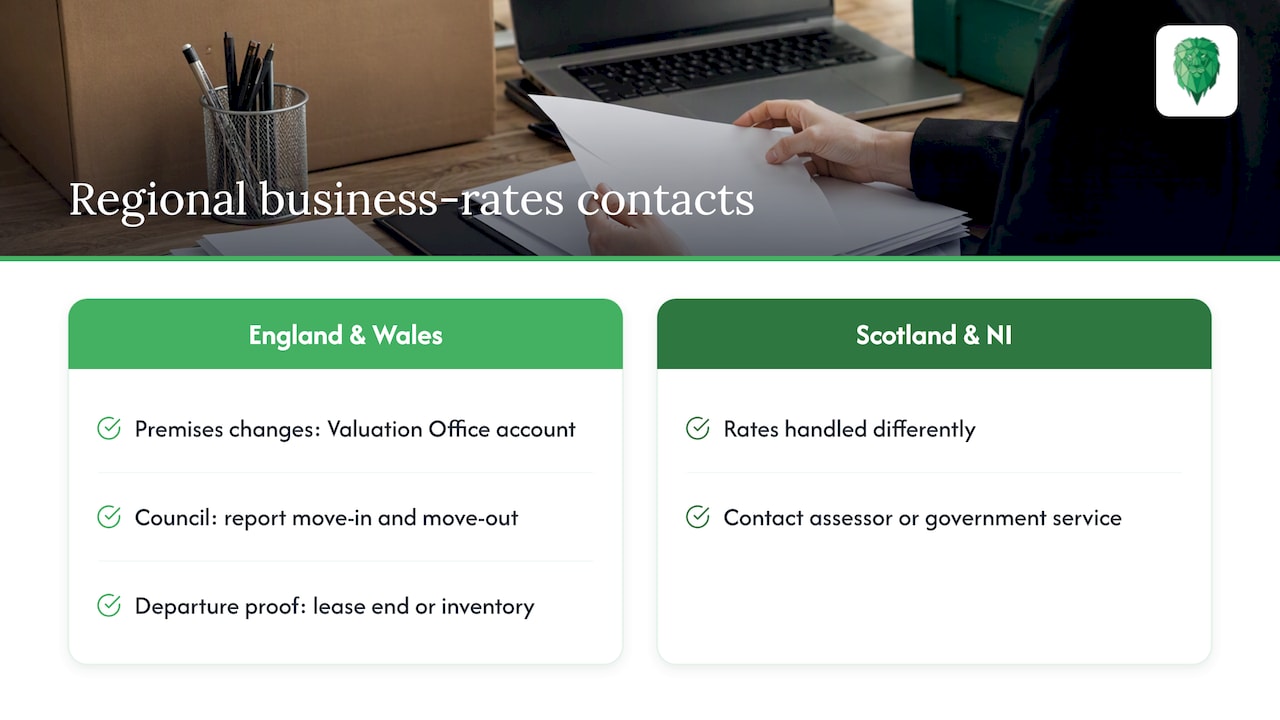
Business rates follow the property, not the company, so both your old and new premises need attention. In England and Wales, GOV.UK says you can report premises changes to the Valuation Office through your business rates valuation account. Reporting matters because it helps make sure you pay the right amount and do not get a backdated increase in your bill.
Your local council also needs to know when you move in or out. Councils usually ask for proof that you have left, for example Ealing Council says it will want proof that a business has left the property. A signed lease end, a surrender document or a final inventory can all be useful, so keep copies.
A regional note: business rates are handled differently in Scotland and Northern Ireland, so check with your local assessor or the relevant government service rather than following the England and Wales steps. The same GOV.UK page flags this difference.
Energy: closing the old account and opening the new one, part of Business move notifications UK
Energy is the notification that most often causes surprise bills. Ofgem advises that when a business changes premises, it should tell its current supplier as soon as possible and include a meter reading if it can. If you are also switching supplier, notify both the old and new supplier and give evidence to both. The new supplier can help with this.
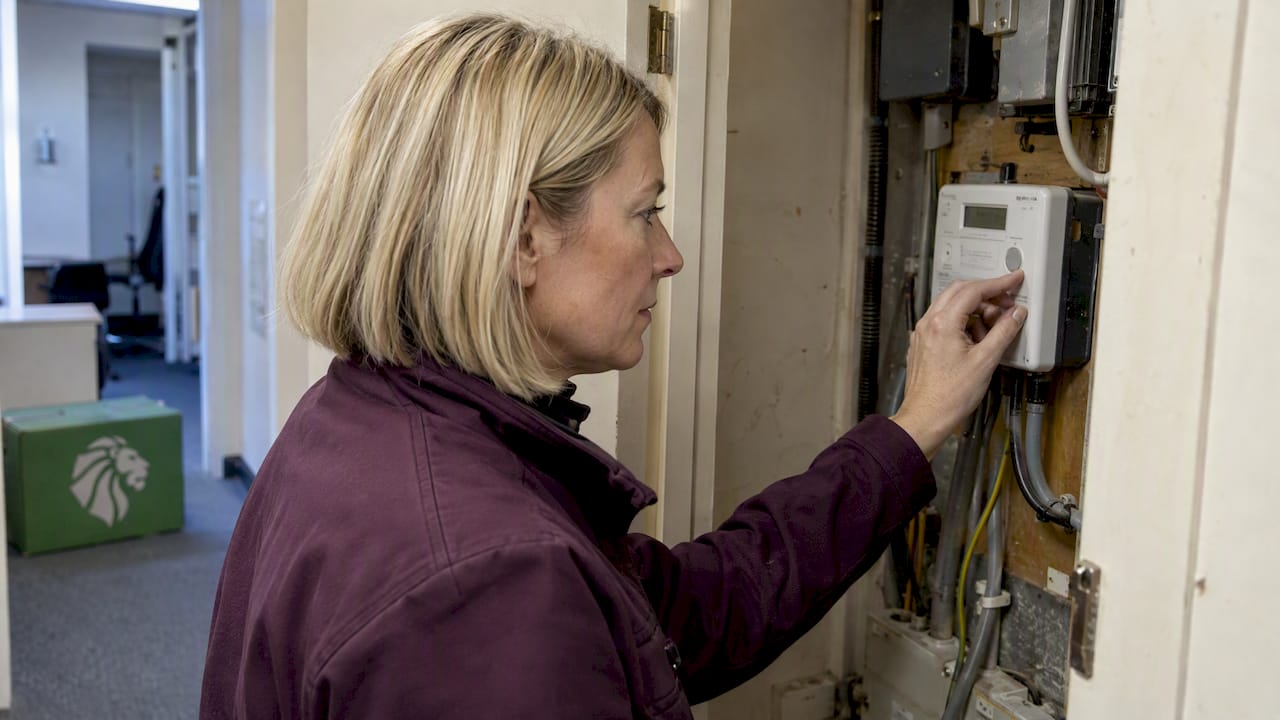
Why hurry? Citizens Advice warns that if you do not close the account when moving out, you might be charged for the next tenant’s energy use.
What to have ready
Suppliers will want proof that you really are the new occupier or have really left. Ofgem lists a meter reading where possible, plus evidence such as a lease agreement, property sale documents or title deeds. Some suppliers may also ask for mortgage documents, business rates bills, or letters from your bank, solicitor or landlord. Citizens Advice adds landlord confirmation, confirmation from the solicitor or estate agent handling the move, a business rates statement or a mortgage completion letter.
Our advice: make one folder, digital or paper, with all of these. You will reuse them across several notifications.
- Take photos of the meters on your last day at the old site, with the date visible.
- Take the same photos on your first day at the new site.
- Keep your lease or completion documents where you can reach them from any device.
Insurers, banks and other organisations, part of Business move notifications UK
This group is less about law and more about protecting yourself. Your own list will differ, but most businesses should consider:
- Business insurance: cover is tied to the address, so tell your insurer before you move. Ask whether goods in transit are covered during the move itself. Our guide to commercial move insurance lists five questions worth asking first.
- Your bank and card providers: update the business address on accounts, cards and any merchant services.
- Licences, memberships and trade bodies: anything issued for a specific location may need updating.
- Telecoms and internet providers: book the transfer or new line early, as installation can have a lead time.
- Landlords and managing agents: confirm keys, access and any final inspection.
- Post: arrange mail redirection so late letters still reach you.
If you also need to move or reinstall IT, ask early. Our office relocation service covers server relocation and Wi-Fi and video conference installation, so your connection is ready when your team walks in.
Telling customers and suppliers, part of Business move notifications UK
Authorities have forms. Customers do not, and they are the group you least want to lose touch with. Think about every way a customer or supplier might contact you: post, email, phone, invoices, your website, Google listing and social media.
A good mix looks like this:
- Email your key contacts personally, a few weeks ahead, with the new address, the date and who to call if something goes wrong.
- Add a note to invoices and receipts so everybody sees it, even those who skip emails.
- Update your website, email signatures and online listings on moving day, not before, so nobody turns up at an empty office.
- Put a sign on the old door for the first few weeks, pointing to the new address.
- Update your voicemail if there will be a gap in phone cover.
You can also borrow a habit from safety guidance. Devon and Somerset Fire and Rescue Service suggests keeping updated contact details for key customers and suppliers in multiple locations, ideally with one off-site, and assembling a crash box with site plans, contact lists and essential equipment. It is written for emergencies, but it works just as well as a moving-day pack. Our own guide to business continuity during a move shows how to keep trading while the boxes travel.
Do not forget the stuff you leave behind, part of Business move notifications UK
Office moves create a lot of waste: old cardboard, broken furniture, outdated electronics. Sorting this before the van arrives means less to carry, less to pay for and a cleaner handover to your landlord. If you produce a lot of packaging, it is worth a look at recycling logistics for offices to see how waste can be handled more efficiently while you plan the move.
A timeline you can copy, part of Business move notifications UK
These timings are our suggestions, not legal rules. The legal deadlines (30 days for VAT-registered businesses reporting to HMRC, 14 days for officer changes at Companies House) are quoted above.
Once you have signed for the new premises
- Put all documents in your move folder.
- Tell your landlord or agent when you plan to leave the old site.
- Check which business rates authority applies to each site.
- Book your removal company and any out-of-hours slot. See our tips on an out of hours office move.
A few weeks before
- Notify your energy supplier of the move date, or both suppliers if you are switching.
- Tell your insurer and ask about cover in transit.
- Email key customers and suppliers.
- Order your telecoms and internet.
- Complete a risk assessment for the move.
In the final week
- Confirm access, parking and lift bookings at both sites.
- Prepare the crash box with contact lists and essentials.
- Arrange mail redirection.
Moving day and just after
- Photograph meters at both sites.
- Update your website, listings, signatures and invoices.
- Report the new address to HMRC and, for a limited company, Companies House, if you have not already.
- Report the changes to the Valuation Office or your local rates authority, and give the council any proof of leaving it needs.
- Check that the energy account at the old site is closed.
Our perspective: notifications are part of the move, not an afterthought, part of Business move notifications UK
We have been moving businesses for over 15 years, and the pattern is familiar. The vans are booked, the furniture is labelled, and then three weeks later a client mentions a letter that went to the old address or a bill that did not stop. The physical move gets all the attention, while the paperwork quietly decides how smooth the first month is.
Our advice is simple. Treat notifications as a project with an owner, a list and a date, just like the removal itself. Give one person responsibility. Keep one folder. Tick things off as you go. If the owner of a small business is doing everything alone, split the list in two: legal and money first, relationships second.
Also, remember that moving day is a marathon, not a sprint. If you have taken care of the notifications ahead of time, you can give moving day your full attention: protecting equipment, keeping your team calm and getting the new office working.
— Claudiu
Let us handle the heavy lifting, part of Business move notifications UK
We cannot file your HMRC or Companies House forms for you, but we can take the physical side of the move off your plate. Our office relocation service covers packing, furniture disassembly and assembly, insured transport and, where needed, storage and server relocation. If you are moving in a major city, see our pages for business relocation in London and Manchester.

One thing worth knowing: our waiting time fee is £24 per hour per man, so a well-timed access plan really does save money. Get an instant online quote and book once your dates are confirmed.
FAQ
Do I have to tell HMRC if my business moves?
Yes. HMRC expects you to report changes to your trading address or correspondence address. If you are VAT-registered, you must report within 30 days. Use the GOV.UK page for your business type to find the right route.
Does a limited company need to update Companies House when it moves?
Yes. A change of registered office address must be reported and takes effect once registered. The registered email address is updated separately. You can file online or on paper, and the new address must be in the same part of the UK where the company is registered.
What happens if I forget to close my energy account at the old premises?
You could be billed for the next occupier’s usage. Tell your supplier as soon as possible and give a meter reading taken on your last day. If you are changing supplier, tell both the old and the new one.
Are business rates handled the same way across the UK?
No. The GOV.UK guidance on reporting premises changes to the Valuation Office covers England and Wales. Scotland and Northern Ireland handle business rates differently, so check with the local authority or assessor there.
When should I tell customers about my move?
We suggest a few weeks before, using a personal email to key contacts. Then add a note to invoices, update your website and listings on moving day and keep a sign on the old door for a while.
Sources
- Tell HMRC about a change to your business
- Running a limited company: company changes you must report
- AD01: Change of registered office address
- Companies House blog: important dates
- Business rates: if your business or premises change
- Ealing Council: business rates information
- Ofgem: change of tenancy for businesses
- Citizens Advice: energy supply when you move business premises
- Devon and Somerset Fire and Rescue Service: prepare your business for an emergency