Declutter before moving: start now, and sort room by room using one simple rule: keep, sell, donate or toss. That single habit shortens packing time, lowers your moving costs and speeds up unpacking at the other end.
Before you touch a single box, run each item through a quick decision test: Have you used it in the last 12 months? Would it cost less to replace than to move? Will it actually fit in your next home? If the answer to any of these is no, it’s leaving.
Get moving in the next hour with these steps:
- Grab boxes, bin bags, labels and a marker pen.
- Pick one small area (a drawer, a shelf) and sort it into keep, sell, donate, toss.
- Set a timer for 60 minutes and see how far you get.
Key Takeaways
Decluttering before moving reduces cost, speeds up packing, and prevents clutter from simply following you into your new home.
| Point | Details |
|---|---|
| Start 6 to 8 weeks early | Begin with storage areas, then bedrooms, kitchen and a final sweep in the last fortnight. |
| Use a simple sorting system | Apply four box, 12-12-12 or 5-5-5 rules to avoid decision fatigue on every item. |
| Apply the cost-to-replace test | Skip moving anything that costs more to transport than to buy again locally. |
| Set firm disposal deadlines | Give sale listings 7 to 14 days, then switch to donation or junk removal. |
| Label by room, not by number | A clear labelling system speeds up unpacking and helps your removal team work efficiently. |
Table of Contents
- 48 to 72 hour starter checklist to build momentum
- Your decluttering timeline: 8 weeks to moving day
- Room-by-room checklist: what to sort where
- Speed decision systems: pick a rule and stick to it
- How to dispose of your things without a bottleneck
- What a lighter load means for packing and moving day
- Notes from Van-247delivery: when to call in professional help
- Why most decluttering advice gets the order wrong
- Sources
- FAQ
48 to 72 hour starter checklist to build momentum
You don’t need a grand plan to begin decluttering before moving. You need supplies and a first session. Gather boxes, labels, a marker and bin bags today, then decide which sorting system you’ll use (more on that below) so you’re not second guessing yourself room by room.
- Book your sessions. Assign one 60 to 90 minute slot per room over the next three days. Anything longer and fatigue sets in.
- Pack an essentials box. Fill it with what you’ll need in the first 24 to 48 hours at the new place: chargers, medication, toiletries, a change of clothes.
- Set it aside physically. Keep the essentials box away from the general packing pile so it doesn’t end up buried in the van.
Momentum matters more than perfection here. A messy hour of progress beats a perfectly planned session that never happens.
Your decluttering timeline: 8 weeks to moving day part of declutter before moving
Timing shapes how much stress you carry into moving week. Most removal specialists recommend starting roughly 6 to 8 weeks before your move date, which helps you go through each room methodically without rushing or regretting decisions.
- 8 weeks out: Tackle storage areas first, the loft, garage, shed and under-stairs cupboard. These hold the most forgotten items and, according to industry guidance, take roughly twice as long to clear as a typical living room. Starting here avoids a bottleneck later.
- 6 weeks out: Move to bedrooms and living rooms. Clothes, books and décor pile up quietly and need proper attention.
- 4 weeks out: Clear the kitchen and bathrooms. Use up perishables, cull duplicate gadgets and toiletries you’re never going to finish.
- 2 weeks out and moving week: Do a final sweep of every room, confirm donation pickups or drop-off slots, and book junk removal if anything’s still lingering.
Stick roughly to this order and you’ll never be facing three rooms at once with four days left on the clock.
Room-by-room checklist: what to sort where part of declutter before moving
Working through a house properly means treating each room as its own mini project, with its own decision targets.
Storage spaces (loft, garage, basement): Empty everything out first, even if it means a temporary mess. Sort quickly and prioritise anything untouched for 12 months or more. This is usually where the biggest wins hide.
Bedrooms: Apply the one-year rule to clothing: if you haven’t worn it in a year, it goes. For furniture, ask whether the mattress or wardrobe is worth the cost of transport, or whether it’s cheaper to replace once you’ve settled in.
Kitchen: Use up perishables in the final fortnight rather than moving them. Cull duplicate mugs, mismatched Tupperware and small appliances that never left the cupboard.
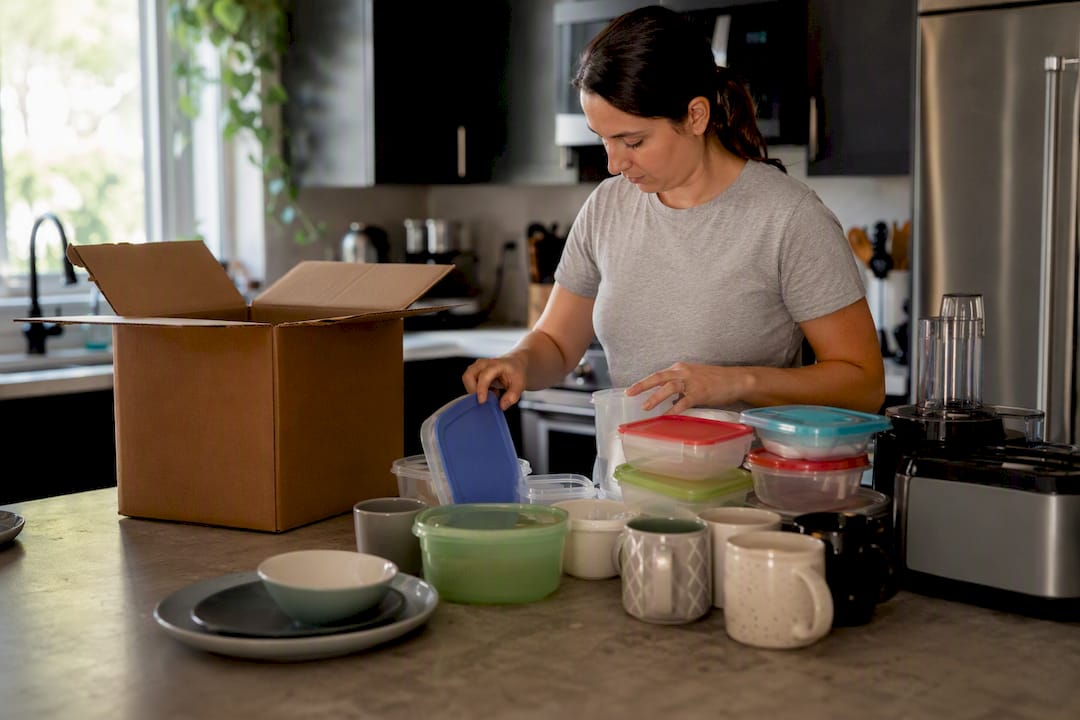
Living areas: Keep the pieces you genuinely love and use. Donate bulky décor, excess ornaments and the books you’re never going to reread.

Home office: Scan or shred old paperwork rather than boxing it up blind. Recycle electronics responsibly, most councils and retailers run take-back schemes for old monitors and cables.
Garage and garden: Larger tools, seasonal gear and anything gathering dust deserves a hard look. Sell what has value, junk what doesn’t.

Pro Tip: Photograph anything you’re unsure about before you decide. Seeing it on a screen, out of context, makes the “do I really need this” decision much easier than staring at it in a cupboard.
Speed decision systems: pick a rule and stick to it part of declutter before moving
Decision fatigue is real when you’re sorting hundreds of items, so borrow a system rather than deciding from scratch every time.
- The four box method: Label boxes keep, sell, donate, toss, and every item goes in one, no exceptions.
- 12-12-12: In each session, find 12 items to donate, 12 to sell, and 12 to throw away. It’s a structured way to make steady progress without getting stuck.
- 5-5-5: On busy days, spend just 5 minutes finding 5 items to remove. It’s a low-effort micro-session that still adds up over a week.
For sentimental items, ask three questions: Have I used it recently? Would a photo preserve the memory just as well? Could I fit it in a single small keepsake box? If it fails all three, it’s time to let it go.
How to dispose of your things without a bottleneck part of declutter before moving
Once you’ve sorted, you need somewhere for everything to actually go, and each channel moves at a different speed.
- Sell: Furniture and electronics in good condition are worth listing, but set a firm 7 to 14 day deadline. If nothing’s sold by then, switch straight to donation rather than let items linger.
- Donate: UK charity shops and reuse schemes take clothing, books and small furniture, but many need advance notice for bulky pickups. Book early.
- Recycle and hazardous waste: Batteries, paint and old medicines can’t go in with general rubbish. Take them to a council recycling centre or pharmacy take-back point instead.
- Junk removal: For anything left over close to moving day, a same-day collection service clears the rest without you having to find a home for it.
The financial upside is real. Because removal firms typically charge by weight and volume, cutting your load before moving day can save more than £500 compared with paying to shift everything you own, including the things you’ll never unpack.
What a lighter load means for packing and moving day part of declutter before moving
Fewer possessions change more than your storage cupboards. They change the shape of moving day itself.
- Get a tighter quote. Movers price by weight and volume, so a smaller inventory usually means a smaller bill and less time spent loading and unloading.
- Pack your essentials box last, load it first. Keep it in the car or somewhere accessible, never buried at the back of the van, so you’re not digging through boxes at 9pm looking for a toothbrush.
- Label by room, not by box number. Write the destination room on every box, and keep a simple written inventory. It makes unpacking faster and helps your removal team know exactly where things go, which our own packing checklist walks through in more detail.
A smaller, clearly labelled inventory turns moving day from a guessing game into a straightforward job.
Notes from Van-247delivery: when to call in professional help
Fifteen years of house removals has taught us one thing clearly: decluttering properly before we arrive makes the whole job faster and cheaper for you. Lighter loads mean quicker loading, fewer trips, and a quote that reflects what you’re actually moving, not what you were planning to sort out “eventually”.
- If you’re only dealing with a few bulky items, a sofa, a wardrobe, a piano, book a bulky item collection rather than a full house removal.
- For a full property, our house removals service includes packing and disassembly, so nothing gets left behind because it seemed too awkward to shift.
- To get an accurate quote, send photos of large items, a simple room list, and flag anything oversized in advance. It saves everyone a surprise on the day.
Decluttering first isn’t just tidier. It’s the difference between an efficient move and a stressful one.
Why most decluttering advice gets the order wrong part of declutter before moving
Most decluttering guides treat every room as equal, work through the house alphabetically, or worse, tell you to “start wherever feels manageable.” That advice sounds gentle. It’s actually why so many people stall out in week three with a garage still full of boxes and four days left before the van arrives.
The evidence points somewhere more specific: storage spaces take disproportionately longer than living spaces, so they need to go first, not last, when they’re usually left as an afterthought because they’re out of sight. Tackling the loft in week one, while it feels like the least urgent task, is what actually protects your schedule.
The other thing conventional advice underplays is money. Decluttering isn’t just about tidiness or peace of mind, it’s a direct lever on what your move costs, because removal pricing tracks weight and volume. Treat sorting as a cost-cutting exercise, not a spring clean, and you’ll make faster, less sentimental decisions.
If you take one thing from this plan, prioritise storage areas first and treat every other room as easier by comparison.
— Claudiu
Sources
For more on the numbers behind decluttering, see Dropcurb’s room-by-room checklist and Surewise’s guide to decluttering before a house move. For extra packing detail, our partners at Bridges cover stress-free local move packing.
- Decluttering Before Moving: The Room-by-Room Checklist 2026 | Dropcurb
- Decluttering before moving house | Surewise
- Move
FAQ
What is the 3-3-3 rule for decluttering?
It’s a micro-session method: pick 3 items to keep, 3 to donate and 3 to throw away in a short burst, similar in spirit to the 12-12-12 and 5-5-5 systems used to keep momentum without overwhelm.
What are 12 items I should throw away before moving?
Expired pantry food, old toiletries, worn out towels, single socks, dead batteries, expired medicines, broken electronics, mismatched Tupperware, old magazines, chipped crockery, worn out mattress toppers and unused cables are common candidates.
What should I do to declutter before moving?
Start 6 to 8 weeks out, clear storage areas first, then work through bedrooms, living areas and the kitchen using a keep, sell, donate, toss system for every item.
What to do 2 days before moving?
Do a final sweep of every room, confirm any donation pickups or junk removal bookings, pack your essentials box last, and load it somewhere accessible rather than at the back of the van.