Difficult access moves: if your move involves a narrow street, multiple flights of stairs, or restricted parking, book a specialist survey before you agree to any final price. That single step converts the most common source of surprise charges into planned, written line items you can budget for.
When to hire a specialist removals partner:
- Narrow street where a full-size lorry cannot park within 75–100 feet of your front door
- Long carry of more than 30 metres from the vehicle to your entrance
- Restricted or permit-only parking with no loading bay nearby
- Multiple flights of stairs with tight landings or low ceilings
- Oversized items (piano, gun safe, large sofa) that cannot turn internal corners
Your next three steps, within 72 hours:
- Measure every critical distance: doorway widths, stair widths, ceiling heights on each landing, and the distance from the nearest parking point to your front door.
- Photograph and video your full access route, including locked gates, narrow passages, and any steps.
- Notify your building manager or local council to ask about parking suspensions, lift bookings, and loading restrictions.
Key takeaways
Booking a specialist survey before agreeing a final price is the single most effective step you can take to avoid surprise charges on a difficult-access move.
| Point | Details |
|---|---|
| Book a survey first | Request an in-person or virtual survey whenever access is restricted; it converts surprise charges into written, agreed line items. |
| Measure and photograph everything | Doorway widths, stair widths, carry distances, and ceiling heights at both properties should be shared with your removals firm before quoting. |
| Get accessorials in writing | Ask specifically about long-carry, stair, shuttle, and hoist charges; request a binding or not-to-exceed estimate to cap your exposure. |
| Secure permits and lift bookings early | Apply for parking suspensions at least three weeks in advance; book the building lift in writing with a confirmation email. |
| Van-247delivery for specialist moves | Van-247delivery offers survey-led house removals and man-with-a-van services with specialist equipment, insurance, and written accessorial disclosure across the UK. |
Table of Contents
- Why difficult-access moves cost more and take longer
- How specialist movers actually solve access problems
- Step-by-step planning checklist for a restricted-access move
- Expert tips that save money and prevent damage
- Common mistakes that push up your final bill
- What equipment and specialist services actually do
- How quotes change for difficult access and how to avoid surprises
- When should you request an on-site or virtual survey?
- A real-world example: narrow-street flat move, handled end-to-end
- Why specialist expertise matters more than you might expect
- Van-247delivery handles difficult access moves across the UK
- Sources
- FAQ
Why difficult-access moves cost more and take longer part of difficult access moves
Restricted access is fundamentally a labour problem. Every extra flight of stairs or additional 30 metres of carry distance adds time, and time on a moving job means crew cost. A staircase that takes two minutes per trip multiplied across 80 boxes adds hours to a job that looked straightforward on paper.
The charges that appear on your final bill because of access issues are called accessorials. Common ones include long-carry fees, stair fees, shuttle charges (when a smaller vehicle must relay items from a large lorry parked further away), waiting time, and building or lift reservation fees. According to a 2026 industry analysis, accessorial charges commonly add several hundred to a few thousand dollars to a move, and many consumers encounter multiple accessorials they had not budgeted for. The same pattern holds in the UK: a base quote that looks reasonable can grow significantly once access realities are factored in.
Accessorial charges are not penalties — they reflect the genuine extra labour and equipment that restricted access demands. The problem is not that they exist; it is that they often appear for the first time on move day, when you have no leverage to negotiate or prepare.
The risk summary is short: undisclosed access issues lead to delays, damage from rushed manoeuvres through tight spaces, and a final bill that bears little resemblance to the original estimate. Planning ahead removes all three risks.
How specialist movers actually solve access problems, part of difficult access moves
Professional removals crews treat awkward access as an engineering challenge. There is almost always a method that works; the question is matching the right one to your situation.
Small van or man-and-van service works well when the street is too narrow for a full-size lorry. A man-and-van team can park closer, reducing or eliminating long-carry fees entirely. It suits smaller loads and flats where a large vehicle would simply be impractical.
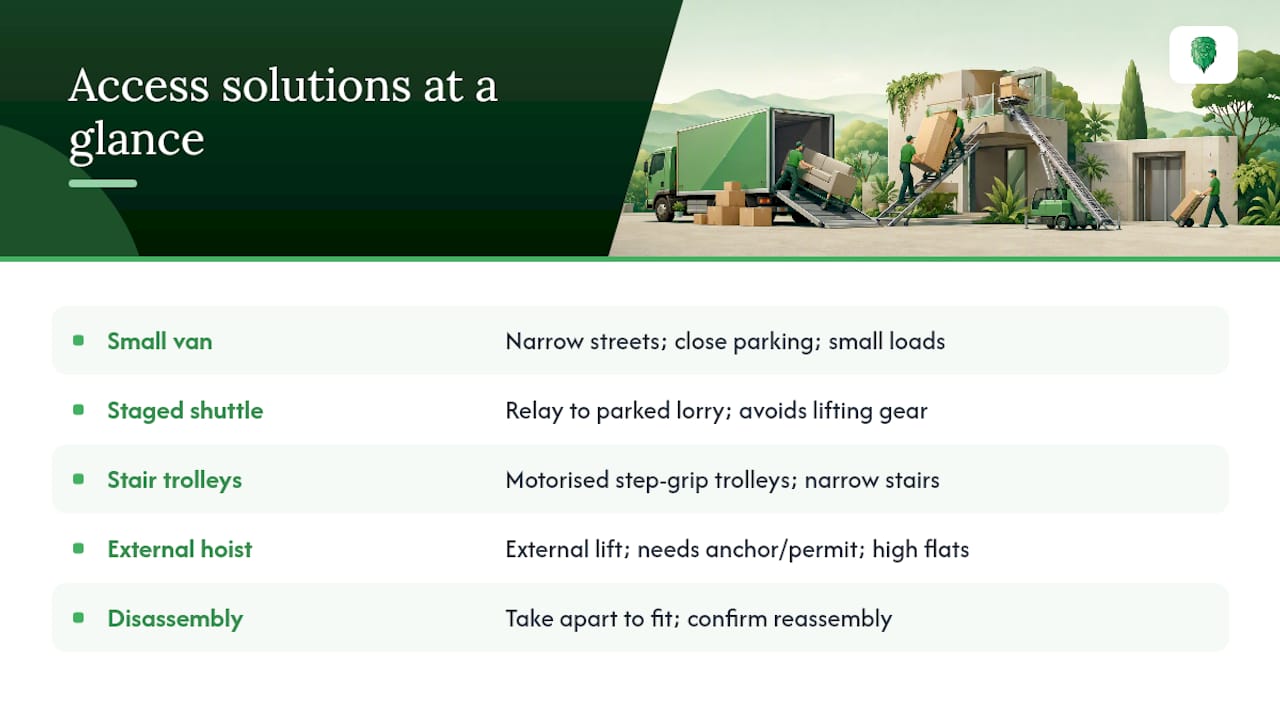
Staged shuttle move uses a smaller vehicle to relay items between your property and a larger lorry parked on a wider road. It adds time but avoids the need for specialist lifting equipment. Best suited to terraced streets or properties with a long driveway where the main vehicle cannot get close.
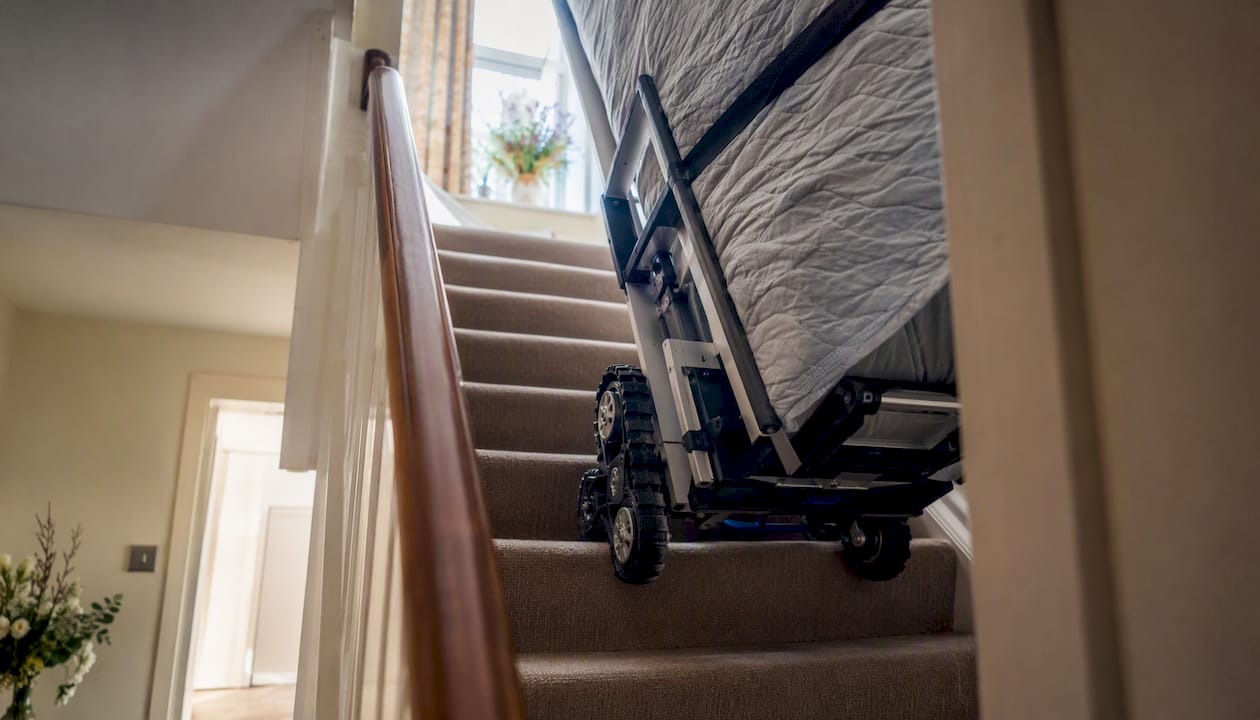
Stair-climbing trolleys are motorised or mechanical trolleys that grip each step and walk heavy items down or up a staircase without manual lifting. They are the go-to solution for narrow internal staircases where a sofa or washing machine would otherwise require four people and a lot of risk.
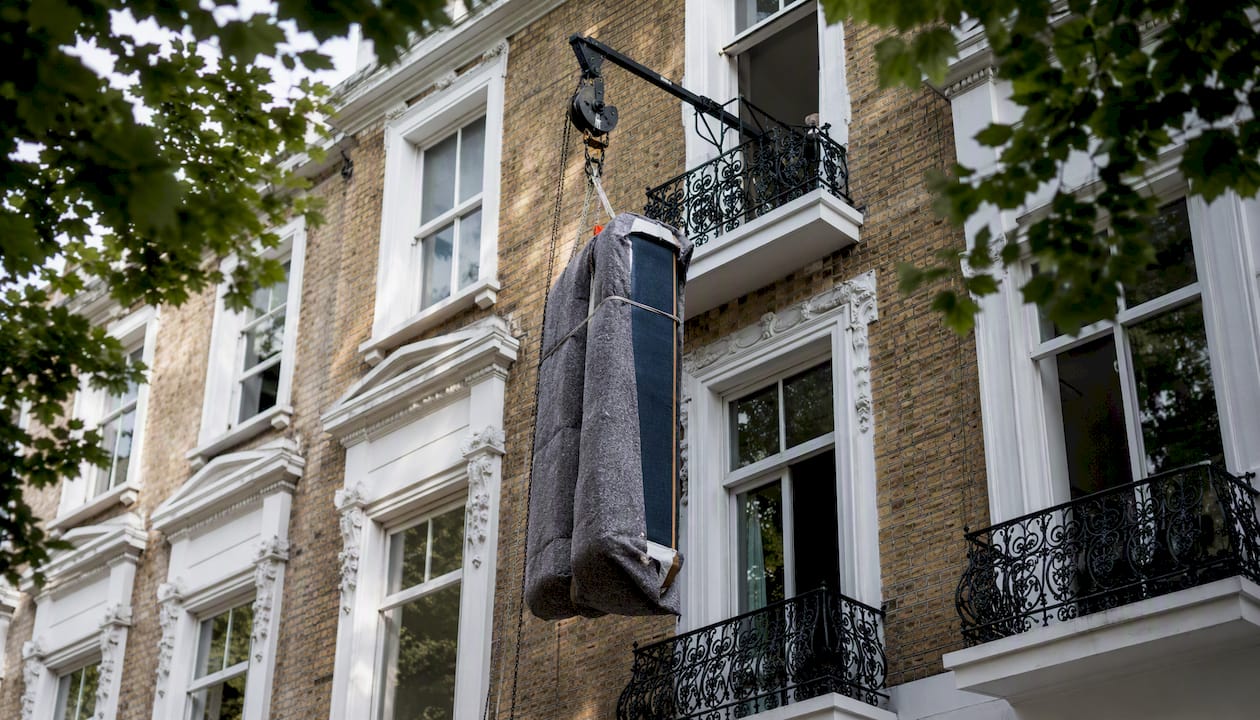
External hoists and balcony cranes lift furniture vertically up the outside of a building, bypassing internal staircases entirely. They require a stable anchor point, adequate balcony or window access, and in some cases a permit from the local council. The best option for a large corner sofa going into a third-floor flat with a tight stairwell.
Furniture disassembly and rebuild reduces the footprint of large items so they can pass through standard doorways and around tight corners. Beds, wardrobes, and flat-pack shelving are the most common candidates. Confirm at the estimate stage whether your removals firm includes reassembly, or whether that is a separate charge.
Pro Tip: Before booking any method, walk the full carry path yourself with a tape measure and a phone camera. Note every pinch point: the gap between a door frame and a radiator, the half-landing where the staircase turns, the low beam in the hallway. Share that footage with your removals firm before they quote.
Step-by-step planning checklist for a restricted-access move part of difficult access moves
A little structure here saves a lot of stress later. Work through this in order.
- At first contact with your removals firm: disclose everything. Describe the street width, parking situation, number of stair flights, any items over 100kg, and the distance from where the vehicle can park to your front door. Send photos and a short video of the access route at the same time. Use a move difficulty score calculator to estimate crew size and likely time before you call.
- At the estimate stage: request either an in-person site visit or a detailed virtual survey. Ask the firm to confirm in writing which accessorials apply and what triggers them. Ask specifically about long-carry policy, stair fees, and whether a shuttle is likely.
- Two to four weeks before move day: apply for a parking suspension permit if needed (your local council handles this; allow at least two weeks). Book the building lift in writing if you are in a block of flats. Confirm crew size and equipment with your removals firm.
- One week before: confirm all permits are approved and share copies with your removals firm. Disassemble large furniture items that will not fit through doorways. Label boxes by destination room to speed up the carry.
- Move day: clear all pathways of rugs, cables, and obstacles. Appoint one person as the on-site point of contact so the crew is not waiting for decisions. Keep children and pets away from carry routes.
Documents to prepare and share before move day:
- Photographs and a short video of the full access route
- Floor plan of both properties showing room layout and doorway positions
- Inventory of any items over 100kg or with unusual dimensions
- Copies of parking suspension permits and lift booking confirmations
Pro Tip: Ring your local council’s parking team at least three weeks before your move date. Parking suspension applications in many London boroughs and city centres take 10–14 working days to process, and a failed application on move day means your crew parks far away and you pay long-carry fees.
Expert tips that save money and prevent damage part of difficult access moves
The single most effective thing you can do is pre-disclose access with photos and a short video. MoveSmart’s 2026 analysis found that undisclosed obstacles are a leading reason for quote increases on move day, and that strategic disclosure reduces the likelihood of surprise charges. Send the footage before you ask for a price, not after.
Practical tips worth acting on:
- Move small boxes and light items to the ground floor yourself the evening before. This cuts stair-fee time and is something any able-bodied household member can do.
- Disassemble beds, wardrobes, and large shelving units before the crew arrives. Every item that passes through a doorway flat rather than upright saves minutes per trip.
- Fit corner guards and door-frame protectors before the crew starts. Damage to plaster and paintwork is most common at the tightest points of the carry path.
- Use furniture sliders on hard floors to move heavy items to the carry path without scratching surfaces or straining the crew before the real work begins.
- Ask your removals firm whether they use stair runners. These protect carpets and give the crew better grip on each step, reducing slip risk on long stair carries.
For moving large items safely, the principle is always the same: reduce the item’s footprint before it meets the obstacle, not during.
Common mistakes that push up your final bill
Most cost surprises on move day trace back to one of a handful of predictable errors. Recognising them in advance is the cheapest form of insurance.
- Not disclosing the parking situation at estimate time. If your street has double yellow lines and no loading bay, your crew will park further away. That distance triggers a long-carry charge measured from the rear of the vehicle to your front door, often billed per 30-metre increment beyond the included distance.
- Under-measuring doorways and stair widths. A sofa that is 10cm too wide for a staircase cannot be forced through. The crew either disassembles it on site (time cost) or uses an external hoist (equipment cost). Neither is cheap when unplanned.
- Assuming the base quote covers everything. Stair fees, shuttle charges, and waiting time are almost always separate line items. Ask at estimate time, and get the answer in writing.
- Forgetting to book the building lift. In a block of flats, an unbooked lift means the crew uses the stairs. That is a stair fee you could have avoided with a phone call.
- Not mentioning heavy or unusual items. A piano, gun safe, or large American-style fridge requires specialist equipment and often an additional crew member. Mentioning it after the quote is agreed rarely ends well.
The most expensive sentence in moving is: “I didn’t think I needed to mention that.” Disclose everything upfront, in writing, with photographs. It costs nothing and protects you from charges you cannot dispute on move day.
What equipment and specialist services actually do
Understanding what you are being quoted for helps you ask the right questions and spot a quote that is missing something important.
| Equipment or service | What it does | When you need it |
|---|---|---|
| Stair-climbing trolley | Motorised trolley that walks items up or down stairs step by step | Narrow internal staircases; heavy appliances; multiple flights |
| External hoist or crane | Lifts furniture vertically up the outside of a building | Large items that cannot navigate internal corners or tight stairwells |
| Shuttle vehicle | Smaller van relays items between property and main lorry | Street too narrow for a full-size lorry; long driveway |
| Freight lift reservation | Secures exclusive use of a building lift for the move | Blocks of flats with shared lifts; prevents delays and stair fees |
| Specialist two- or three-person crew | Additional crew members for heavy or awkward items | Items over 100kg; long carries; multiple flights of stairs |
| Packaging and protection service | Corner guards, door-frame protectors, furniture blankets, stair runners | Any move through tight spaces where surfaces are at risk |
Questions to ask your removals firm about qualifications and safety:
- Are hoist operators trained and insured for external lifts?
- Does the firm carry public liability insurance covering property damage during a hoist operation?
- Can they provide a lift anchorage certificate if a balcony or window anchor is used?
- Are stair-climbing trolley operators trained on the specific model being used?
For detailed guidance on furniture moving techniques, including disassembly and protection methods, check the Van-247delivery resource library.
How quotes change for difficult access and how to avoid surprises
Your base quote covers the crew, the vehicle, and a standard carry distance. Everything triggered by access conditions is on top of that. Relo recommends asking specific questions at estimate time and considering binding or not-to-exceed estimates to cap your exposure.
The main accessorials to ask about:
- Long carry: charged when the vehicle cannot park within the included distance (typically 75–100 feet from your door). Billed per increment beyond that threshold.
- Stair fee: charged per flight, sometimes per item. Ask whether it applies to both properties.
- Shuttle charge: covers the cost of a relay vehicle when the main lorry cannot reach the property.
- Waiting time: billed when the crew cannot start or continue because of access delays (lift not booked, parking not cleared, permits not in place).
- Hoist or crane hire: a separate line item when external lifting is required.
- Building or lift fees: some buildings charge a move-in or move-out fee; confirm with your building manager before the estimate.
How to protect yourself:
Ask for a binding or not-to-exceed estimate rather than a non-binding one. A binding estimate caps your final bill at the quoted figure regardless of actual time. A not-to-exceed estimate sets a ceiling. Either is preferable to an open-ended quote when access is complex.
A short example: a base quote of £800 for a two-bedroom flat move can grow to £1,100–£1,300 once stair fees (two flights at both ends), a shuttle charge (narrow street), and a hoist for one large sofa are added. None of those charges are unreasonable; all of them are avoidable surprises if disclosed and agreed in writing beforehand.
When should you request an on-site or virtual survey?
Request a survey whenever any of the following apply to your move:
- The street is too narrow for a standard removals lorry
- Parking is restricted, permit-only, or more than 75 feet from your door
- The property has more than two flights of stairs
- Any item weighs over 100kg or has dimensions that make internal corners difficult
- The loading bay access is unclear or shared with other residents
- You are moving into or out of a listed building with restrictions on external equipment
What a good survey report should include:
- Measured carry distances at both properties
- Recommended equipment and crew size
- A list of identified accessorials with trigger conditions
- Photographs of pinch points and access routes
- A written cost addendum or binding clause covering the access-specific charges
A virtual survey works well when travel distance makes an in-person visit impractical. To make it effective, walk the surveyor through the full carry path on a video call, show every locked gate and narrow passage, and measure doorways and stair widths on camera so the surveyor can record them directly.
Pro Tip: Use the move difficulty score calculator before your survey call. It gives you a score based on home size, floors, access type, and heavy items. Share that score with your removals firm — it frames the conversation and signals that you have done your homework.
A real-world example: narrow-street flat move, handled end-to-end
A family moving from a third-floor Victorian conversion in a terraced street faced three compounding problems: no parking within 40 metres of the front door, a staircase with two tight half-landings, and a large corner sofa that could not navigate the internal turns.
How it was handled, step by step:
- Initial enquiry: the family sent photographs and a short video of the staircase, street, and sofa dimensions before requesting a quote.
- Virtual survey: the removals firm conducted a 20-minute video call, measured the sofa against the staircase width on screen, and confirmed an external hoist was needed for that item only.
- Permit application: a parking suspension was applied for three weeks in advance, securing a 10-metre loading zone directly outside the property.
- Move day: a man-and-van handled the shuttle from the parking point to the building entrance; the hoist lifted the sofa from the street to the third-floor window; the remaining items went via stair-climbing trolley.
Three lessons you can apply directly:
- Secure your parking suspension permit at least three weeks before move day. A last-minute application is rarely approved in time.
- Include the hoist as a named line item in your written estimate, with a fixed charge. Do not leave it as a “we’ll see on the day” item.
- Reserve the building lift in writing, with a confirmation email from the building manager. A verbal agreement is not enough when move day arrives.
The difference between a stressful move and a smooth one is almost always paperwork: the permit, the written estimate, the lift booking. None of it takes more than an hour to arrange, and each one removes a category of risk entirely.
Why specialist expertise matters more than you might expect part of difficult access moves
Most people underestimate how quickly a standard move becomes a specialist one. A single flight of stairs, a street that is 10cm too narrow for a standard lorry, or one item that cannot turn a corner — any of these tips a move into territory where general-purpose movers are out of their depth.
The conventional wisdom is to get three quotes and choose the middle one. For a straightforward move, that is reasonable. For a difficult-access move, it is the wrong frame entirely. What you need is not the middle price; it is the firm that has done a proper survey, identified every accessorial in advance, and put it all in writing. A higher quote that covers everything is almost always cheaper than a lower quote that does not.
Red flags to watch for: a firm that quotes without asking about parking or stair count; a quote with no mention of accessorials; a salesperson who assures you “it’ll be fine” without having seen the access route. Any of these signals a firm that will discover the problems on move day, at your expense.
The assessment criteria that matter: survey quality (did they ask the right questions?), written disclosure of all accessorials, public liability insurance that covers hoist operations, and references from moves with similar access challenges. Those four things tell you more than the price does.
Van-247delivery handles difficult access moves across the UK
When your move involves restricted streets, multiple staircases, or oversized items, you need a removals partner that plans before it moves. Van-247delivery offers house removals and man-with-a-van services designed specifically for the kind of access challenges this guide covers: narrow streets, long carries, stair-heavy flats, and specialist item transport including pianos and large furniture.
Every booking includes the option of a virtual or in-person survey, permit assistance, and specialist equipment coordination. Insurance is included, and the team can advise on whether a hoist, shuttle, or stair-climbing trolley is the right fit for your specific access situation. You get a written quote that names every applicable charge before you commit, so there are no surprises on move day.
Get an instant quote for your move today, or contact the team to book a survey of your access route.
Sources
The following sources informed this guide and are worth consulting directly for specific rules, calculators, and cost breakdowns.
- 2026 accessorial charges: the 25 services that add $500 to $2,500 to your moving bill — MoveCost
- Movers
- The ‘Stair Tax’ and other hidden moving fees: an AI route analysis | MoveSmart Blog
FAQ
What counts as a difficult-access move?
A move is classed as difficult access when the vehicle cannot park within the standard included distance (typically 75–100 feet) of the entrance, or when the property has multiple stair flights, tight landings, oversized items, or restricted parking.
How much extra do difficult access moves cost?
Accessorial charges for stairs, long carries, shuttles, and hoists commonly add several hundred to a few thousand dollars to a base quote; the UK equivalent varies by job, but budgeting an additional 20–40% above the base estimate is a sensible starting point when access is restricted.
How do I avoid surprise charges on a restricted-access move?
Disclose all access details upfront with photographs and measurements, request a written survey report, and ask for a binding or not-to-exceed estimate that names every applicable accessorial charge before you agree to the job.
When do I need an external hoist rather than a stair-climbing trolley?
An external hoist is needed when a large item (typically a corner sofa, piano, or oversized wardrobe) cannot navigate the internal staircase corners, even with a stair-climbing trolley. If the item fits on the trolley and the staircase is wide enough, the trolley is usually faster and cheaper.
Can Van-247delivery handle moves with restricted street access?
Yes. Van-247delivery offers man-with-a-van and house removals services suited to narrow streets, long carries, and stair-heavy properties, with virtual surveys, specialist equipment, and written accessorial disclosure included.