Eco friendly packing materials: the greenest way to pack is to use less, reuse what you already own and choose materials that your local council or supermarket will actually take back. Boxes, paper, blankets and reusable crates do most of the work in a house move. Special “eco” products only help if you can recycle or reuse them where you live. This guide shows what to pack with, how to protect fragile items without piling on plastic, and what to do with it all once you have unpacked. If you would rather hand the packing over, our team can pack for you as part of a house removal.
TL;DR
- Start with what you own: reuse sturdy boxes, pack soft items in drawers and wrap breakables in towels, blankets and clothes.
- Paper tape, scrunched paper and paper-based wrap can be recycled with cardboard, while soft plastic usually needs a supermarket collection point.
- “Compostable” only helps if the packaging is certified and there is a collection that composts it. Check before you buy.
- Recycling rules differ from council to council, so look up your own postcode before moving day.
- Large, fragile or valuable items, such as pianos, pallets and office kit, need protection first and green credentials second.
Table of Contents
- What eco-friendly packing materials really means
- The materials that work for a house move
- Alternatives to bubble wrap for fragile items
- Furniture, pianos, pallets and offices
- A simple low-waste packing plan
- Let us do the packing
- Recycling and disposal in the UK after your move
- FAQ
- Sources
What eco-friendly packing materials really means
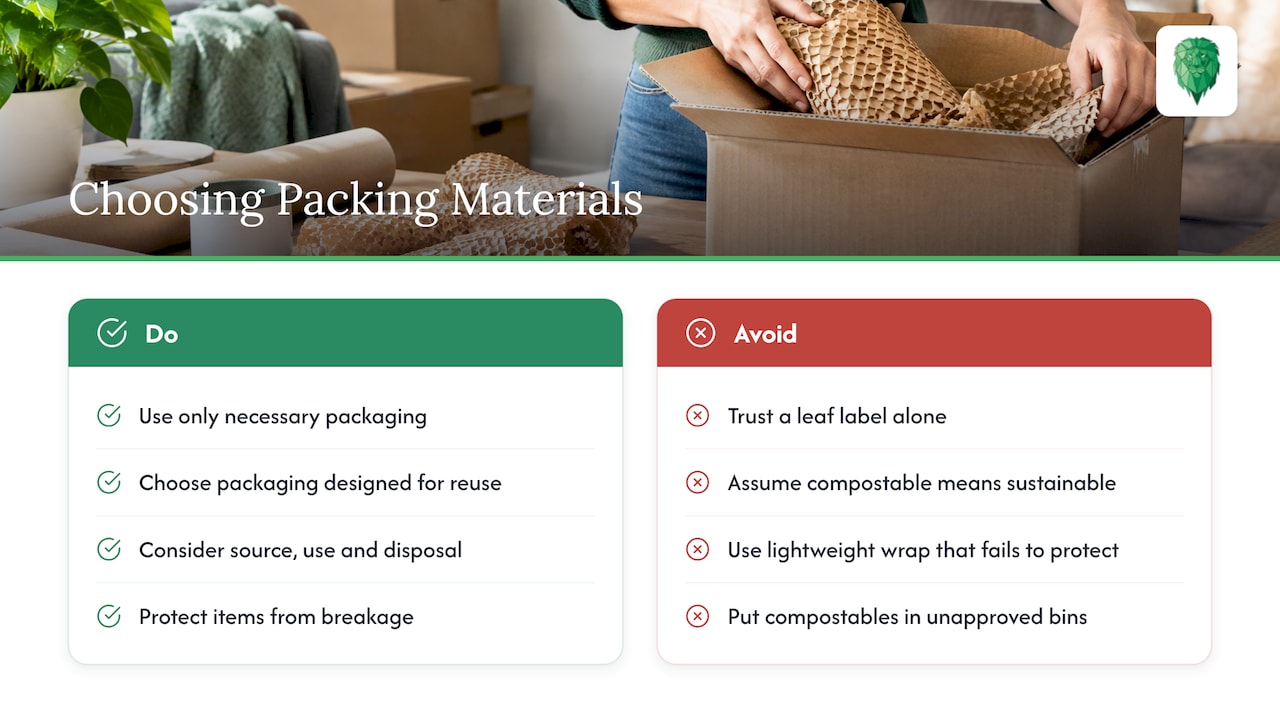
It is easy to be put off by the label. A box printed with a leaf is not automatically better than a plain one. A few ideas from UK guidance help you judge any material in a minute.
Use no more than you need. The government’s packaging guidance says packaging should be the minimum weight and volume needed for safety and hygiene, and that reusable packaging must be designed to be used several times. That is a good rule for your own move too: the lightest wrap that still protects the item is the greener choice, and a crate you use ten times beats ten boxes you use once.
Check what it is made of.
The same guidance sets a limit of 100 parts per million for the combined amount of cadmium, mercury, lead and hexavalent chromium in packaging. Reputable UK suppliers work within that, so it is mostly a reason to buy standard packing supplies from a proper supplier rather than a mystery import.
Be careful with “compostable”.
WRAP, the UK sustainability charity, says compostable packaging is not automatically more sustainable just because it is bio-based or compostable. You need to think about where the material comes from, how it is used and how it will be disposed of. Its guidance also says industrially compostable packaging needs independent certification to a recognised standard, and has to be collected and sent to a suitable organic-waste site. A compostable bag in a household bin that goes to landfill or incineration does not do what the label suggests.
Protection comes first.
A broken vase is wasted material, wasted money and a wasted morning. The Food and Drink Federation’s packaging checklist makes the same point for industry: good eco-design balances using less material with protection, strength, stacking and end-of-life recovery. For a move, that means a lightweight option only counts if the item arrives in one piece.
A simple test for any material: can I reuse it, can I recycle it where I live, and does it protect what is inside? If the answer to all three is yes, you have a good choice.
The materials that work for a house move, part of eco friendly packing materials
Here is a practical shopping and sourcing list. You will not need all of it.
| Material | Best for | Reuse or recycle |
|---|---|---|
| Sturdy second-hand cardboard boxes | Books, kitchenware, general items | Reuse again, then recycle with cardboard |
| Reusable plastic crates | Heavy items, repeat moves, storage | Reuse many times |
| Paper packing tape | Sealing boxes | Can go in with cardboard recycling |
| Plain scrunched paper | Void fill and wrapping plates and glasses | Recycle with paper |
| Towels, blankets, bedding, clothes | Wrapping fragile items and furniture | Already yours, nothing to dispose of |
| Honeycomb or kraft paper wrap | Cushioning breakables | Recycle with paper and cardboard |
| Existing drawers and suitcases | Clothes and soft items | Already yours |
Boxes and crates
Boxes are the backbone of any move. Reusing boxes from a shop, a friend or your last move is the cheapest and lowest-impact option, as long as they are strong. Check for soft corners, damp and torn bases. A box that collapses under a stack of books is not a saving. Keep heavier items in smaller boxes so they are easier to lift and the base is not overloaded.
If you move often, or you are heading into storage, durable reusable crates are worth considering because they can be used again and again. They stack neatly and do not need tape.
Tape and fillers
Switching from plastic tape to paper tape is one of the easiest changes you can make. Paper tape can be recycled together with the cardboard it seals, so you do not need to peel it off every box before it goes in the recycling. Use enough strips along the base seam, because a box bottom is where most failures happen.
For void fill, plain scrunched paper does a good job. Newspaper works, though the ink can smudge on pale items, so a layer of plain paper next to anything light-coloured is a good idea.
What you already own
Before you buy anything, look around the house:
- Clothes and soft items can stay in chest-of-drawer drawers if the furniture is moved with them in place and the drawers are light enough to carry safely.
- Towels, tea towels, throws and duvet covers wrap glasses, ornaments and picture frames well.
- Suitcases and holdalls take clothes, shoes and bedding.
- Cushions and pillows fill gaps in boxes.
This is the lowest-waste way to pack, and it also reduces the number of boxes you need to buy, carry and load.
Alternatives to bubble wrap for fragile items, part of eco friendly packing materials
Bubble wrap does a very good job, and our guide to bubble wrap rolls explains how to use it well. If you want a lighter-touch option for some of your belongings, there are plenty of choices that work just as well for everyday breakables.
Paper and towels for crockery. Wrap each plate or bowl separately in paper, stack plates on their edges rather than flat, and use a towel layer at the bottom and top of the box. Glasses go in upright with scrunched paper stuffed inside and around them.
Soft furnishings for ornaments and frames. A duvet cover or throw wraps a mirror, a framed picture or a lamp base neatly. Tuck the edges in so nothing slips loose, and tape the bundle with paper tape if you need to hold it together.
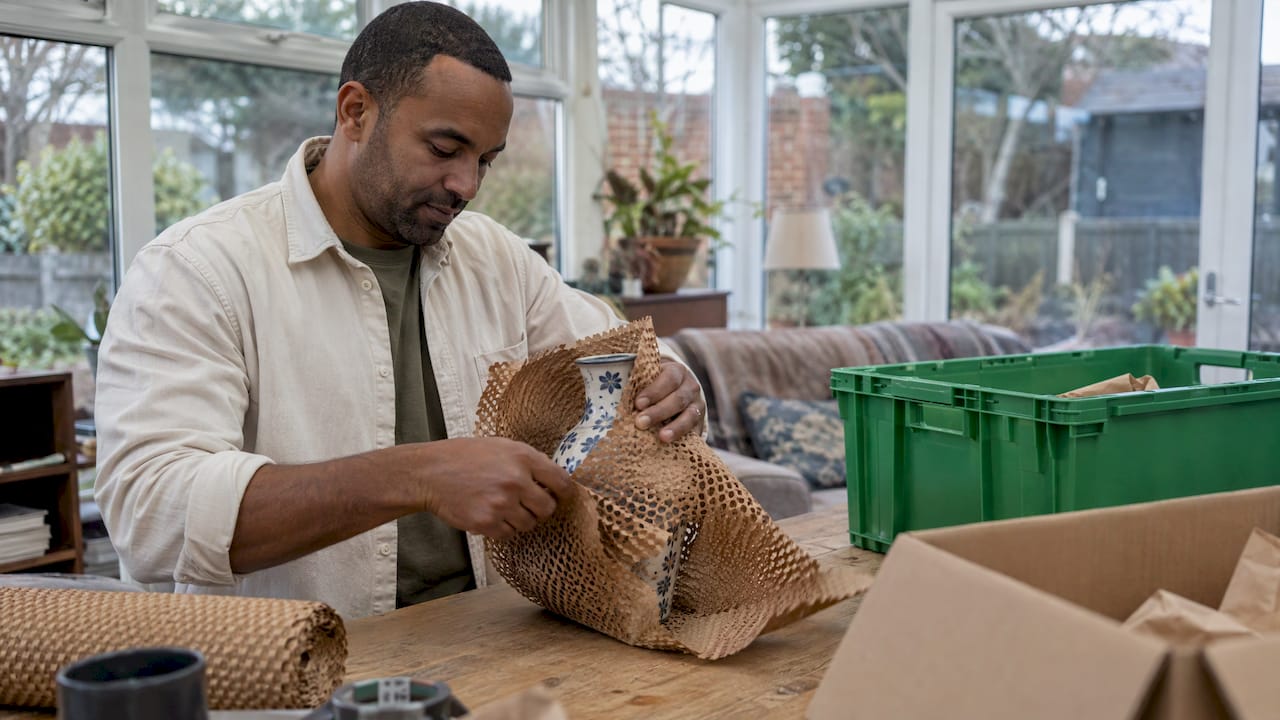
Honeycomb paper wrap. This is a paper-based cushioning that opens out into a protective layer, and it is made to be recycled with paper and cardboard. It suits a set of glasses, a vase or anything that you would normally wrap in plastic.
Plain popcorn as void fill. Unflavoured popcorn does a surprisingly good job of filling gaps in a box, though keep it dry and away from pets and damp.
Rolling tips for the box itself.
- Put a layer of crumpled paper or a folded towel at the bottom.
- Place the heaviest items at the base, lighter ones above.
- Fill every gap so nothing can shift. Shake the box gently: if you hear movement, add more filler.
- Label the box “fragile” and mark which side is up.
For very valuable or delicate pieces, such as antiques, artwork or glass-topped furniture, protection is the priority. Our guide to packing material for stress-free moves covers what each type of item needs.
Furniture, pianos, pallets and offices, part of eco friendly packing materials
Eco friendly packing looks different once the load gets larger.
Furniture and large items
Sofas, wardrobes and tables do not go in boxes. Moving blankets and covers protect surfaces, and corner protectors made of cardboard guard the edges. Taking furniture apart where possible also means less wrapping and a more compact load. If you are not sure how to take something to pieces, or put it back together, assembly and disassembly is something we offer alongside the move. Our guide on large item courier packaging explains how big items should be wrapped and protected. If you are sending a single bulky piece, our furniture and large items service is built for exactly that.
Pianos
A piano is heavy, valuable and sensitive to knocks. It needs thick padding, secure covers and the right equipment, so this is not a job for improvised wrapping. Reusable padded covers are the standard approach, which is also the low-waste one, since they are used move after move. If you have a piano to move, our piano removal service is the next step.
Pallets and freight
For pallet deliveries, the greenest choices are usually the practical ones: boxes sized correctly so there is no empty space, stretch wrap used only as much as needed to keep the load stable, and a pallet that can be reused. Lighter packaging also helps. The British Business Bank notes that cutting packaging weight can reduce raw-material use and fit more packages into each delivery round. Our article on shipping with pallets or multiple packages helps you decide the best format, and our pallet delivery page shows how we handle it.
Office relocations
Offices create a lot of packaging: filing boxes, monitors, cables and furniture. The same logic applies. Reusable crates for files and equipment save hundreds of cardboard boxes, and labelling by department makes unpacking quick. The bank also suggests measuring how much of your packaging is recycled, recyclable, compostable or reusable, which is a useful habit for a business that wants to report on its move. Our office relocation service also covers server relocation and the reinstallation of WI-FI and video conference systems, so the kit that matters most is handled by people who do this regularly.
A simple low-waste packing plan, part of eco friendly packing materials
A move feels like a marathon, not a sprint, so spread the work out.
- Four weeks before: declutter. Everything you do not take is something you do not have to wrap, box or lift. Sell, donate or recycle what you no longer need.
- Three weeks before: gather materials. Collect used boxes, set aside towels and blankets and buy paper tape and paper for wrapping. Count what you have against the rooms you need to pack.
- Two weeks before: pack the rarely used. Books, out-of-season clothes, spare linen and decorative items go first.
- One week before: pack the fragile. Wrap with paper and soft furnishings, fill gaps and label clearly.
- The last two days: essentials. Pack a box of kettle, mugs, chargers, toiletries and a change of clothes, and keep it with you.
- After you arrive: unpack, flatten and sort. Flatten boxes you will reuse, keep crates, and sort paper, cardboard and soft plastic for the right bins.
A few common mistakes to avoid:
- Overfilling a box so that it bulges and the tape pulls apart.
- Using too little filler, so items rattle.
- Buying a large amount of specialist packaging before you know how many boxes you need.
- Assuming a “biodegradable” label means you can bin it anywhere.
Let us do the packing with our eco friendly packing materials
If you want a calm move without sourcing and wrapping everything yourself, our team can pack your belongings for you. Packing is one of the services we offer alongside house removals, with unpacking, storage, furniture assembly and disassembly, and cleaning after your move also available. With over 15 years of experience handling large, fragile and valuable items, and insured transport, we aim to take the stress out of moving day. Tell us when you request an instant quote that you would like to keep packaging waste low, and we will talk it through with you. You can start on our main site.
If you would like to compare packing options first, our packaging near me guide shows what is available.
Recycling and disposal in the UK after your move, part of eco friendly packing materials
The most important thing to know is that recycling rules are set locally. Two neighbouring councils can give you different answers, so check yours before you start unpacking.
Cardboard and paper, part of eco friendly packing materials
These are accepted by nearly every household collection in the UK. Flatten boxes, remove any plastic tape or labels if your council asks you to, and keep them dry. Paper tape can stay on.
Soft plastic and bubble wrap, part of eco friendly packing materials
These are usually not collected from the kerbside. Richmond upon Thames Council says bubble wrap is among the soft plastics accepted at larger participating supermarkets, and warns that store acceptance varies. South Ribble Council says plastic film and bubble wrap should not go in the blue bin and suggests checking local grocery stores. In short, collect it in a bag and take it to a collection point, or reuse it for your next move.
Polystyrene and plastic film, part of eco friendly packing materials
Westminster City Council lists both among the items not accepted in its ordinary recycling collection. In Scotland, Stirling Council’s directory says polystyrene packaging goes in residual waste in its area, while plastic film can go in general waste or back to a participating supermarket. If you want to avoid this headache entirely, paper-based fillers are the simpler route. Our piece on styrofoam packing peanuts explains how they are used if you receive them in a delivery, and the best way to deal with them is to reuse them.
Compostable packaging, part of eco friendly packing materials
Only put it in a food or garden waste bin if your council says it accepts it. Otherwise it may not be processed as intended, which is why WRAP stresses collection and treatment infrastructure alongside certification.
Reuse before you recycle, part of eco friendly packing materials
Keep good boxes for storage, offer spare boxes on local community groups, and hold on to blankets, crates and paper for the next time you need them. Reuse is almost always better than recycling because the material does not have to be processed again.
Our view on greener packing
After more than 15 years of moving homes, offices, furniture and pianos, we have learned that the greenest move is a well-planned one. When items are packed properly the first time, nothing is broken, nothing has to be replaced and nothing is wasted.
That is why we think of packing as part of the whole job rather than an add-on. Sturdy boxes used with care, protective blankets that go from job to job and sensible loading all cut down on waste. Our packing, unpacking, storage and furniture assembly and disassembly services mean you can leave the wrapping to us and still keep your move low-impact.
For fragile and valuable things, such as a piano, a mirror or the server in your office, we always put protection first and insured transport behind it. Tell us what matters to you when you ask for a quote and we will plan around it.
Claudiu
FAQ
Is paper tape as strong as plastic tape?
For standard house-move boxes, a good self-adhesive paper tape holds well if you apply several strips along the base seam and the top. Press it down firmly and keep the box dry. Paper tape can be recycled with cardboard, so it simplifies disposal.
Can I recycle bubble wrap at home in the UK?
Usually not in your kerbside bin. Councils such as Richmond upon Thames and South Ribble point residents towards supermarket soft plastic collection points, but acceptance varies by store and area. Check your own council’s website before you go, and reuse the wrap where you can.
Is compostable packaging always the greener choice?
No. WRAP says compostable packaging is not automatically more sustainable, and that it needs recognised certification and a collection that sends it to a suitable composting site. If your council does not collect it, a reusable or recyclable paper option is often simpler.
What can I use instead of bubble wrap?
Scrunched plain paper, towels, blankets, throws, duvet covers and clothing protect most breakables, and honeycomb paper wrap is a recyclable paper-based cushioning option. Wrap items individually, fill every gap in the box and check that nothing moves when you shake it gently.
Can you pack and move fragile or valuable items for me?
Yes. We offer packing, unpacking, storage, furniture assembly and disassembly alongside house removals, furniture and large item transport and piano removal, and our transport is insured. Request an instant quote on our site and tell us what you are moving.
Sources
- Packaging waste: environmental responsibilities, GOV.UK
- Considerations for compostable plastic packaging, WRAP
- Packaging for people, planet and profit, Food and Drink Federation
- Sustainable packaging for small businesses, British Business Bank
- Where to recycle your items, London Borough of Richmond upon Thames
- Blue bin, South Ribble Council
- P-R recycling list, Westminster City Council
- Waste and Recycling Directory, Stirling Council