Moving gym equipment is not like moving a wardrobe. A treadmill is heavy, a power rack is long, a multi-gym is a puzzle of cables and pins, and almost all of it has to go through doors that were never designed for it. The good news: with a bit of measuring, a clear order of work and the right number of hands, it is very doable. For a home gym, a studio or a small office fitness room, the safest route is to have a removals team handle disassembly, loading and delivery for you. We do exactly that, as part of our furniture and large items service.
This guide walks you through the whole job so you know what to expect, whether a team does the heavy work or you prepare the ground first.
TL;DR
- Measure doors, stairs, lifts and corners before anything else. Most gym moves go wrong at a doorframe, not on the road.
- Take machines apart as far as the manufacturer allows, keep every bolt labelled, and protect floors along the whole route.
- There is no fixed legal weight limit for lifting in the UK. Risk is judged by the load, the task and the people, so use a team and a trolley, not heroics.
- Tell your removals team about every heavy or awkward item before moving day so the right crew and van turn up.
- After the move, level, calibrate and test each machine before the first workout.
Table of Contents
- Start with the route, not the equipment
- Make a simple inventory
- Dismantle with a plan
- Lift safely: teams, trolleys and technique
- Choose the right vehicle and crew
- Protect the equipment in transit
- Unload, reassemble and test
- Which kind of move are you planning?
- A simple timeline
- Our point of view
- Book your move with us
- FAQ
- Sources
Start with the route, not the equipment
Before you touch a single bolt, walk the route from the gym space to the van and from the van to the new room. Write down the width of every door, the turns in the hallway, the number of stairs and the size of any lift. It is surprisingly common to find out too late that a treadmill or bench is wider than the doorframe, so measure first and dismantle second.
For each item, note three figures: length, width and height as it will travel, and its weight from the manual or the label. Then compare them with your measurements.
A checklist used for moving heavy equipment in the commercial world is a handy model for this. Engineering firm IES’s equipment move checklist covers vehicle access and ground conditions, floor loading capacity, access through doors, ramps, lifts and stairs, floor protection along the move route, and a working area of 2 m around the largest footprint. You do not need an industrial survey for a home gym, but the same questions apply:
- Can the van park close to the door, and is the ground firm enough for a trolley or ramp?
- Is there a lift, and is it big enough for the longest piece?
- Can the new floor take the weight? This matters most for upper floors and for a rack loaded with plates.
- Is there enough clear space at the destination, including room around each machine?
If a door is the problem, taking it off its hinges often buys you the extra centimetres. If it is still too tight, an alternative route through a garage or garden may work.
Make a simple inventory
List every item in a table or notebook. It takes ten minutes and saves hours.
| Item | Approx. weight | Dismantle? | Notes |
|---|---|---|---|
| Treadmill | Check the manual | Fold or remove console | Electrical, keep upright if possible |
| Power rack | Check the manual | Yes, into uprights and beams | Label every bolt |
| Weight plates and dumbbells | Per item | No | Pack in small, strong boxes |
| Multi-gym | Check the manual | Yes | Photograph cable routing |
| Exercise bike | Check the manual | Pedals and seat off | Protect the display |
Weights vary a lot between models, so use your own manual rather than a guess. Plates are the classic trap: a box that looks small can be far too heavy to carry safely. Pack them light and many, not heavy and few.
Dismantle with a plan
Take photos of each machine from several angles before you start, especially around cables, pulleys and any wiring. Then work in a logical order and bag the fixings for each machine separately. Label the bags and tape them to the frame part they came from, or keep them in one labelled box that travels with you.
A few reliable habits:
- Switch off and unplug anything electrical, and let it cool if it has been used.
- Remove loose parts first: handles, seats, pedals, cushions, consoles, water bottle holders.
- Fold or lock moving parts as the manual describes, so belts, arms and carriages cannot swing.
- Unload weight stacks and plates before moving the frame.
- Keep manuals and tools in one clearly marked box.
Manufacturers know their machines best. A UK treadmill maker’s assembly and operating instructions say assembly must be carried out by at least two adults, that the machine should be built on a mat or packaging board to protect the floor, and that for long transport distances it should be disassembled and safely packed. It also suggests laying the route with cardboard on sensitive floors such as parquet or laminate. The same logic works in reverse for a move.
If the thought of a full dismantle makes you nervous, you are not alone. Our teams also offer furniture assembly and disassembly as part of a booking, which takes that job off your list. For treadmills specifically, our treadmill moving guide goes into more detail.
Lift safely: teams, trolleys and technique
Gym equipment is dense. That makes it tempting to “just get it done”, which is how backs and fingers get hurt. In Great Britain the main rule set is the Manual Handling Operations Regulations 1992. The HSE’s guidance on those Regulations sets no specific weight limit. It asks you to assess the load, the person, the task, the environment and the equipment instead.
Three takeaways from that guidance are useful for any gym move:
- Team lifting is not simple addition. As a rough guide, two people can handle about two-thirds of what they could manage separately added together, and three people about half. Teams of more than four are unlikely to work well.
- One person leads. Someone plans the lift and calls it, and the strongest people take the heavier end of an uneven load.
- Use mechanical help where you can. A trolley, a ramp or a hoist reduces the risk of injury.
Practical rules for moving day:
- Clear the route completely: shoes, rugs, pets, children.
- Lay floor protection in hallways and around doorframes.
- Wear gloves and sturdy shoes.
- Keep loads close to your body and bend your knees, not your back. Our guide on how to lift heavy objects shows the technique step by step.
- Stop and re-plan if something feels too heavy. A rethink costs minutes, an injury costs weeks.
Choose the right vehicle and crew
The vehicle needs to carry the weight, not just fit the volume. Overloading a van is dangerous, and long rack uprights or a boxed treadmill need a proper cargo space with tie-down points. A handful of weight plates can push a small van towards its payload limit faster than you would think.
For a few items, a man and van service is often enough. For a whole home gym, a bigger van and a two-person crew are a better fit. For a studio or a fitness room in an office, this becomes an office relocation job. For a gym that is part of a house move, it sits well inside our house removals service, alongside packing and unpacking.
Whichever you choose, tell the crew in advance about:
- every heavy or awkward item, with approximate weights;
- stairs, lifts, narrow doors, steep drives or long carries at either end;
- any item that is already dismantled and any that is not;
- parking restrictions at both addresses.
That last point matters because surprises on the day lead to delays, and delays lead to waiting time. Our waiting time fee is £24 per hour per man, so a clear briefing and a clear route protect your budget as well as your time.
Protect the equipment in transit
A good load is quiet. Nothing rattles, shifts or leans.
- Wrap frames and uprights in blankets or foam so paint and floors stay intact.
- Keep consoles and screens padded and upright, ideally in their original boxes if you still have them.
- Secure everything with straps. Heavy items go low and toward the front of the van, lighter ones on top.
- Never stack plates loosely. Boxed, strapped and low is the rule.
- Keep treadmill belts and decks clear of anything that can press into them.
If you are not sure how to wrap an awkward shape, that is one of the things our packing service is there for. We also provide insured transport, so valuable equipment is covered on the road.
Unload, reassemble and test
Once at the new place, resist the urge to rush. Start by laying floor protection on the route and in the room. Then bring items in largest first, so you do not box yourself in.
Plan the layout before you build. A sensible target is clear space around each machine: the treadmill manual mentioned earlier calls for a flat, solid surface and at least 2 m of safety area behind the machine. Check manuals for the clearance each machine needs.
Then reassemble in the reverse order of dismantling, using your photos and labelled bags:
- Put the heavy frame pieces in place and tighten bolts loosely first.
- Check everything is square and level, then tighten fully.
- Reattach cables, pulleys, seats and consoles.
- Reload weight stacks.
- Run a no-load test before anyone trains on it.
Treadmills often need a quick calibration after a move. As an example, one UK treadmill user manual describes an incline calibration: the display shows CAL, the incline moves to maximum and back to minimum, and once the belt stops the incline system is calibrated. Your own model may differ, so follow its manual.
Which kind of move are you planning?
| Situation | What usually works best |
|---|---|
| A few items going with a house move | Add them to your house removals booking |
| One or two bulky machines, short distance | Man and van with a trolley and two people |
| A full home gym with a rack and plates | A larger van and a crew, with disassembly included |
| A fitness room in an office | Office relocation |
| Gym kit going on a pallet to a unit or another site | Pallet delivery |
A simple timeline
Two weeks before: measure routes, list equipment, find manuals, book your move and mention every heavy item.
One week before: photograph machines, collect boxes and padding, check parking at both ends.
The day before: unplug and cool machines, remove loose parts, clear the routes.
Moving day: floor protection down, heavy items first, straps on, tools and fixings in a labelled box.
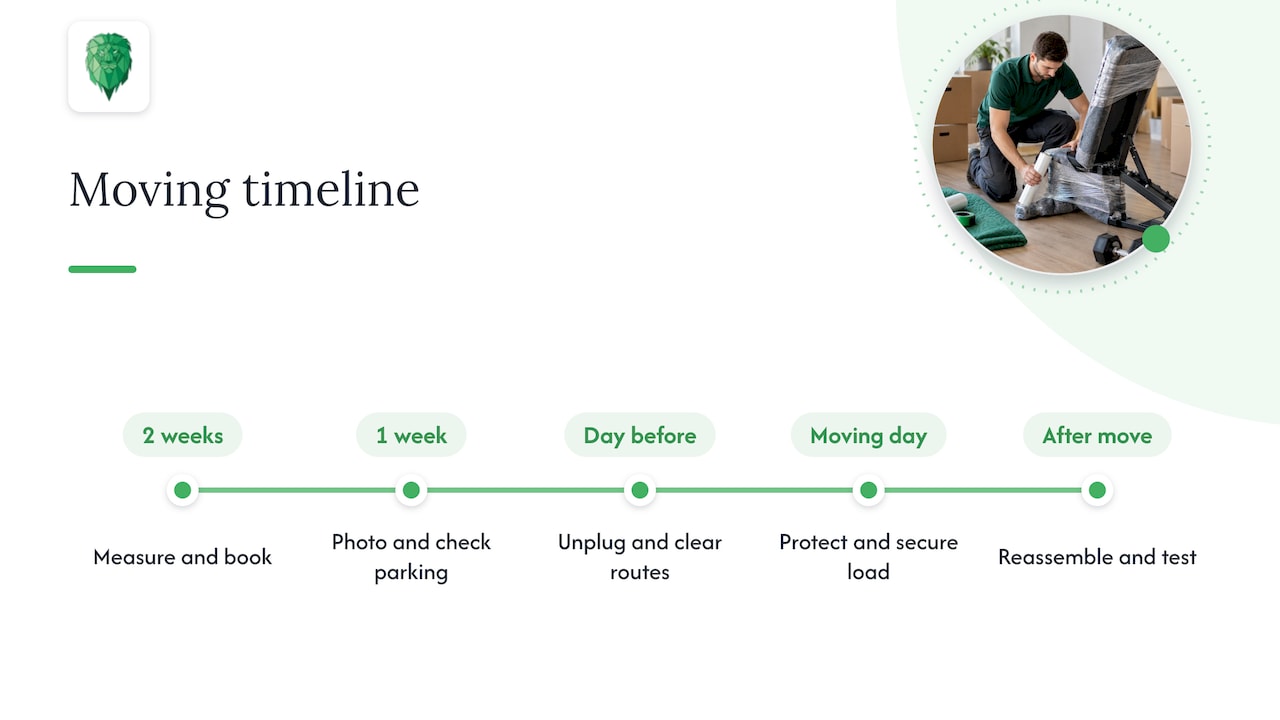
After the move: reassemble, level, calibrate, test, then enjoy your first session.
Our point of view
Gym equipment looks simple until it sits in a narrow hallway. In our experience of more than 15 years in moving, the jobs that go smoothly are the ones planned on paper first: a measured route, a list of items and a crew told what to expect.
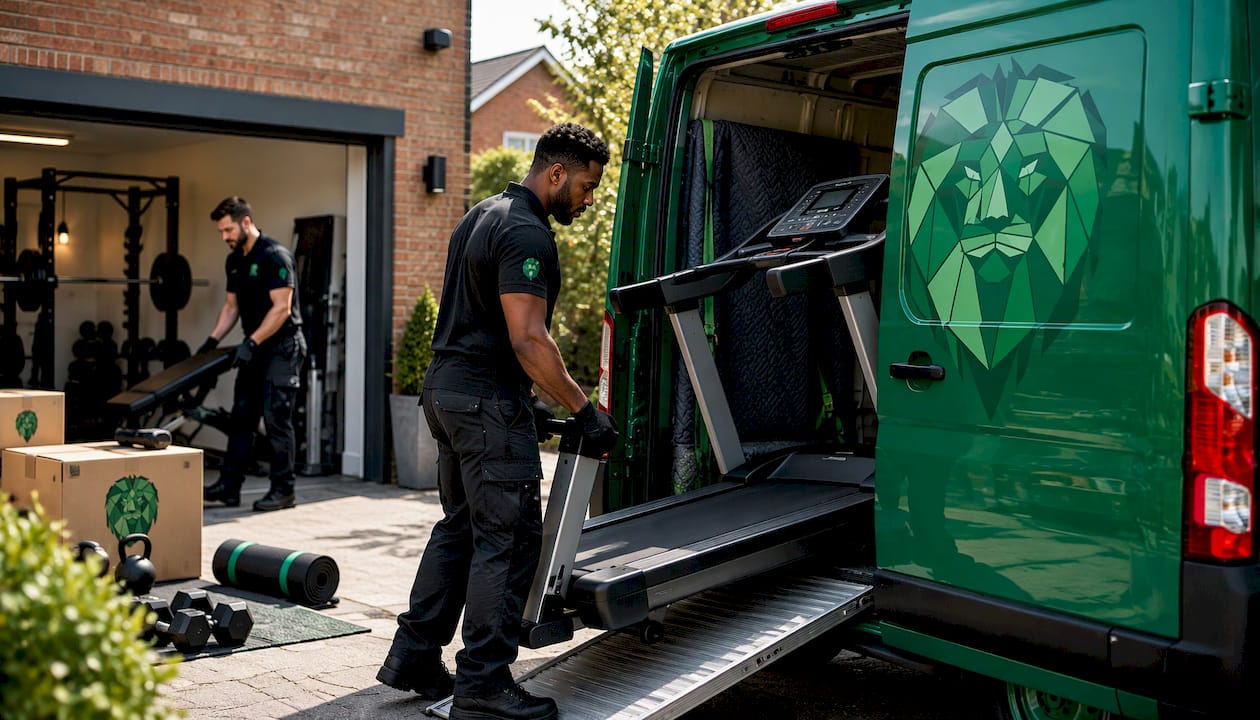
That is why we treat large and heavy items as a specialist part of removals rather than an afterthought. Our teams can take machines apart, pack them, move them in insured transport and put them back together, so you do not have to carry a rack up the stairs on your own.
Moving is stressful enough. Handing over the heavy part, and keeping the planning part for yourself, is a calm way to do it.
Claudiu
Book your move with us
We move house contents, large items and office equipment across the UK, with packing, storage, furniture assembly and disassembly available alongside. You can get an instant online quote and book a date that suits you. Tell us about the heavy pieces when you book, and we will plan the crew around them.
Ready to plan it? Start at our furniture and large items page or go to van-247delivery.com.
FAQ
Do I need to dismantle gym equipment before moving it?
Usually, yes, at least in part. Folding or removing consoles, seats, pedals and handles makes machines lighter, narrower and safer to carry. Follow each manufacturer’s manual, and keep every bolt labelled for reassembly.
Is there a legal weight limit for lifting gym equipment?
Not a fixed one. The HSE’s guidance on the Manual Handling Operations Regulations 1992 says risk is judged by the load, the person, the task and the environment. In practice, that means using a team, a trolley and a clear route.
What should I tell a removals company about my gym equipment?
Give them a list of items with approximate weights, which pieces are already taken apart, and details of stairs, lifts and narrow doors at both addresses. It helps them send the right crew and van, and avoids delays on the day.
Can gym equipment go in a normal house move?
Yes. It can be part of a house removal, as long as it is on the list when you book. A treadmill or multi-gym needs more time and people than a sofa, so mention it early.
Sources
- IES Equipment Move checklist
- Treadmill assembly and operating instructions
- HSE guidance on the Manual Handling Operations Regulations 1992
- Treadmill user’s manual with incline calibration