How movers pack tvs: professional movers protect a TV in one consistent sequence: a soft contact layer straight onto the screen, foam corners at every edge, a wrap of bubble wrap or moving blankets, then a snug fit inside a double-walled TV box, always carried and transported upright. That order matters more than any single material. For a large screen, an OLED panel, or anything you’d genuinely mourn losing, booking professional packing or insured white-glove transport takes the guesswork out of moving day entirely.
TL;DR:
- Proper packing materials, including custom double-walled boxes and foam corners, are essential to prevent movement and damage during transit.
- The correct packing sequence involves cooling the TV, removing the stand, applying a contact layer, and securing it with multiple cushioning layers before boxing.
- Large or OLED screens above 65 inches require extra protective measures like additional foam, multiple blankets, or custom crating due to their sensitivity to flex and vibration.
- Transporting the TV upright and securing it with straps, away from heavy objects, significantly reduces the risk of damage during loading and unloading.
- Booking professional packing and insured transport is highly recommended for high-value, oversized, or awkwardly accessible TVs, especially for long-distance moves.
Table of Contents
- What materials do professional movers use to pack a TV?
- What’s the step-by-step process for packing a TV?
- How do you pack a 65 inch TV or an OLED screen for moving?
- How do you load and transport a TV safely in a van?
- How can you protect a TV without the original box?
- When should you book professional TV packing?
- What I’ve learnt from years of watching removals go wrong
- Let Van-247delivery pack and move your TV properly
- Sources
- FAQ
What materials do professional movers use to pack a TV, part of how movers pack tvs?
Movers reach for kit that’s built specifically for flat screens, not generic packing supplies pressed into service. The centrepiece is a TV-specific double-walled box, often an adjustable kit with inner and outer sleeves that telescope to fit different screen sizes. Fit matters here: too loose and the TV shifts in transit, too tight and you can’t get the corner protectors seated properly.
A typical mover’s kit includes:
- Foam corner protectors, sized to the screen’s edges
- Anti-static contact-layer sheeting or plain packing paper
- Bubble wrap, ideally with the air pockets facing outward
- Thick moving blankets for an extra shock-absorbing layer
- Stretch wrap to lock everything in place without adhesive touching the TV
- Packing tape and ratchet straps for the outer box and van bracing
Pro Tip: Buy a TV kit sized to your screen’s diagonal measurement rather than a generic “large” box. A correctly fitted inner and outer sleeve with foam corners stops almost all movement, which matters far more on modern LED and OLED panels than it did on older, sturdier screens.
UK buyers can source these kits from removal suppliers and specialist retailers, with complete TV moving sets available from UK stockists sized by screen diagonal. Expect to pay somewhere in the region of £15 to £40 for a decent kit, depending on screen size and whether it includes both foam corners and an adjustable box.
What’s the step-by-step process for packing a TV, part of how movers pack tvs?
Getting the order right is what separates a TV that arrives fine from one that arrives with a hairline crack across the panel. This is the sequence professional packers follow, and it’s worth copying exactly.
-
Prepare the TV first.
Power it down, unplug everything, and let it cool for at least 15 minutes before you touch the screen. Photograph the back panel so you remember which cable went where.
-
Remove the stand and any wall bracket.
Bag the screws separately and tape the bag to the stand or to the inside of the box, never loose inside with the TV.
-
Lay down a contact layer.
Place packing paper or an anti-static sheet directly on the screen before anything else touches it. This is non-negotiable: never let tape or bubble wrap sit straight against the panel.
-
Fit the foam corners.
These absorb knocks that would otherwise concentrate stress on the most fragile part of any screen, the edges.
-
Wrap in bubble wrap
, air pockets facing outward, followed by one or two moving blankets for cushioning against bumps.
-
Secure with stretch wrap
, wrapping around the whole bundle to hold the blankets and bubble wrap tight without needing tape on the screen itself.
-
Box it up.
Slide the wrapped TV into the inner sleeve, then the outer box, filling any remaining gaps with packing paper or foam so nothing can shift.
-
Seal and label.
Mark the box “Fragile” and “This Side Up” on every visible face, not just the top.
-
Lift with two people.
TVs are awkward rather than heavy, and a single-person lift is how corners get dropped or panels get flexed.
Pro Tip: Wear clean gloves when handling the screen directly during Steps 3 and 4. Skin oils and dust trapped under the contact layer can leave marks that only show up once the TV is powered on again in your new home.
How do you pack a 65 inch TV or an OLED screen for moving, part of how movers pack tvs?
Bigger screens need more than just a bigger box. Once you’re above 65 inches, or dealing with an OLED or QLED panel, the packing has to account for how much these panels flex under their own weight when not perfectly supported.
- Use extra foam protection at every corner, not just the standard set that comes with a kit
- Wrap with at least two full moving blankets rather than one
- Consider a custom-built crate for screens that don’t fit any standard adjustable kit
- Keep the packed TV rigid inside the box; any flex during transit risks micro-cracks in the panel that won’t show up until weeks later
Vibration is the real enemy here. Large and OLED screens are especially sensitive to vibration, which is why movers often recommend professional packing or custom crating for anything above 65 inches or with a five-figure replacement cost. If your TV falls into that bracket, it’s worth declaring its value to your mover and checking exactly what standard insurance covers, since some policies exclude panel damage that isn’t visible on delivery. That’s the point at which white-glove handling stops being a luxury and starts being common sense.
How do you load and transport a TV safely in a van, part of how movers pack tvs?
Loading is where a lot of otherwise careful packing gets undone. The rule professional movers never break: keep the TV upright at all times, whether it’s being carried, loaded, or sat waiting in the van.
- Brace the TV between soft, flat surfaces, such as mattresses or padded furniture, never against something with hard edges or protruding fittings
- Secure it with ratchet straps to the van’s internal rails if fitted, rather than relying on gravity and other boxes to hold it in place
- Keep it away from heavy furniture that could tip or slide during braking
- Load it last and unload it first, positioning it at the front of the load area or against a padded bulkhead wall
This last point follows the four core rules movers apply to flat-screen transport: the right box, the correct wrapping order, vertical transport, and physical separation from heavy items in the load bay.
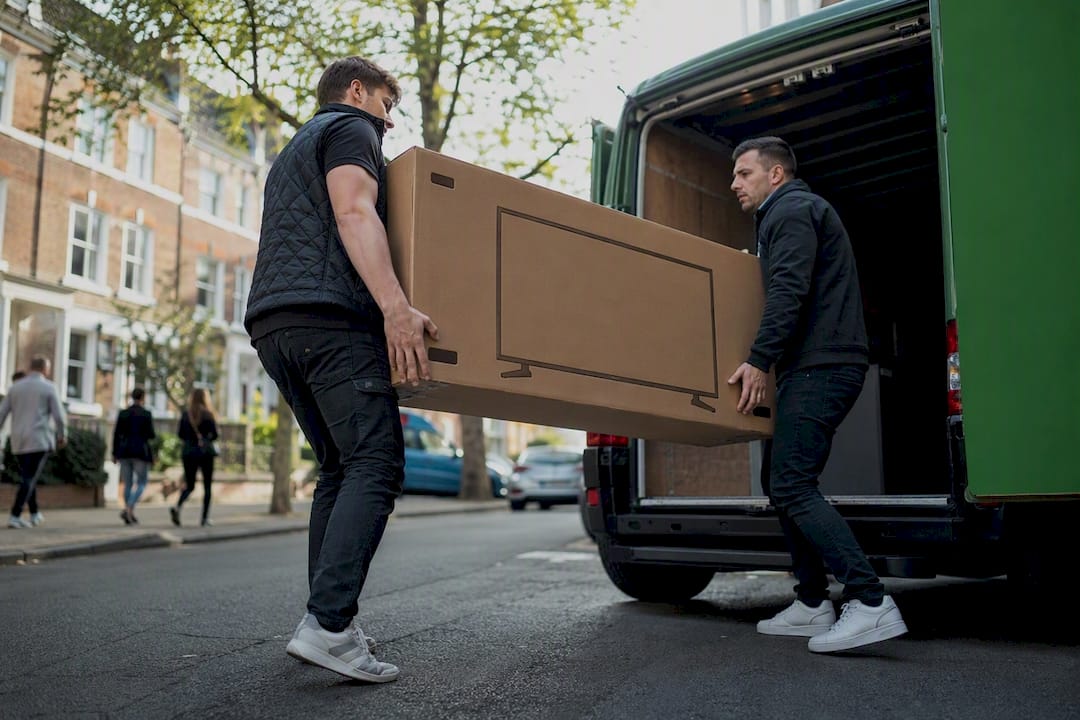
UK moves add their own wrinkles. Narrow terraced streets mean vans often can’t park directly outside, so factor in a short carry across pavement, possibly up or down front steps. If you’re in a flat with a staircase and no lift, that’s exactly the scenario where a two-person carry with a properly boxed TV earns its keep. Short-distance urban moves feel low-risk, but a TV that shifts in a van doing repeated stop-start driving through traffic can suffer just as much damage as one going 200 miles up the motorway.
How can you protect a TV without the original box, part of how movers pack tvs?
Losing the original box isn’t the disaster it feels like. Movers have a reliable fallback for exactly this situation, and it holds up fine for local moves.
- Build a contact layer with packing paper or a bedsheet, laid flat against the screen
- Add foam corner protectors, or improvise with folded towels taped to themselves (never to the screen) at each corner
- Wrap with at least two moving blankets, overlapping the edges completely
- Lock the whole bundle with stretch wrap so the blankets can’t slip during handling
- Wedge it upright in the van against a padded flat surface and strap it in place
This approach is genuinely fine for short local moves. It’s a different story for long-distance trips or anything involving heavy traffic and multiple stops. Where a tight blanket wrap with foam corners and upright bracing is described as an acceptable but riskier alternative to a proper box. The extra time on the road means more chances for the wrap to loosen.
When should you book professional TV packing part of how movers pack tvs?
Some situations genuinely call for paying someone else to handle it. Book professional packing when you’re dealing with:
- A screen above 65 inches, or any OLED/QLED panel
- A TV worth enough that replacing it would actually hurt
- Awkward access, such as narrow stairwells, tight doorways, or no lift
- Multiple TVs to move in one go
- A long-distance move where the TV will spend hours on the road
Professional packing typically includes purpose-fit boxes matched to your exact screen size, custom foam or crating for oversized panels, insured transport, and handlers who do this daily rather than once every few years. Van-247delivery has been operating across the UK for over 15 years, offering insured transport options and packing add-ons alongside its house removal and man-with-a-van services, with instant online quotes so you know the cost before you commit to anything.
What I’ve learnt from years of watching removals go wrong
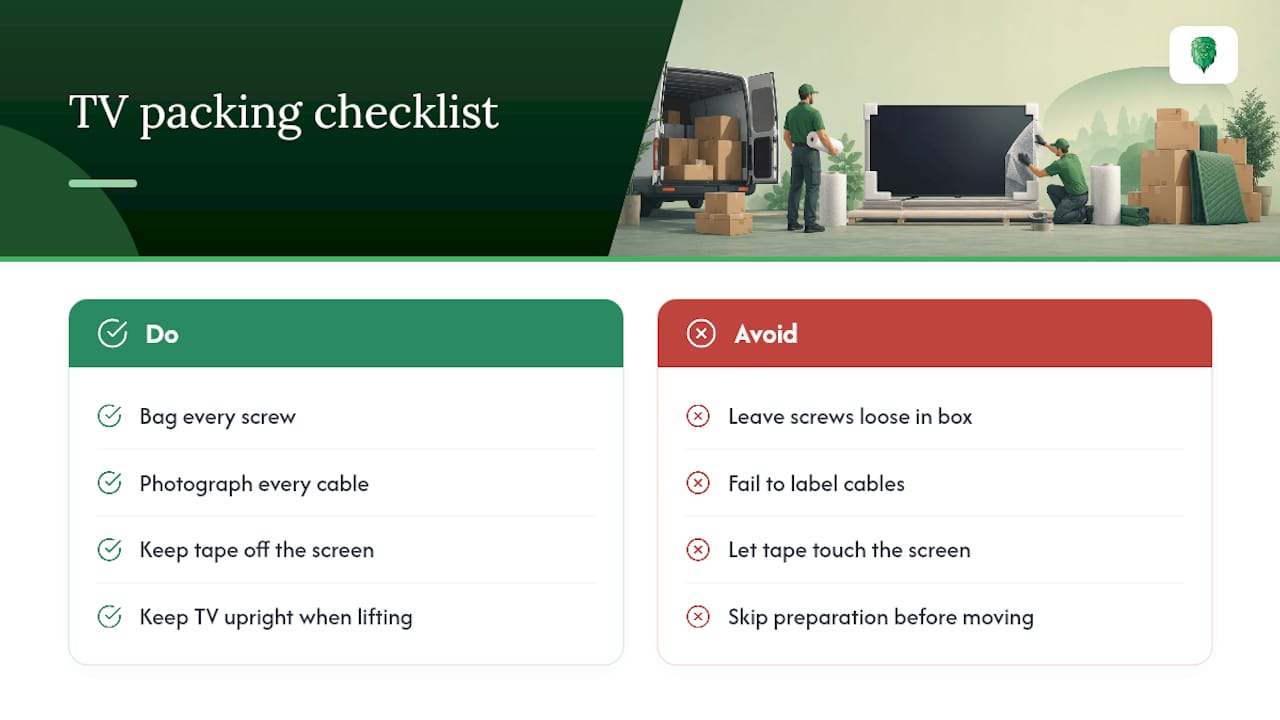
The single biggest cause of TV damage on moving day isn’t dropped boxes. It’s loose screws rattling around inside a box, or cables that nobody labelled, leading to a rushed, careless reassembly at the other end. Nine times out of ten, the damage traces back to skipped preparation, not bad luck in the van.
My checklist for anyone packing a TV themselves: bag every screw, photograph every cable, never let tape touch the screen, and keep the thing upright from the moment you lift it. Get those four things right and you’ve eliminated most of what actually goes wrong.
— Claudiu
Let Van-247delivery pack and move your TV properly
Van-247delivery is the practical alternative to piecing together your own foam corners, blankets, and straps the night before a move. Our house removal service includes packing add-ons built around exactly the sequence covered above, contact layer, foam corners, secure boxing, upright transport, with insured cover so a high-value screen isn’t riding on hope alone.

Getting a quote takes minutes: tell us your move date, rough distance, and whether you need packing included, and you’ll get an instant price with no obligation. On move day, our team handles the TV exactly as outlined here, boxed, braced, and kept upright throughout, whether it travels alongside a full house removal or on its own with a man-with-a-van booking for a single-item move. If you’re only moving the television and a few other pieces, our man-with-a-van services cover that without the cost of a full removal. For a complete house move with packing built in, start your house removal quote and get the TV, and everything else, handled properly from the first box to the last.
Sources
For UK-sized TV boxes and foam kits, The Box Warehouse’s guide covers sizing by screen diagonal. For handling other breakables during the same move. See Van-247delivery’s guide to moving fragile items safely. And for a broader look at planning a calm, well-organised relocation, Guestly Homes’ relocation guide is worth a read.
- How to Pack and Move a Flat Screen TV | U-Haul
- How to Pack a TV for Moving: TV Packing Tips | MoveAdvisor
- How to Pack a Flat Screen TV | Elite Moving and Storage
- How to Pack a TV Without the Box: 7 Easy Steps | YouMoveMe
FAQ
What do professional movers use to pack a TV?
Movers use a contact layer on the screen, foam corner protectors, bubble wrap or moving blankets. And a double-walled TV box with an adjustable inner and outer sleeve, always transported upright.
How do you pack a 65 inch TV for moving?
Add extra moving blankets and foam protection beyond a standard kit, keep the box rigid to prevent flex. And consider a custom crate or professional packing given how vibration-sensitive large screens are.
How much does a TV moving box cost?
A TV-specific box with foam corners typically costs between £15 and £40 in the UK. Depending on screen size and whether the kit includes both inner and outer sleeves.
What is the best way to transport a TV when moving?
Keep the TV upright at all times, brace it between soft flat surfaces or strap it to van rails. And position it away from heavy furniture, ideally loaded last and unloaded first.
Do movers wrap TVs in blankets even when using a box?
Yes. Blankets go on after the contact layer and foam corners, adding a cushioning layer before the TV goes into its box. and they’re the main protection used when no original box is available.