Moving van size guide: the right van is the smallest one that carries everything in a single trip. Go too small and you pay for a second run. Go too big and you pay for space you never use. This guide gives you typical van sizes, what each one holds, and a simple way to match your belongings to a van. It also shows why the easiest route is to let a crew make the final call.
If you are asking what size van you need, the short answer is below. The longer answer covers the awkward things: sofas, wardrobes, a piano, pallets.
TL;DR
- A small van suits a few boxes and one or two bulky items. A Luton van suits a two to three bedroom home.
- Measure your biggest item first. Length and height decide the van more often than total volume.
- Weight matters as well as space. Books, tools and appliances fill the weight limit before they fill the van.
- If you are between two sizes, choose the bigger one. One trip is cheaper than two.
- With our man and van service you describe your load and get an instant online quote, with the lifting done for you.
Table of Contents
- The main van sizes at a glance
- Match the van to your home
- Count your boxes and bulky items
- Measure before you decide
- Weight is the hidden limit
- Do you need a special licence?
- Special loads that change the answer
- Common mistakes when choosing a van
- Why it helps to let a crew choose
- Our view: size the move, not just the van
- Ready to book?
- FAQ
- Sources
The main van sizes at a glance, part of moving van size guide
Van makers publish different figures for every model, so treat the numbers below as typical ranges, not promises. Always check the load length, width and height of the specific vehicle.
| Van type | Typical load space | Typical load length | Best for |
|---|---|---|---|
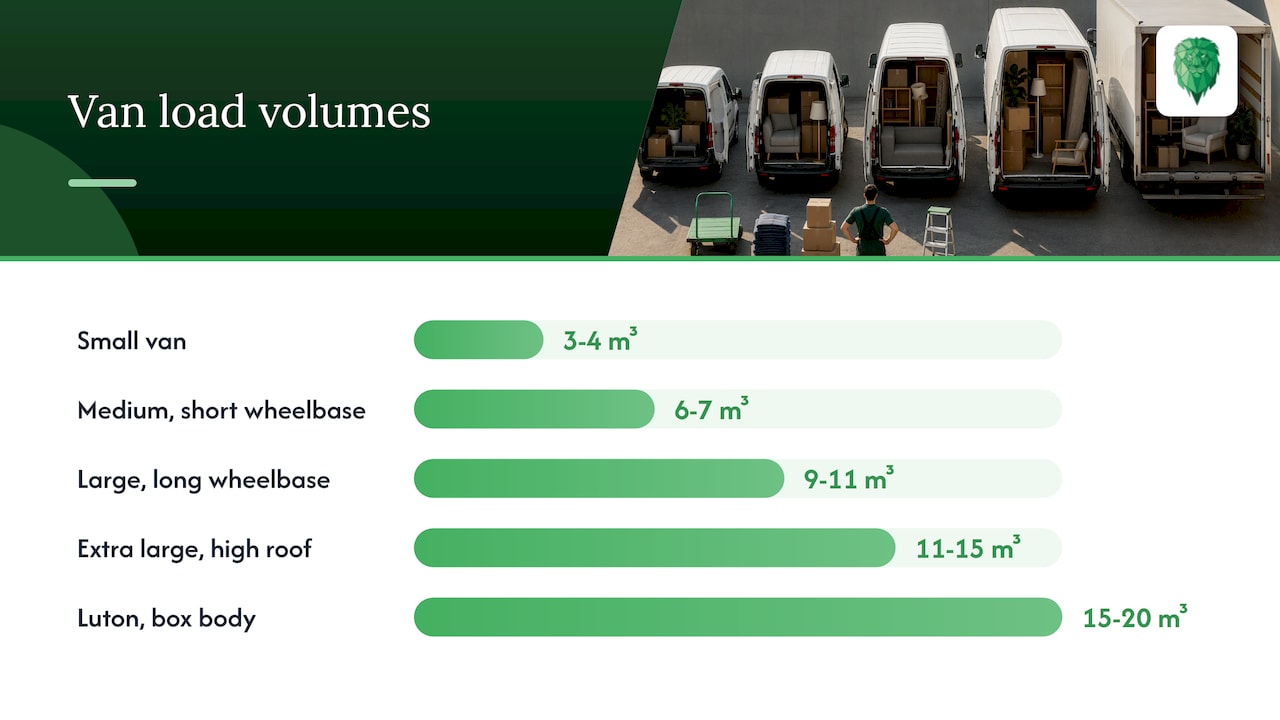
| Small van | around 3 to 4 m³ | about 1.5 to 1.8 m | Boxes, a bike, a chair, a small table |
| Medium (short wheelbase) van | around 6 to 7 m³ | about 2.4 to 2.6 m | Studio flat, a few pieces of furniture, a washing machine |
| Large (long wheelbase) van | around 9 to 11 m³ | about 3 to 3.4 m | One-bedroom flat, a sofa and a double bed |
| Extra large, high-roof van | around 11 to 15 m³ | about 3.4 to 4 m | Two-bedroom flat with a full set of furniture |
| Luton van (box body) | around 15 to 20 m³ | about 4 m or more | Two to three bedroom home |
The “wheelbase” is simply the distance between the front and rear wheels. A longer wheelbase means a longer load area. A high roof adds height, which helps with wardrobes, tall bookcases and stacked boxes.
One point catches people out: the Luton van has a box that extends over the cab. That space is handy for light, awkward items such as mattresses, but it is not much use for heavy goods.
Match the van to your home, part of moving van size guide
There is no exact formula, because a one-bedroom flat belongs to a minimalist in one case and to a collector in another. Use these as starting points, then adjust for what you really own.
A room or a studio
A few boxes, a desk, a chair and a bed frame will usually go in a small or medium van. If you own a double mattress and a two-seater sofa, lean towards medium.
One-bedroom flat
A large long wheelbase van is the usual fit. You have a bed, a sofa, a wardrobe or chest of drawers, a table, a TV unit and perhaps 20 to 30 boxes. Packed carefully, this goes in one trip.
Two-bedroom home
This is where people most often misjudge. A high-roof large van can work if you are tidy and have few bulky items. A Luton van is the safer choice if you have a three-piece suite, a dining table with chairs, a fridge-freezer or a garden set.
Three bedrooms and above
One Luton van may not hold it all. Many house moves of this size are planned as a larger vehicle with a crew, or two vehicles. Our house removals service covers this kind of job, including unpacking and storage if your dates do not line up.
Count your boxes and bulky items, part of moving van size guide
Here is a quick way to turn your home into a van size without guessing.
- List the big items. Beds, mattresses, sofas, wardrobes, tables, appliances, bikes.
- Count the boxes. A standard room usually produces 10 to 20 boxes if you pack sensibly.
- Add the odd things. Mirrors, lamps, plants, a vacuum cleaner, ironing board.
- Compare with the van’s load length. Line up your longest items against the van floor. Sofas and wardrobes are the usual culprits.
- Add a margin. Aim to fill roughly three quarters of the space, not 100%. Furniture does not stack like bricks.
If you have the time, draw a rough rectangle on the garage floor or lounge carpet the size of the van’s load area and place your furniture inside it. It is a surprisingly good test.
Measure before you decide, part of moving van size guide
The things that go wrong on moving day are rarely about total volume. They are about one wardrobe that is 10 cm too tall, or a sofa that cannot turn in the hallway.
Measure these:
- The longest item, to see if it fits lengthways in the van.
- The tallest item, which matters for a standard roof versus a high roof.
- Doorways, stairwells and lifts at both addresses. If a piece will not get out of the house, the van size is irrelevant.
- Parking and access, because a long Luton van needs more kerb space than a small one. Low bridges, narrow streets and controlled parking zones all play a part.
If an item will not fit through a door in one piece, the answer is often to take it apart. We offer furniture assembly and disassembly, so a bed frame or wardrobe can travel flat and go back together at the other end.
Weight is the hidden limit, part of moving van size guide
Every van has a payload: the weight of cargo it may legally carry. Small and medium vans usually carry less than people expect, and a Luton van is commonly in the region of a tonne, depending on the model. Heavy household goods add up quickly. Boxes of books, tools, a washing machine, a solid wood table and a fridge-freezer can use a lot of that allowance before the van looks full.
If you have a lot of dense items, choose a larger or additional vehicle rather than cramming one. Overloading is unsafe, and it is the driver’s responsibility to stay within the vehicle’s legal limits.
Do you need a special licence? Part of moving van size guide
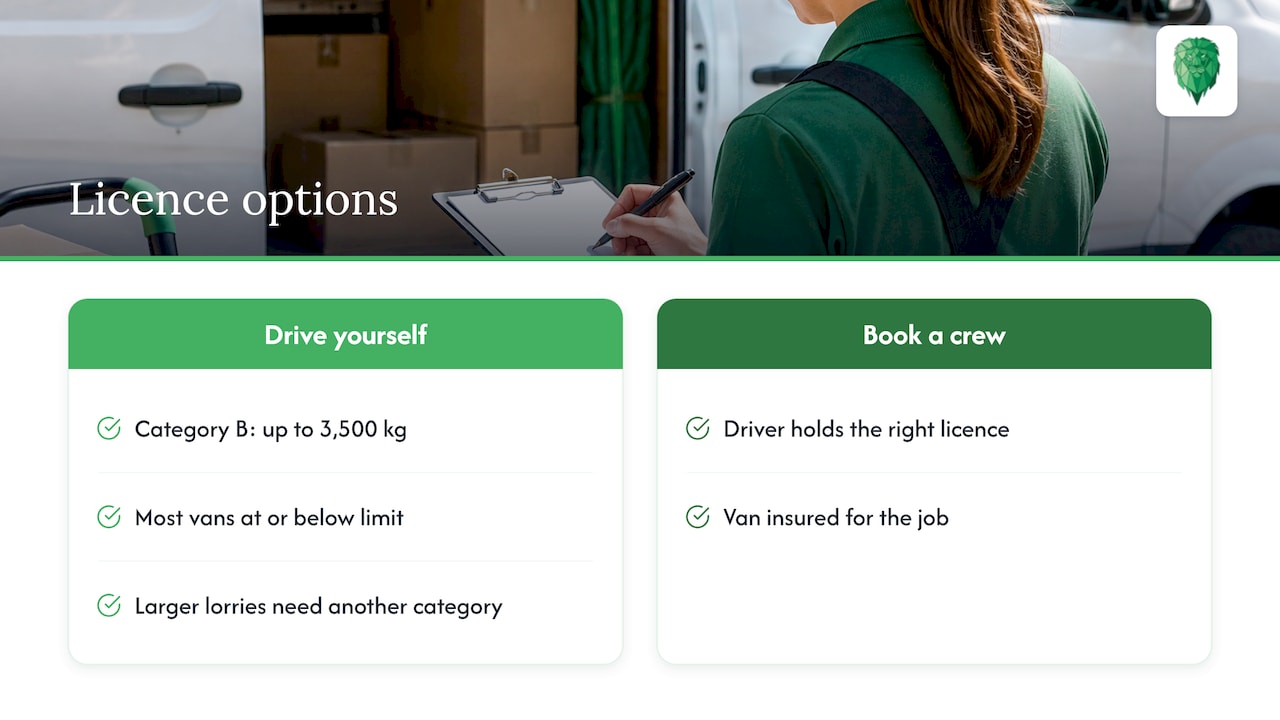
This matters only if you plan to drive a van yourself, but it is a question many readers ask. According to the government’s guidance on driving licence categories, a standard category B car licence covers vehicles up to 3,500 kg maximum authorised mass. Most vans, including many Luton vans, sit at or under that figure. Larger lorries need a different licence category.
When you book a crew with a vehicle, none of this is your concern: the driver holds the right licence, and the van is insured for the job.
Special loads that change the answer, part of moving van size guide
Some items matter more than the number of boxes.
Furniture and large items
Single big pieces, such as a corner sofa, a sideboard or a wardrobe, can be moved without a full house removal. Our furniture and large items service is built for that, and our guide to smart ways to move large items safely explains how to prepare them.
Pianos
A piano is heavy, awkward and easily damaged, so van size is only a small part of the story. It needs the right equipment and a team that knows how to handle it. See our piano removal service.
Pallets and freight
Pallets are measured in footprint and height, not in rooms. A standard pallet takes up a fixed floor area, so the question is how many pallets fit and whether they can be stacked. If you are sending goods rather than moving house, our pallet delivery is the place to start.
Offices
Office moves mix desks, chairs, filing cabinets, boxes and IT equipment. Furniture dimensions and the number of workstations are better measures than square footage. Our office relocation service includes server relocation and Wi-Fi and video conference system installation and reinstallation, so the technical side is not left to the last minute. Packing is easier with a plan, and our office packing tips will help.
Common mistakes when choosing a van, part of moving van size guide
- Underestimating boxes. Most people have more than they think, especially in lofts, garages and under beds.
- Forgetting the outdoors. Garden furniture, bikes, tools and lawnmowers add up.
- Ignoring access. A big van is no help if it cannot park near the door.
- Choosing on price alone. A cheaper small van that needs two trips usually costs more than one trip in the right size.
- Not allowing for time. Loading, driving and unloading take longer with stairs, no lift or a long carry. Our waiting time fee is £24 per hour per man, so a clear plan for the day pays off.
Why it helps to let a crew choose, part of moving van size guide
A table can only get you so far. The reasons it is easier to describe your move to a team that does this every day:
- You do not need to calculate cubic metres or payloads.
- The people loading the van know how to pack it so that heavy items sit low and fragile ones stay protected.
- If your list changes the week before the move, you can adjust the booking rather than hiring a vehicle you now have the wrong size for.
- Lifting, loading, driving and unloading all happen without you needing to do them.
We have been moving people and goods across the UK for over 15 years, and our service is insured transport, so your belongings are covered while they travel. You can add packing, storage and unpacking, which is useful when the van is only part of the job. If you are weighing up hiring a van to move yourself, our page on renting a van for moving explains how our service compares.
Our view: size the move, not just the van, part of moving van size guide
Most people start by asking how big the van should be. We think the better question is: what is the easiest way to get everything there safely in one go?
After more than 15 years of moving homes, offices, furniture, pianos and pallets across the UK, we know that the size of the van is only one piece of it. The route, the stairs, the parking and the fragile items decide just as much. That is why we offer packing, assembly, disassembly, storage and unpacking alongside the van itself. A job that is planned around all of these usually runs more calmly than one planned around cubic metres.
Our advice is simple: list your big items, count your boxes, note any awkward access, and get an instant quote. If you are in doubt between two sizes, tell us. Moving day is a marathon, not a sprint, and the right team makes it feel a lot lighter.
Claudiu
Ready to book?
Tell us what you are moving and where it is going, and you get an instant online quote. Whether you need a man and van for a studio, a full house removal or something specialist, we can take care of the lifting, loading and driving.
Start with our man and van service, or see everything we do on the Van-247 homepage.
FAQ
What size van do I need for a one-bedroom flat?
A large long wheelbase van is the usual choice, typically around 9 to 11 m³. It should take a bed, a sofa, a wardrobe or drawers, a table and a few dozen boxes. If you have a lot of extras, such as a bike or a washing machine, a high-roof or Luton van gives you room to spare.
How much can you fit in a small van?
A small van holds a handful of boxes, a chair, a small table or a bike. It is a good match for a single room, a student move or a single item. Anything with a full-size sofa or a double bed is better in a medium or large van.
Is it better to choose a bigger van than I think I need?
In most cases yes. Furniture is awkward to stack and you will always find a few extra items on the day. One trip in a slightly larger van generally beats two trips in a smaller one, because you avoid extra driving and extra time.
Can I drive a moving van on a normal car licence?
Usually, yes, if the van’s maximum authorised mass is no more than 3,500 kg, as set out in the government’s licence categories. Check the vehicle’s weight before you drive one. If you book us, the driver is part of the service, so you do not need to think about it.