Corporate relocation in 2026 is defined by three forces reshaping every office move: rising attendance, tighter energy regulations, and the end of fully flexible working. Office moving trends 2026 are no longer just about shifting desks from one building to another. They demand strategic planning that spans IT, HR, Finance, and Facilities, often beginning a full year before moving day.
If you are a business leader or office manager weighing a relocation, understanding these forces now will save you significant time, money, and disruption later.
How have hybrid work and attendance trends shaped office relocation in 2026?
The return to the office is no longer a gentle suggestion. Global office utilisation rose to 56% in mid-2026, approaching the pre-pandemic average of 61%. That figure tells you the office is back as a daily reality for most workers, not an occasional destination.
The shift in attendance patterns is even sharper when you look at weekly habits. The share of employees attending the office three to four days per week surged by 19 percentage points in 2026, reaching 55%. That means the majority of your workforce now has a predictable, regular presence, which changes everything about how much space you actually need.

Fixed hybrid models are replacing the fully flexible arrangements that defined 2022 and 2023. 62% of organisations now require fixed in-office days, up from 49% in 2025 and just 28% in 2022. Fully flexible hybrid models, where employees chose their own days freely, declined to just 14% in 2026 from 40% in 2022. That collapse in flexibility means your space planning must now reflect a more predictable attendance pattern, not a worst-case scenario.
For office managers, this has a direct practical consequence:
- Space sizing must reflect peak attendance days, not total headcount.
- Layout planning should prioritise assigned or bookable desks for fixed-day workers.
- Lease negotiations need to account for consistent, measurable occupancy rather than speculative future growth.
The days of over-provisioning space “just in case” are over. The data now exists to plan with precision.
Why is energy efficiency pivotal in 2026 office relocations?
Energy performance is no longer a nice-to-have in a new office. It is a legal and financial requirement that directly affects which buildings you can even sign a lease on.
UK law requires commercial buildings to meet minimum Energy Performance Certificate ratings before new leases can be granted. Buildings rated below ‘E’ are legally unlettable, and tighter thresholds are already enacted for 2026 and beyond. If you are considering a building that does not meet these standards, you cannot legally occupy it under a new lease, full stop.
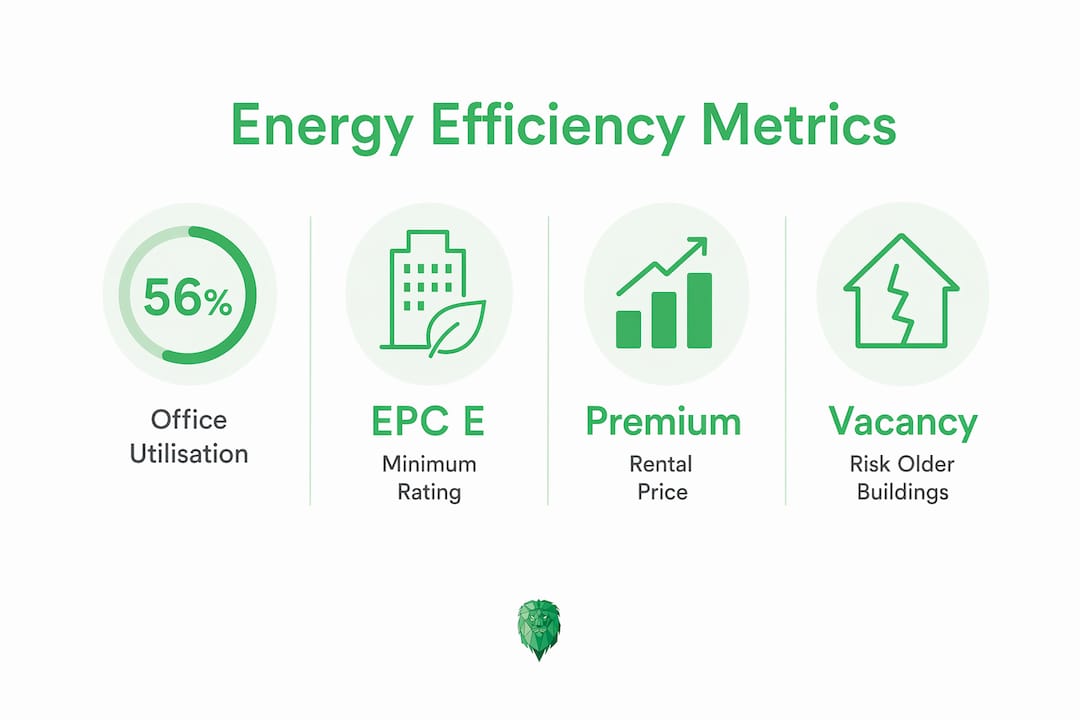
The market impact is visible in rental pricing. Older, lower-rated stock faces significant vacancy, while BREEAM-certified and energy-efficient buildings command premium rents. That premium is not just about prestige. It reflects genuine scarcity: fewer buildings meet the new standards, so competition for compliant space is real.
| Energy rating | Lettability status | Market position |
|---|---|---|
| A or B | Fully lettable | Premium rent, high demand |
| C or D | Lettable, watch future thresholds | Moderate demand |
| E | Minimum threshold, legally lettable | Declining demand |
| F or G | Legally unlettable for new leases | Vacant or pending upgrade |
Pro Tip: Check the EPC rating of any shortlisted building before entering lease negotiations. A building rated D today may fall below future thresholds within your lease term, creating compliance risk mid-tenancy.
Compliance timelines also affect how you negotiate. If a building is currently rated E but faces tighter requirements in two years, your lease renewal could become legally complicated. Factor energy compliance into your lease break clauses and renewal options from day one.
What role does cross-functional collaboration play in successful office moves?
The biggest mistake organisations make is treating an office move as a Facilities project. Successful office moves require early alignment among IT, HR, Finance, and Facilities, ideally beginning 6–12 months before the move date. Each department carries responsibilities that, if delayed, create bottlenecks for everyone else.
Here is a practical sequence that reflects current best practice:
- IT leads on connectivity first. Provisioning dedicated internet access can take 30–90 days on-net and 60–120 days off-net. Order it the moment the lease is signed, not the month before you move.
- HR leads on change management. Only 31% of companies currently deploy formal change management programmes in 2026. That gap is where compliance with return-to-office directives breaks down.
- Finance confirms the full cost picture. This includes fit-out, IT infrastructure, temporary storage, and professional removal services, not just the deposit and first month’s rent.
- Facilities coordinates the physical logistics. Floor plans, furniture procurement, and removal scheduling all depend on decisions made by the other three departments first.
Pro Tip: Assign a single project lead who has authority across all four departments. Without one person accountable for the whole move, decisions stall at departmental boundaries and timelines slip.
Formal change management matters more than most leaders expect. Organisations that skip it see higher rates of non-compliance with new attendance policies, which defeats the purpose of the move entirely. Pair your relocation with clear communication about why the new space was chosen and what it offers employees.
How are workplace design and utilisation metrics evolving?
Office design in 2026 has moved away from the pre-pandemic model of one desk per employee. Peak headcount-based sizing is now the standard, and the target employee-to-desk ratio sits below 0.67. That means for every 100 employees, you plan for fewer than 67 desks, based on actual attendance data rather than theoretical capacity.
This shift has real consequences for how you brief an architect or fit-out contractor:
- Collaboration zones replace rows of fixed desks, supporting the team-based work that draws people into the office on fixed days.
- Wellness spaces including quiet rooms, phone booths, and breakout areas reflect the expectation that the office must offer something home working cannot.
- Bookable desk systems replace assigned seating for roles with variable attendance patterns.
The practical benefit of this approach is significant. A business with 200 employees attending on a fixed three-day schedule may only need space for 120 to 130 people at peak. That reduction in footprint directly reduces rent, rates, and fit-out costs. The move toward growth-focused relocation rather than simple downsizing means organisations are reinvesting those savings into better-quality, better-located space rather than just cutting costs.
What are practical office moving strategies that minimise downtime?
Minimising disruption during a corporate relocation requires a plan that starts earlier than most teams expect. Business relocations in 2025 and 2026 shifted toward deliberate, growth-oriented moves, which means the planning bar has risen. Here is what the best-prepared organisations do differently:
- Start the timeline at lease signing, not six weeks before moving day. A 6–12 month runway gives every department time to complete their workstream without rushing.
- Order IT infrastructure immediately. Internet provisioning lead times are the most commonly underestimated delay in office moves. Book it before you book the removal van.
- Communicate early and often with your team. Staff who understand the rationale for a move and the benefits of the new space adapt faster and comply more readily with new attendance expectations.
- Engage a professional removal service with commercial experience. The physical logistics of moving servers, specialist equipment, and large furniture require expertise that general carriers do not provide. You can read more about planning your office move and the business case for doing it properly.
- Schedule the physical move outside peak business hours. Weekend or overnight moves reduce the impact on client-facing operations and give IT time to test connectivity before staff arrive Monday morning.
Pro Tip: Build a two-week buffer between your physical move date and your official “open for business” date in the new space. That window absorbs the inevitable snags with IT, access cards, and furniture delivery without affecting client commitments.
The moving industry’s own visibility in 2026 reflects how competitive the market for quality commercial removal services has become. Book early, especially if your move falls in the spring or autumn, when demand peaks.
Key takeaways
Office moves in 2026 succeed when energy compliance, fixed hybrid attendance data, and cross-functional planning are treated as equal priorities from the start.
| Point | Details |
|---|---|
| Attendance data drives space sizing | Target a desk-to-employee ratio below 0.67, based on actual peak attendance days. |
| Energy compliance is non-negotiable | Only lease buildings rated E or above; check future threshold changes before signing. |
| IT provisioning must come first | Order dedicated internet access the day the lease is signed to avoid 60–120 day delays. |
| Cross-functional planning reduces risk | Involve IT, HR, Finance, and Facilities at least 6–12 months before the move date. |
| Change management protects compliance | Only 31% of companies use formal change programmes; those that do see better attendance outcomes. |
What I have learned from watching office moves go wrong in 2026
The office moves that go smoothly in 2026 share one quality: the decision-makers treated the relocation as an organisational change project, not a logistics exercise. The ones that struggle almost always made the same mistake. They handed the move to Facilities, gave them six weeks, and were then surprised when the internet was not working on day one and half the staff did not understand why they were moving at all.
What strikes me most about the current moment is how much the stakes have risen. Energy compliance alone has turned building selection into a legal and financial decision that requires proper due diligence. A building that looks attractive on price may be unlettable within your lease term if its EPC rating falls below future thresholds. That is not a hypothetical risk. It is happening to organisations right now.
The cultural dimension is equally underestimated. A relocation is one of the most visible signals you send your workforce about how you value their experience. If the new space is better designed, better located, and better equipped, people notice and respond positively. If it feels like a cost-cutting exercise dressed up as progress, you will see it in attendance figures and morale within months.
My honest advice: invest in commercial removals expertise early, build your cross-functional team before you sign anything, and treat change management as a core deliverable rather than an afterthought. The organisations that do this well come out of a move stronger than they went in.
— Claudiu
Planning your office relocation with Van-247delivery
Office moves in 2026 are more complex than they were five years ago, but the right support makes them manageable. Van-247delivery has over 15 years of experience handling commercial relocations across the UK, from single-floor office moves to multi-site corporate transitions.
Whether you need a full office removal service with packing, disassembly, and insured transport, or a flexible man-and-van solution for smaller equipment and overflow items, Van-247delivery offers instant quotes, real-time tracking, and a team that understands the pressures of keeping your business running through a move. Get in touch today to discuss your 2026 relocation timeline.
FAQ
How far in advance should you plan an office move?
Start planning at least 6–12 months before your intended move date. This gives IT, HR, Finance, and Facilities enough time to complete their workstreams without creating bottlenecks.
What EPC rating does an office building need for a new lease in the UK?
UK law requires a minimum EPC rating of E for new commercial leases. Buildings rated F or G are legally unlettable, and tighter thresholds are already in force for 2026 and beyond.
How does hybrid work affect how much office space you need?
Fixed hybrid models mean you can size your office for peak attendance days rather than total headcount. A desk-to-employee ratio below 0.67 is now considered best practice under hybrid working arrangements.
Why does internet provisioning cause so many office move delays?
Dedicated internet access takes 30–90 days to provision on-net and 60–120 days off-net. Ordering it too late is one of the most common and costly mistakes in office relocation projects.
What is the biggest risk of skipping change management during an office move?
Organisations that do not run formal change management programmes see higher rates of non-compliance with return-to-office policies. Only 31% of companies currently use these programmes, despite their direct impact on attendance outcomes.