Parking for removals: you can’t claim the road outside your house just because you’re moving. In the UK, residential streets are public, so the van needs either a legal place to load or a council-approved parking suspension. For anything bigger than a few boxes, the suspension is almost always the safer route. It is also the one that most people book too late.
This guide walks you through the options in plain English: loading on yellow lines, suspensions and permits, how much space you need, what it costs, when to apply and what to do if someone parks in your reserved bay.
TL;DR
- There is no legal right to reserve the road outside your home. A council suspension (sometimes called a permit or dispensation) is the official way to do it.
- Loading on yellow lines is usually allowed, but only for continuous loading of items too heavy or bulky to carry by hand, and not where loading restrictions are signed.
- Apply early. Westminster asks for 10 working days’ notice, and other councils ask for anything from 7 to 17 working days.
- Plan roughly 5 metres per bay and at least three bays (15 metres) for a full house removal.
- A suspension reserves the space but doesn’t guarantee it is empty. Know who to ring on the day.
Table of Contents
- Why parking is the hidden stress of moving day
- Can a removal van park outside your house?
- Loading on yellow lines: what you can and can’t do
- Parking suspensions, permits and dispensations explained
- How much do parking suspensions cost?
- How much space do you really need?
- When to apply: the timeline
- What if someone parks in your suspended bay?
- Keep pavements and dropped kerbs clear
- Our perspective: parking is part of the quote
- Moving in London or running an office move?
- A simple parking checklist for moving day
- FAQ
- Sources
Why parking is the hidden stress of moving day, part of parking for removals
Moving day is a marathon, not a sprint. And the first mile is often the one nobody trained for: getting a large van close enough to the door.
A removal van that has to park two streets away means longer carries, more hours on the clock and more risk for fragile items. A van that stops in the wrong place can pick up a penalty charge notice (PCN) before the first sofa is out. Neither is the start you want.
The good news is that it’s very doable. Parking is a bit of paperwork and a bit of planning, and you can sort it weeks ahead.
Can a removal van park outside your house? Part of parking for removals
Sometimes, yes, but not as of right. Councils are clear that streets are public assets, not private property. As Camden’s guidance on parking bay suspensions makes clear, a suspension is a formal service you apply for. It isn’t something you can arrange informally by asking the neighbours to move.
What the van can legally do depends on what is outside your property:
| Where the van stops | What usually applies | Risk on moving day |
|---|---|---|
| Private driveway or forecourt | Your own land, so no council permission needed | Low, if the van fits and the surface can take its weight |
| Free, unrestricted street | Normal parking rules apply | Medium: no one can be stopped from parking in front of you |
| Residents’ bay or pay-and-display bay | Restrictions apply unless suspended | High without a suspension |
| Single or double yellow line | Loading may be allowed, with conditions | Medium to high, depending on how continuous the loading is |
| Dropped kerb | Parking here is prohibited | Very high: avoid |
If you have a driveway, check the van’s height, length and weight with us before moving day. If you don’t, read on.
Loading on yellow lines: what you can and can’t do? Part of parking for removals
Many people assume a removal van can sit on any yellow line while it’s being loaded. It can, but only under tight conditions.
The Highway Code says you must not wait or park on yellow lines during the times shown on nearby time plates. Loading and unloading are treated differently from parking. In most places they are permitted on yellow lines, unless kerb marks and upright signs show a loading restriction. The activity has to be continuous, and the goods have to be too heavy or bulky to carry by hand.
That last part trips people up. Here’s what it means in practice:
- Carrying a wardrobe out and straight into the van counts as loading.
- Stopping to check a list, drink a cup of tea or wait for the next person doesn’t.
- Walking up and down stairs with boxes is borderline at best.
- Taking time to dismantle a bed on the pavement isn’t loading.
Enforcement officers typically watch for a few minutes to see whether loading is genuinely continuous before issuing a PCN. Observation times are set by each council. For example, Wokingham’s PCN guidance lists a 5-minute observation period for being parked in a restricted street during prescribed hours, while some contraventions have none at all.
Islington also points out that loading time doesn’t include paperwork or stair time and that it has to be the active movement of goods. Real house moves are full of pauses. That’s why yellow-line loading suits a small, quick job, such as a single sofa or a couple of boxed items, and not a three-bedroom house.
When yellow lines are worth the gamble
Only when all of these are true:
- The line has no loading restriction marks on the kerb or signs.
- You’re moving a handful of large items, not a full home.
- There’s a crew ready to carry continuously, with no waiting.
- The stairs and access are simple.
If any of those is shaky, pay for the suspension. One PCN can cost more than the suspension would have.
Parking suspensions, permits and dispensations explained. Part of parking for removals
Councils don’t all use the same words. Westminster talks about dispensations in some cases, while Camden and others say suspensions. The idea is the same: the council temporarily lifts the normal parking controls, and often reserves the space, for a removal vehicle.
A suspension stops other drivers using one or more bays for the dates you booked. It usually needs a cost and signs posted in advance.
A permit or dispensation lets a vehicle stop where restrictions would normally apply, for example on a yellow line or in a resident bay. It doesn’t always keep the space clear for you.
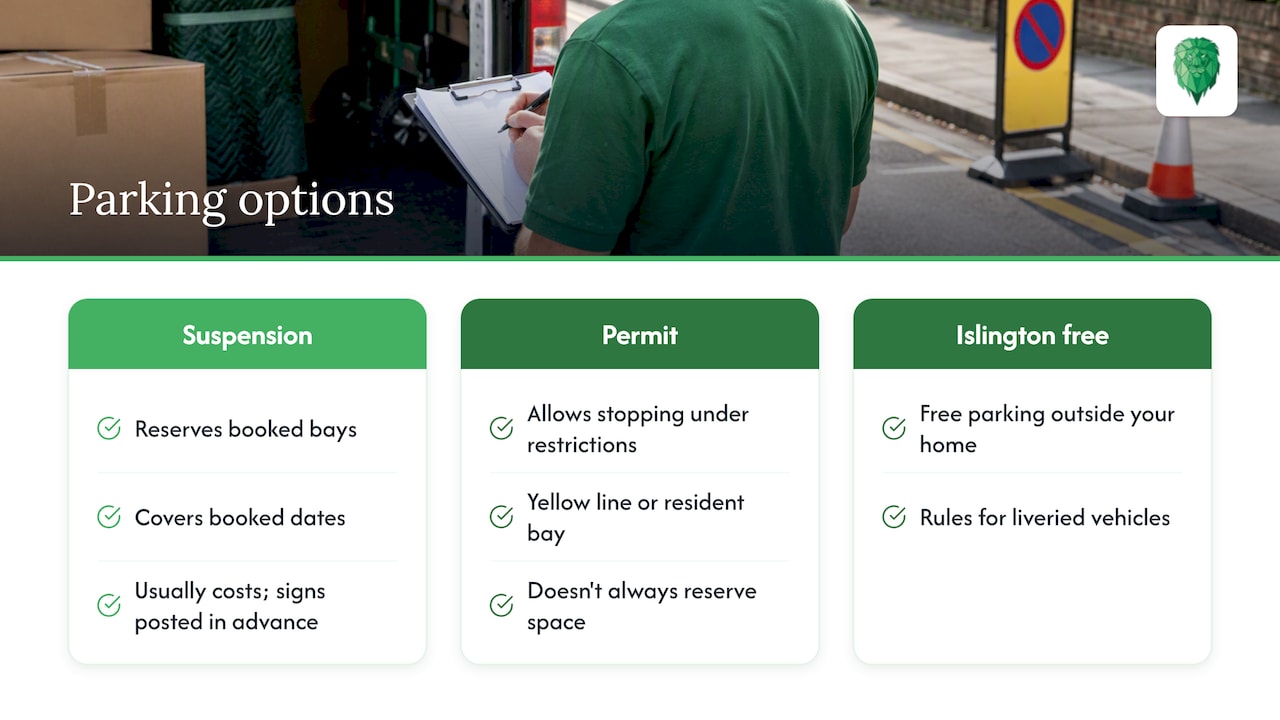
Free options exist in some areas. Islington’s page says you can park outside your home when moving, free of charge, and it describes rules for liveried vehicles, meaning hired or removal vehicles that clearly show company branding. Check your own council: policies differ a lot from one borough to the next.
Whoever you book, the suspension is normally applied for in your name. Ask your removal firm for the van size and the likely time on site, because councils often ask for both on the form.
How much do parking suspensions cost? Part of parking for removals
It varies widely by council, by zone and by how many days you book. Here are two published examples. Always check the live figures, because councils update them.
| Council | Published charge | Notes |
|---|---|---|
| Camden | £79.63 for the first day, per space | Administration fees are on top |
| Westminster | £51 (Zones A, C and D) or £55 (Zones B, E, F and G) for day 1, per space | £20 short notice fee if applied for within 10 calendar days of the start |
Notice the words “per space”. A bay is treated as 5 metres where it isn’t marked on the street, so if you need three bays, multiply. Late applications can also add admin fees, which in some boroughs run well above £20.
Outside London, prices are often lower, but the process is similar. Bath and North East Somerset Council, for instance, covers suspensions for moving home or expecting a large delivery, and Brighton and Hove has its own page for reserving a bay when moving house.
How much space do you really need? Part of parking for removals
This is where well-planned moves go wrong. Order one bay and a large van might not fit, with no room to lower a tail lift or run a ramp.
A standard bay is typically 5 metres long. For a professional house removal, aim for at least three bays, or 15 metres. That gives space for the lorry or large van and enough clear kerb for loading. Smaller flats might manage with less, but forgetting to book enough is a classic cause of fines and delays.
A quick way to size it:
- Studio or one-bed flat, light furniture: one or two bays may be enough. Ask the crew for the van size first.
- Two or three-bed house: plan for three bays.
- Larger home, or two vehicles: plan for more, and tell the council.
Also think about the other end. You may need parking at both addresses, and the rules at the new address may differ completely.
When to apply: the timeline. Part of parking for removals
Most councils want 7 to 17 working days’ notice, and some have a shorter window for a higher fee. Westminster, for example, asks for 10 working days. If you apply later, expect that admin fee.
A sensible schedule:
- As soon as the date is fixed: check your council’s page and note its notice period.
- Three to four weeks before: look at your street on the council’s parking map, if there is one, to see which bays can be suspended.
- At least three weeks before: apply and pay. Print or save the confirmation.
- Two to three days before: check the signs have gone up. Take photos with a time stamp.
- Moving day, early: check the bay is clear before the van arrives.
We’ve written more on why some councils need 10 working days for a move-day parking space if you want the detail. And if your move date shifts, our guide to rescheduling a move explains how to avoid fees, which is worth reading before you cancel a suspension.
What if someone parks in your suspended bay? Part of parking for removals
It happens more than you’d think. A suspension reserves the space, but it doesn’t make sure the space is empty. Camden’s guidance says that if a car is still there on the day, you need to contact the council’s parking enforcement number shown on the suspension signs.
The council can issue a PCN and may arrange removal, but removal isn’t guaranteed. Islington’s page on moving home notes that enforcement officers prioritise vehicles by local policy. Here’s how to be ready:
- Keep the suspension confirmation on your phone.
- Photograph the signs in place, the car and the number plate.
- Ring the number on the sign as early as possible, not once the van is idling in the road.
- Don’t knock on doors in frustration. Ask politely if the owner can move it, as it may just be a neighbour who missed the sign.
- Tell your removal crew, so they can park safely and keep working while you wait.
If you’re worried about who pays a fine if something goes wrong, our guide on parking fines: keeper or driver sets out how responsibility works.
Keep pavements and dropped kerbs clear, part of parking for removals
This is about being a good neighbour as well as avoiding fines. Dropped kerbs are legally protected. Under section 86 of the Traffic Management Act 2004, in a special enforcement area a vehicle must not be parked on the carriageway next to a lowered footway where that is prohibited. Councils in England and Wales have also been given new local powers to keep pavements clear for disabled people, wheelchair users and people with pushchairs.
So don’t let the van, a ramp or a pile of boxes block the pavement. If you need to stack things, leave a clear route. It’s friendlier, and it keeps you on the right side of the rules.
Our perspective: parking is part of the quote. Part of parking for removals
We have been moving people and businesses around the UK for over 15 years, and parking is the topic customers ask about least and regret most. The pattern is familiar. The date is booked, the boxes are packed, and then someone realises the street is a permit zone with no space for a lorry.
Here’s what we’d tell a friend:
- Raise parking when you ask for a quote. Tell us the street, the floor, the lift situation and whether there’s a driveway. We can then suggest van size and crew.
- Don’t count on yellow-line loading for a full house. Real moves have pauses. A suspension costs less than the stress of a ticket.
- Think about the carry distance. A bay right at the door is worth paying for if you have a piano, a big wardrobe or a long flight of stairs.
- Narrow streets are their own puzzle. If access is tight, our two-week plan for narrow-street removals shows how to avoid fines.
Good planning really does make moving day calmer. You’ve got this.
— Claudiu
Moving in London or running an office move? Part of parking for removals
Parking is at its trickiest in busy cities and business districts. If you’re moving in the capital, take a look at our removals London service. If it’s an office, our office relocation service covers the move itself, plus server relocation and Wi-Fi and video conferencing setup. For a home move, see our house removals, which can include packing, unpacking, storage and cleaning after your move.
Waiting time is charged at 24 GBP per hour per man, so a clear, reserved space also helps keep your move on schedule. For a quote, start on our website.
A simple parking checklist for moving day, part of parking for removals
- Check what is outside your property: driveway, bay, yellow line or dropped kerb.
- Look up your council’s suspension page and its notice period.
- Work out bays needed: roughly 5 metres each, three for a full house.
- Apply and pay in good time, and save the confirmation.
- Check the new address too.
- Share the details with your removal crew.
- On the day, confirm the bay is clear before the van arrives.
- Keep the council enforcement number to hand.
FAQ
Do I need a permit to park a removal van?
Sometimes. If you have a driveway, no. If you’re on a controlled street with resident bays, pay-and-display bays or yellow lines, you generally need a suspension or permit from the council, though a few allow free parking for moving home. Check your own council’s page, as the rules differ by area.
Can the removal company apply for the suspension for me?
Usually the application is made in the resident’s name, so you will need to apply yourself. Your removal firm can tell you the van size and how long it needs, which the form often asks for. Share your confirmation with them afterwards.
Can I reserve the space outside my house with cones?
No. There’s no legal right to reserve the road outside your property, and councils advise using the official suspension process instead of informal arrangements with neighbours. Cones with no suspension behind them won’t stop another driver or a warden.
How many parking bays does a house move need?
A bay is typically 5 metres, and a professional house removal usually needs at least three, so 15 metres. A small flat may need fewer. Ask your crew about the van size before you apply, because booking too few bays often leads to fines and delays.
What happens if my move overruns?
If your suspension covers the day, you’re fine within the booked time. If you’re relying on yellow-line loading, an overrun or any breaks in loading can lead to a PCN. For a bigger move, the suspension is the safer choice.
Sources
- Parking bay suspensions, Camden Council
- Parking bay suspensions, Westminster City Council
- Parking to move home, Islington Council
- Parking bay suspensions, Bath and North East Somerset Council
- Parking suspensions, Brighton and Hove City Council
- The Highway Code: waiting and parking (238 to 252)
- Traffic Management Act 2004, section 86
- Wokingham Borough Council PCN cancellation guidance
- New local powers to keep pavements clear, GOV.UK