Piano storage requirements: a piano needs a steady, dry-but-not-too-dry room, away from outside walls, radiators and sunlight, a breathable cover and a careful move in and out. Get those four things right and your piano can sit in storage for months and come out in good shape. Get them wrong and the wood, felt and strings pay for it. A piano is not like a wardrobe: it reacts to the air around it. If you are planning a house move, a refurbishment or a stretch abroad, this guide walks you through what the piano needs, how to get it ready and how to choose where it goes. Our piano removal team can handle the heavy part, the lifting, carrying and loading, so you can focus on the conditions.
TL;DR
- Steady beats perfect. Aim for roughly 45–60% relative humidity and a constant room temperature around 20°C, with as little swing as possible.
- Keep it away from change. Outside walls, windows, radiators, vents, direct sun and draughts are the enemy.
- Cover it so it can breathe. Use a padded cloth-type cover, not sealed plastic, and keep the lid and fallboard closed.
- Tune and check. Plan a tune after storage, and look in on the piano and the room every few weeks on a long stay.
- Moving matters as much as storing. Most damage happens on the way in and out, so use movers who handle pianos.
Table of Contents
- Why pianos are fussy about where they live
- The conditions your piano needs in storage
- Where can you store a piano? Your options
- How to prepare a piano for storage
- Looking after a piano while it is stored
- Getting it back: acclimatisation and tuning
- What piano storage costs in the UK
- Common storage mistakes
- Our view: the move is half of the storage plan
- Let us handle the piano
- FAQ
- Sources
Why pianos are fussy about where they live, part of piano storage requirements
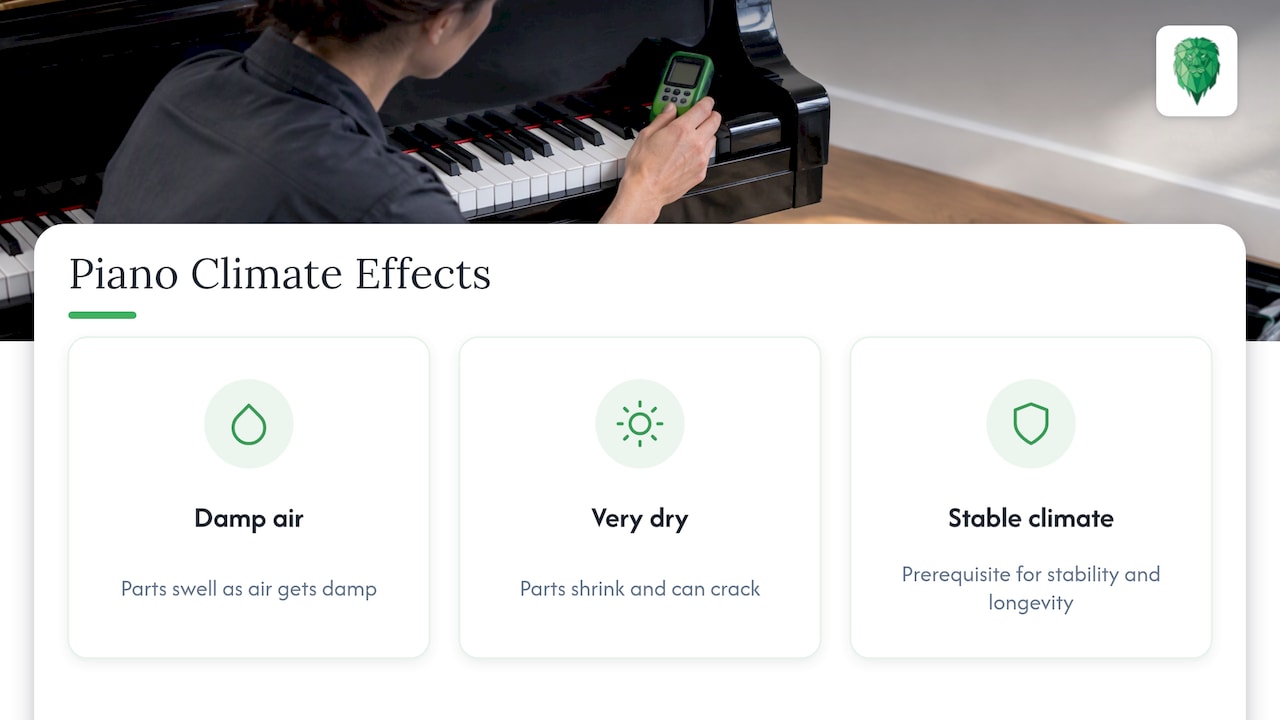
Inside a piano there is a large wooden soundboard, a cast-iron frame, hundreds of steel strings and an action made of wood, felt and leather. Wood and felt take on and give off moisture. When the air gets damp, parts swell. When it gets very dry, they shrink and can crack.
Piano technician Mario Igrec puts it plainly in his reference book: controlling the climate is an absolute prerequisite for a piano’s stability and longevity. That is the heart of every storage requirement. It is not about luxury. It is about avoiding big, fast changes.
The good news: you do not need a laboratory. You need a stable room, a sensible cover and a bit of routine.
The conditions your piano needs in storage, part of piano storage requirements
Humidity: the number that matters most
Relative humidity is the amount of moisture in the air as a percentage of what the air could hold. A cheap gadget called a hygrometer shows it, and it costs very little.
Two leading makers give guidance that overlaps nicely:
- C. Bechstein says a humidity of 40–60% is good, with fluctuations kept to a minimum, and recommends a hygrometer to check the room.
- Steinway recommends a relative humidity of 45–70% and a constant temperature of about 20°C.
The sensible middle ground is around 45–60%. Pick a target in that band and keep it as steady as you can.
What goes wrong outside the band? Bechstein explains that high humidity impairs tuning and makes the felt, leather and wooden parts of the action swell, which spoils the touch. Below 40%, it advises using a humidifier or air washer to prevent drying damage.
Temperature: constant, not exact. Part of piano storage requirements
The figure you will see most often is about 20°C, which is Steinway’s recommendation for a constant room temperature. Sticking to that number is less important than avoiding sudden swings. Steinway also advises avoiding sudden temperature fluctuations and using a good-quality humidifier during the heating season.
In a typical UK home, that usually means an ordinary heated room where the temperature drifts gently through the seasons rather than lurching from freezing nights to warm afternoons.
Position: where in the room. Part of piano storage requirements
Igrec’s first rule is not to place a piano near sources of temperature and humidity change: poorly insulated outer walls, windows, radiators, heating or air-conditioning vents, direct sunlight and draughts.
A quick checklist for the spot:
- An inside wall, rather than an exterior one.
- Away from radiators, vents and fireplaces.
- Out of direct sun, which also fades the finish.
- Clear of doors that open straight outside.
- Level, solid flooring that can carry the weight.
- Nothing stacked on, or leaned against, the piano.
Cover: let it breathe. Part of piano storage requirements
A padded cover does more than keep dust off. According to Igrec, a padded cover absorbs and releases moisture, which evens out humidity changes. Sealed plastic sheeting does the opposite: it can trap moisture against the wood and invite mould. Choose cloth-based, padded wrapping and leave room for air.
Keep the keyboard lid closed, and on an upright, the fallboard shut. If you tape anything, tape the cover to itself, never straight onto the finish, as adhesive can lift polish.
Where can you store a piano? Your options, part of piano storage requirements
There are really four kinds of place, and they are not equal.
| Option | Stability | Fits a piano? |
|---|---|---|
| A heated spare room or hallway in a home | Usually steady through the seasons | Best choice where you have the space |
| A purpose-run storage facility with a stable indoor environment | Depends on the building | Good for months-long gaps, when the building is dry and indoors |
| An ordinary lock-up or self-storage unit | Can swing with the weather | Possible, only with care and a close eye |
| Garage, shed, cellar or conservatory | Prone to damp, cold snaps or heat | Best avoided |
The pattern is consistent: a stable, heated indoor space is safer than a spot that follows the weather. Where you have a spare room that stays broadly steady, that is a very good home for a piano that is not being played. Garages, sheds, cellars and conservatories are the places where damp and temperature swings do the most harm.
Can a piano go in a storage unit? Part of piano storage requirements
Yes, it can, and many do. The question is not whether it fits but whether the unit holds steady. A unit that is dry, indoors and not exposed to sharp swings gives the piano a fair chance. A metal container that bakes in July and chills in January does not.
Whatever the unit, a few checks help:
- Is it indoors and dry? Look for signs of damp, condensation or a musty smell.
- Is the floor level and sound? Uneven floors can stress the frame and legs over time.
- Is access wide and step-free enough? A piano is heavy and awkward: narrow doors and stairs make the move the riskiest part.
- Will the piano stand on its own castors or feet? Keep an upright upright, not on its back or side.
- Is there room to leave a gap around it? Nothing should be stacked on top or leaned against it.
If you are already booking a house move, it is simpler to treat the piano and the storage as one job. We offer a storage service alongside our house removals, so the people who collect your belongings can plan the whole sequence with you.
How to prepare a piano for storage? Part of piano storage requirements
A few quiet hours of preparation save a lot of heartache later.
Step 1: have it looked at first
Storage does not fix faults. If a piano has sticking keys, loose fittings, a pedal problem or moths in the felt, those problems will still be there when you collect it, and sometimes worse. For a long stay, a technician’s check beforehand is worthwhile. It also gives you a baseline for the tuning afterwards.
Step 2: clean it gently
Wipe the case with a soft, dry microfibre cloth. Skip household sprays and furniture polish, and use as little water as possible, especially around the keys and fallboard. Moisture and chemicals are the last things a keyboard needs.
Step 3: close and secure it
Shut the keyboard lid. On an upright, close the fallboard; on a grand, close the top lid and keep the lid and legs protected. If a lid has a lock, use it. Do not tape directly to the finish.
Step 4: wrap it breathably
Use padded moving blankets or a purpose-made cloth-style cover. Wrap the corners and the pedal lyre (the wooden frame that holds the pedals on a grand). Let air move rather than sealing it in a bag.
Step 5: protect the floor and the feet
The weight sits on small castors or legs, which can mark or dent flooring. Use castor cups or a firm board under them, and keep the piano off bare concrete where damp can rise.
Step 6: plan the move itself
This is the stage where most storage plans stumble. A piano is heavy, top-heavy and awkward, and a knock can crack a leg or knock the action out of regulation. Stairs, tight turns and steps make it worse. Our piano removal service is built around exactly this kind of job. If stairs are part of the picture, our guide on moving a piano upstairs shows what is involved, and our advice on protecting your piano in transit covers the journey.

Looking after a piano while it is stored
Once the piano is in place, a little routine keeps it healthy.
- Check the room every few weeks. Look for damp patches, condensation, pests or a cover that has slipped.
- Keep a hygrometer nearby. If it dips under 40% or climbs well over 60%, the room needs attention. Bechstein suggests a humidifier or air washer when the air is too dry.
- Leave it alone otherwise. No boxes on top, no leaning bikes or luggage, no shelving that could tip.
- Do not play it hard in an unsuitable room. A cold, damp room is not kind to a piano being used.
The longer the stay, the more these checks matter. A weekend gap in a heated spare room needs very little. A year in a unit needs a diary reminder.
Getting it back: acclimatisation and tuning
A piano that has been somewhere cold or unheated needs time to adjust. Bechstein notes that a piano stored in an unheated room needs careful acclimatisation afterwards. In practice, that means:
- Bring it into its new room and leave the cover on for a day or two so it adapts gradually.
- Do not place it beside a radiator to “warm it up”.
- Let the room settle at its normal level before you book the tuner.
Then book a tuning. Steinway recommends frequent tuning during the first year, as the instrument adapts to string tension, and then at least twice a year. It adds that keeping pitch constant matters, because repeatedly raising and lowering it makes the piano less likely to hold its tuning. After a move and a stay in storage, expect the piano to need a tune and perhaps a second one a few weeks later as it settles.
What piano storage costs in the UK. Part of piano storage requirements
There is no single price, and anyone quoting one without knowing your piano is guessing. The main things that move the cost are:
- Type and size of piano. An upright, a baby grand and a concert grand take very different space and handling.
- How long it stays. Short and long stays are priced differently.
- Where it is stored. A stable indoor space costs more than a basic unit, and is worth more to the piano.
- Access. Stairs, narrow doorways, long carries and lifts add time and people.
- Distance and timing. The collection and delivery legs are often the bigger part of the bill.
The most reliable way to see your own figure is to describe the piano, the addresses and the access, and get a quote for the whole job rather than storage by itself. Our guides on piano removal costs and options and what piano removalists charge explain what shapes the price. One fee we do publish is waiting time: £24 per hour per man.
Common storage mistakes, part of piano storage requirements
- Plastic wrap. It traps moisture. Use breathable padding.
- The garage or shed. Temperature and humidity swing too much.
- Putting it by the radiator or window. Heat and sun dry and fade it.
- Stacking things on top. Weight and knocks do damage you will not see until later.
- Skipping the check-up. Existing faults do not go away in storage.
- Self-moving it. This is how legs break and backs get hurt. Our article on how pianos get damaged during a move shows where it goes wrong.
Our view: the move is half of the storage plan, part of piano storage requirements
We have been moving and storing belongings across the UK for over 15 years, and we have learned that people worry about the storage room and forget the carrying. Both matter.
A piano is a delicate instrument inside a heavy box. You can have the perfect room and still lose the piano’s condition on a staircase. That is why we treat the piano as a specialist job: the right number of people, proper padding, the right equipment and insured transport.
Our advice is simple. Choose a stable, indoor place. Wrap the piano so it can breathe. Plan the route before moving day. And book the collection, the storage and the delivery together, so that nobody is improvising with a piano in a doorway.
If you would like us to take that off your hands, we are happy to talk it through.
Claudiu
Let us handle the piano
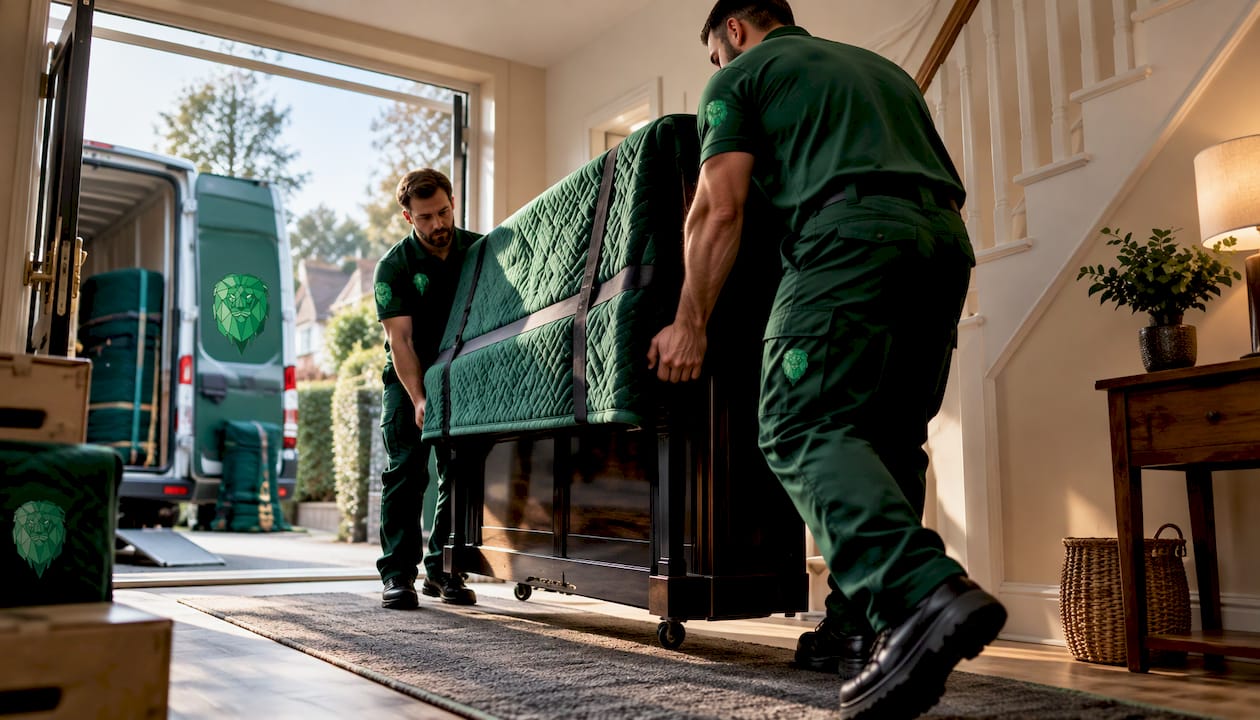
We move pianos, uprights and grands, for homes and businesses across the UK, and we can combine the move with packing, storage and unpacking as part of a house removal. Tell us about the piano, the stairs and the dates, and we will quote for the whole job.
Start with our piano removal page, or see how house removals with storage fit together if the piano is part of a bigger move.
FAQ
What temperature should a piano be kept at?
About 20°C is the figure Steinway gives for a constant room temperature. Steadiness matters more than the exact number, so avoid rooms that swing sharply between cold and warm. Keep the piano away from radiators, windows and direct sun.
What humidity is best for a stored piano?
Bechstein calls 40–60% good, and Steinway gives 45–70%. A target of roughly 45–60% sits inside both and is a sensible aim. Use a hygrometer to check, and keep changes small.
Can a piano be stored in a storage unit?
Yes, as long as the unit is dry, indoors and reasonably steady in temperature. Make sure the floor is level, the access is wide enough for a safe carry and nothing will be stacked on the piano. A basic unit that follows the weather is a poorer choice than a stable indoor space.
How long can a piano stay in storage?
A well-prepared piano in a steady, dry room can stay for months. The longer the stay, the more you should check the room every few weeks for damp or pests and plan tuning once it is back in use. Have any existing faults looked at before it goes in.
Is it safe to store a piano in a garage?
It is best avoided. Garages, sheds, cellars and conservatories are prone to damp and temperature swings, which are exactly what a piano dislikes. A heated indoor room is a much safer home.