Removal lorry access UK: whether a removal lorry can reach your front door comes down to four things: the road (width, bridges, weight limits), the kerb (yellow lines and loading rules), the parking space (and whether you can reserve it), and the walk from the vehicle to your door. Check all four a couple of weeks before the move and tell your removal firm what you find. Most access problems are easy to solve on paper and expensive to solve on the day.
If you are reading this with a sinking feeling because your street is narrow, steep or permanently full of parked cars, take a breath. Awkward access is very common in the UK, and there is nearly always a workable answer.
TL;DR
- Tell your removal firm about every access problem when you ask for a quote: narrow lanes, low bridges, steep drives, long carries, no parking.
- Weight and height signs matter. Structural limits (such as weak bridges) have no access exemption, while many environmental weight limits do.
- You can usually load on single or double yellow lines for a short time, but only where there is no loading ban, and the loading must be continuous.
- In busy areas, ask your council for a parking bay suspension early. Some boroughs want 14 days’ notice, and late requests can cost a lot more.
- If the lorry cannot get close, a smaller vehicle shuttling to a bigger one can solve it. Plan it in advance, because extra time costs money.
Table of Contents
- Why access decides how your move goes
- Step 1: Check the road itself
- Step 2: Understand the kerb
- Step 3: Reserve the space with a parking bay suspension
- Step 4: Measure the last stretch
- What to tell your removal company
- When the lorry cannot get close
- Our view: access is a logistics problem
- How we can help with tricky access
- Your two-week countdown
- FAQ
- Sources
Why access decides how your move goes, part of removal lorry access UK
A removal crew’s day is mostly walking: from the van to the door, up the stairs, back again. Every extra metre between the vehicle and your front door is repeated hundreds of times across a full house. Industry guidance on surveying removals says access determines how long the volume takes to move, and lists floor level, lifts and the distance from the parking position to the door among the factors that matter.
That is why a three-bed house on a quiet cul-de-sac can be quicker than a one-bed flat up four flights on a red route. It is also why accurate access information at the quote stage is the single most useful thing you can give a removal company.
Moving day is a marathon, not a sprint. Good access planning is your training plan.
Step 1: Check the road itself
Start with the road your lorry will actually drive along, not just your own street.
Width and turning space
Walk or drive the last few hundred metres at the time of day the lorry will arrive. Look for:
- parked cars on both sides that leave a single lane
- tight corners at the end of your road
- overhanging trees or low branches
- speed humps, chicanes and width restrictors
- dead ends with no space to turn round
A large lorry needs far more turning room than a car. If you have any doubt, take a few photos and a short video and send them to your removal firm. For anything beyond a simple move, an in-person survey is better still: a property article on choosing a London removal firm notes that firms that survey in person handle access risks better than those relying on remote estimates, because vehicle dimensions and turning circles are hard to judge on video.
Height: bridges and overhead obstructions, part of removal lorry access UK
The standard minimum clearance under highway bridges in the UK is 5.03m (16ft 6in), and the council’s guidance reminds drivers to check the plated height and weight of their own vehicle. Your removal company should know its vehicles’ dimensions. Your job is to flag anything unusual on the approach: a low railway bridge, a car park barrier, an overhead cable, a low archway into a mews or courtyard.
Weight limits and the “except for access” question, part of removal lorry access UK
This is where most confusion happens. Signs showing a weight limit, often 7.5 tonnes, do not all mean the same thing:
- Environmental weight limits are there to keep heavy lorries off residential or unsuitable roads. Under Surrey County Council’s guidance, removal lorries may generally still use these roads for access and deliveries. Check the exact wording on the sign and plate beneath it.
- Structural weight limits, such as those protecting a weak bridge, are mandatory and carry no access exemption.
The 7.5 tonne figure is a maximum gross weight, so a vehicle plated at exactly 7.5t is allowed to pass such a sign, as a transport forum explainer points out. If your road has a restriction, mention it when you book. The crew can then pick the right vehicle and route in advance, rather than discovering the sign at the end of your road.
Step 2: Understand the kerb, part of removal lorry access UK
Once the lorry is on your street, the next question is where it can stop.
Yellow lines and loading
On single and double yellow lines, loading and unloading is permitted for a maximum of 40 minutes in London, provided loading is observed, you do not cause an obstruction and there is no loading ban. Other councils set their own limits, so treat that figure as a London reference point rather than a national rule.
Look at the kerb itself:
- Short yellow marks on the kerb show a loading restriction. A single mark means a ban during the hours on a nearby time plate. Double marks mean no loading at any time.
- Red routes (double red lines) have stricter rules and often need a specific arrangement.
- Resident or pay bays have their own rules, and these differ council by council.
A yellow line does not mean you can leave the lorry unattended while everyone has a cuppa. Loading has to be continuous and visible. A full house move rarely fits into 40 minutes, so on a busy street do not rely on yellow lines alone.
A real example of council rules: Islington
Councils differ a lot. Islington, for instance, says you can park outside your home free of charge when moving. Under its rules, liveried vehicles (clearly showing company branding) can stay as long as needed on a single yellow line or in a resident bay, as long as loading is continuous and no other loading restriction applies. Un-liveried vehicles get more limited rules. If you expect breaks in loading, the council advises buying a permission to park in a bay.
The lesson: check your own council’s page for “parking to move home” or “parking suspensions”. Do not assume the rules from the last borough you lived in apply.
Step 3: Reserve the space with a parking bay suspension, part of removal lorry access UK
If your street is full of parked cars, the best fix is to have the council reserve the space. A parking suspension reserves specific bays for a particular purpose, and you can book one as a resident or a business.
Timing is where people get caught out:
| Item | What to know |
|---|---|
| Notice | Camden’s guidance points to booking at least 14 days ahead; other councils vary, and some ask for around 10 working days |
| Late booking | Short-notice fees can exceed £300 in some boroughs, or the council may not be able to guarantee the bay |
| Vehicle details | Give registration details in advance, so the removal vehicle is not issued a Penalty Charge Notice |
| Enforcement | If someone parks in your suspended bay, contact the council’s suspension enforcement line, not the police |
The figures above come from Camden Council’s parking bay suspension page. Other councils run their own schemes. The Isle of Wight, for example, takes requests through an online form for valid activities, which shows how much the process varies across the country.
Our own guides cover this in detail: read why some councils need 10 working days for a suspension and our two-week plan for narrow street access.
A simple suspension checklist
- Find your council’s parking suspension page (search the council name plus “parking suspension”).
- Ask your removal firm for the vehicle registration, or ask which vehicle will be used.
- Apply as early as the council allows, and at least two weeks ahead for busy urban areas.
- Save the confirmation and keep a copy on your phone for the day.
- Put out the signs or cones if the council asks, and check on the morning that they are still in place.
- Keep the enforcement contact number handy.
Step 4: Measure the last stretch, part of removal lorry access UK
Even with perfect parking, the “last 50 metres” can change the quote. Make a note of:
- the distance from the parking spot to your door (in paces is fine)
- the number of steps, flights of stairs and whether there is a lift
- the width of the lift, doors, hallways and stairwells
- any gravel, steep slopes, narrow paths or gates
- whether the building has loading bay rules or booking times
If you live in a managed block, ask the building manager about lift booking and permitted hours. Some blocks only allow moves at set times, and that affects when your crew can arrive.
For big items, measure them as well as the doorways. A sofa that came in through a window years ago may need disassembly, and the crew should know in advance. Our furniture and large items service covers awkward pieces, and we can handle furniture disassembly and assembly where needed.
What to tell your removal company, part of removal lorry access UK
When you ask for a quote, give your removal firm a short access summary. Copy this list into your message:
- full postcodes of both addresses
- type of property and floor level, with lift details
- the distance from the parking spot to the door
- whether the street is narrow, one-way, steep or a dead end
- any weight or height restrictions on the approach
- yellow lines, red routes, resident bays or private roads
- whether a parking suspension is booked, with the reference
- large, fragile or heavy items (pianos, safes, wardrobes)
- photos of the street and the entrance
The more detail you give, the more accurate the quote. Hiding a problem to get a lower price just moves the cost to moving day.
When the lorry cannot get close, part of removal lorry access UK
Sometimes you do everything right and the street still will not take a big vehicle. You have a few options.
Use a smaller vehicle
For flats, terraces or small lanes, a smaller van may reach the door when a large lorry cannot. You may need more trips, so the crew time goes up, but the move stays safe.
Shuttle to a larger vehicle
A smaller vehicle can ferry the load to a bigger lorry parked on a wider road nearby. It adds handling time, so plan it in advance. This is much better than discovering the problem when the lorry is already at the end of your road.

Move at a quieter time
Early mornings often leave more room at the kerb, because residents have not yet returned and commuters have left. Weekends can be easier in business areas and harder in residential ones. Ask the crew what works locally.
Expect waiting time to cost
If your crew has to wait for a bay to clear, for a lift, or for keys, the clock keeps running. Our published waiting time fee is 24 GBP per hour per man. Good preparation keeps that line off your bill.
Our view: access is a logistics problem, part of removal lorry access UK
We have been moving people and goods across the UK for over 15 years, and the pattern is clear: very few moves go wrong because of the furniture. They go wrong because of the kerb. A lorry that cannot park, a street that cannot take it, a bay nobody reserved.
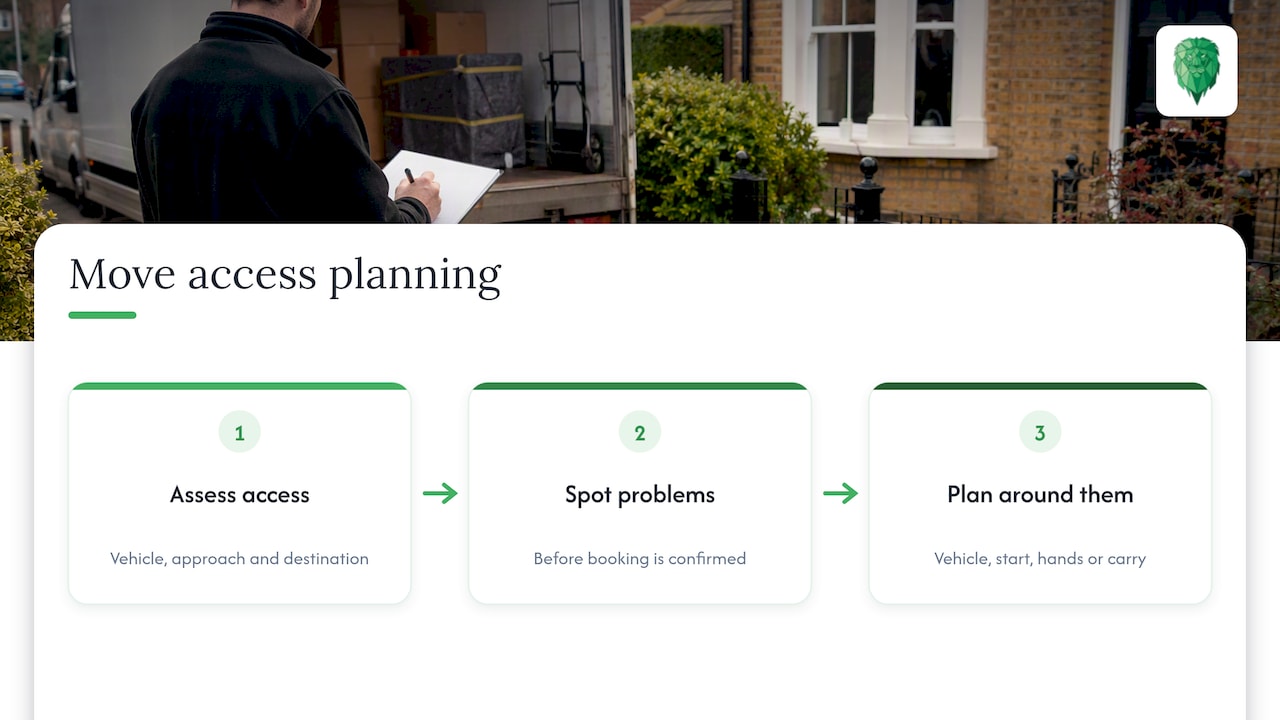
So we treat every move as a small logistics job. Before a booking is confirmed, we want to know how close the vehicle can get, what is on the approach road, and what is waiting at the other end. If a problem shows up early, we can plan around it: a different vehicle, an earlier start, extra hands or a longer carry built into the plan. If it shows up on the day, everyone loses time and patience.
Our advice is simple. Be nosy about your own street. Walk it, photograph it, measure it. Then tell us everything, including the bits you think are embarrassing, like the 40 steps up to your door. We have seen them all, and none of it is a problem as long as it is planned for.
— Claudiu
How we can help with tricky access, part of removal lorry access UK
If your move involves tight streets, restricted parking or a long carry, tell us about it when you ask for an instant online quote. We handle house removals across the UK, with packing, storage, unpacking and cleaning after your move as options, and our transport is insured. In London, take a look at our London removals page. To get started, request a quote from Van-247 and include the access details from the checklist above.
Your two-week countdown
| When | What to do |
|---|---|
| 3 to 4 weeks before | Check the approach road for height, width and weight signs. Read your council’s parking and suspension rules. |
| 2 to 3 weeks before | Send access details and photos to your removal firm. Apply for a parking suspension if needed. |
| 1 week before | Confirm the suspension and vehicle registration. Tell neighbours about the move. Check lift booking in your block. |
| 2 days before | Clear the path to the door. Take photos of the street as it looks now. |
| Moving day | Check the bay is clear first thing. Keep the council reference and enforcement number to hand. |
For paperwork and timings on the day itself, see our removal day paperwork checklist.
FAQ
Can a removal lorry park on double yellow lines?
Often yes, for a limited time. In London, loading and unloading is allowed on single and double yellow lines for up to 40 minutes if loading is observed and there is no loading ban. Check the kerb for marks showing a ban, and your council for local limits. For a full house move, a bay suspension is safer.
Do I need to tell the removal firm about narrow streets?
Yes, every time. Narrow lanes, parked cars and tight corners decide which vehicle can be used and how long the job takes. Sending photos and a short description with your request avoids surprises and extra charges on the day.
How far ahead should I book a parking suspension?
As early as your council allows. Camden’s guidance suggests at least 14 days, and short-notice requests can cost over £300 in some boroughs or fail altogether. Rural and smaller councils may have different timescales, so check yours first.
Can a removal lorry go down a road with a weight limit?
Sometimes. Environmental weight limits generally allow access for deliveries, but structural limits, such as those protecting weak bridges, have no exemption. Read the sign and any plate beneath it carefully, and ask your removal firm to confirm the route for their vehicle.
Sources
- Heavy goods vehicles (HGVs), Surrey County Council
- Loading and unloading, London Councils
- Parking bay suspensions, Camden Council
- Parking to move home, Islington Council
- Suspensions, Isle of Wight Council
- How to Choose a Dependable London Removal Company, Property Investor Today
- How to Do a Removals Survey, Moovi
- The 7.5-tonne weight-limit sign, Transport Forum