Single vs double wall boxes: use single wall boxes for light, soft things like clothes, bedding and cushions. Use double wall boxes for anything heavy, fragile, valuable or bound for a long stay in storage. Most moves need both, and the trick is putting the right contents in the right box. We have been moving homes, offices and fragile items across the UK for over 15 years, and we pack and unpack for customers who would rather not think about any of this. If you are packing yourself, this guide gives you the rules.
TL;DR
- Single wall has one layer of fluted (wavy) paper between two flat sheets. It is lighter, cheaper and easy to carry, so it suits clothes, linen, toys and soft furnishings.
- Double wall has two fluted layers and three flat sheets. It resists crushing and impact better, so it suits books, kitchenware, glass, electronics and anything that will be stacked or stored.
- A common UK rule of thumb: single wall up to about 10 kg, double wall for 10 to 20 kg and for fragile or valuable contents.
- A strong box does not protect what is loose inside it. Wrap, fill gaps and keep weight at the bottom.
- Buy a mix, then pack heavy items in small double wall boxes so nothing becomes too heavy to lift.
Table of Contents
- What the walls actually are
- How strong is each one?
- Which box for which item?
- Does double wall mean you can skip the wrapping?
- Cost, weight and space: the honest trade-offs
- Loading and stacking: where boxes really fail
- What about big or awkward items?
- Offices, pianos and pallets: box choice at work
- Promo: let us pack it for you
- FAQ
- Sources
What the walls actually are, part of single vs double wall boxes
The “wall” in a cardboard box is not a single sheet. It is corrugated board: a rippled layer of paper, called fluting, glued between flat sheets called liners. FEFCO, the European federation of corrugated board makers, describes single wall as one fluting layer between two liners, while double and triple wall are built up from several layers on the same production line.
That makes the maths simple:
| Single wall | Double wall | |
|---|---|---|
| Fluted layers | 1 | 2 |
| Flat liners | 2 | 3 |
| Total layers | 3 | 5 |
| Weight and bulk | Lighter, thinner | Heavier, thicker |
| Cost per box | Lower | Higher |
| Best for | Light, soft or robust items | Heavy, fragile, valuable or stacked items |
The ripples are the clever part. FEFCO explains that the fluted shape forms a row of connected arches, a shape known for carrying heavy loads. Add a second set of arches and the box takes more weight and more knocks before it gives way. A UK packaging guide puts it plainly: the extra corrugation gives double wall greater resistance to crushing and impact.
How strong is each one? Part of single vs double wall boxes
Strength ratings are measured in a few ways, and you will see them on box specifications. One is edge crush test (ECT), which measures how much squeezing force the board’s edge can take before it buckles. Another is burst strength, how much pressure it takes to push through the board.
One US comparison of the two board types gives typical figures: light single wall at 32 ECT for roughly 40 to 65 lb, heavy single wall at 44 ECT for 65 to 95 lb, and double wall at 48 to 61 ECT for roughly 80 to 140 lb. It stresses these are approximate and depend on box size, how it is packed and how it is stacked.
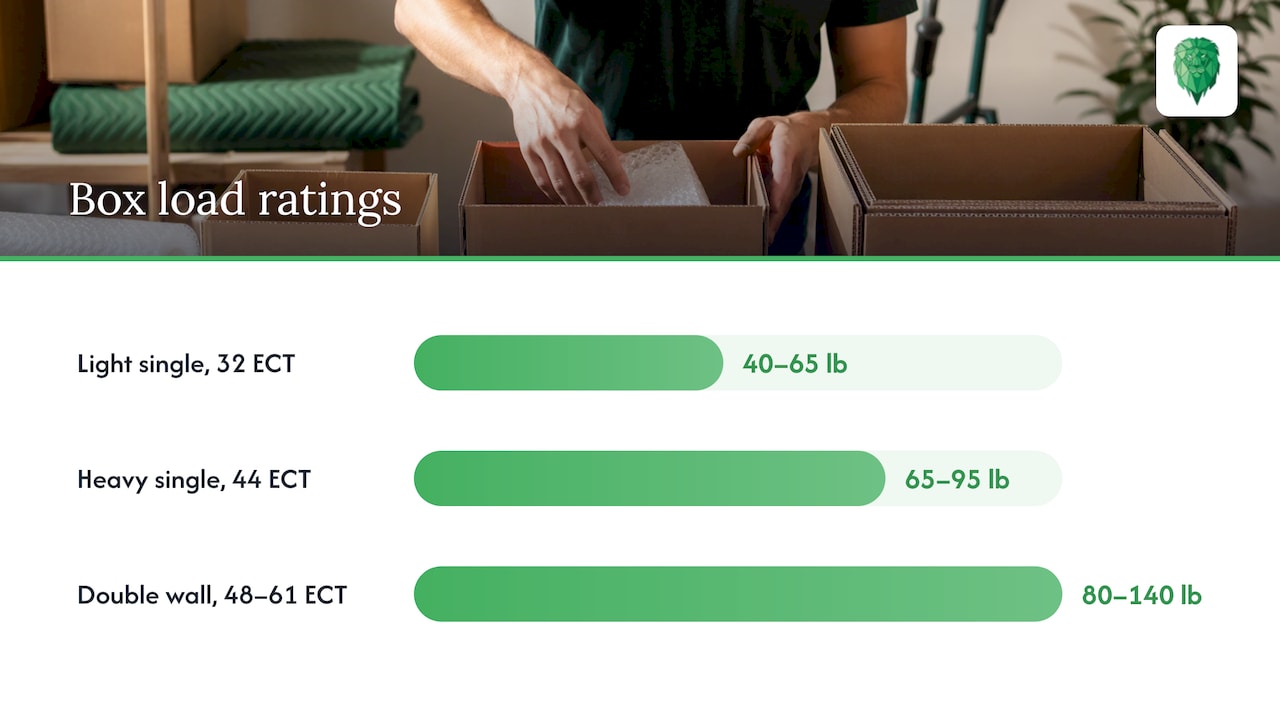
You will not be reading ECT numbers off a box in a shop, but the pattern is useful. Double wall takes roughly twice the load of single wall, and that extra headroom matters more on moving day than the raw number. Boxes get dropped, tilted, stacked three high in a van and left in a garage for weeks.
A second UK source notes that double wall is safer to stack and less likely to crumple under large mass, which is exactly what happens to the bottom row in a loaded van or a spare room.
Which box for which item? Part of single vs double wall boxes
A useful UK rule of thumb comes from a box supplier’s guidance: single wall for everyday parcels up to 10 kg, and double wall for heavier loads of 10 to 20 kg, fragile or valuable goods, long journeys, pallets and anything stored under other boxes. Another UK guide suggests a mixed approach for house moves: single wall for lighter clothing and linen, compact double wall for heavier contents, and double wall with cushioning for fragile items.
Here is how that looks room by room.
Single wall is fine for
- Clothes, coats and shoes (not too many pairs in one box)
- Bedding, towels and curtains
- Cushions, soft toys and lampshades
- Light kitchen items such as plastic containers and tea towels
- Anything you will unload in a day or two
Double wall is the better choice for
- Books, records and files (small double wall boxes only, they get heavy fast)
- Plates, glasses, mugs and ceramics
- Laptops, monitors, printers and other electronics
- Tools, tins and jars
- Ornaments, framed items and anything valuable or sentimental
- Anything going into storage, where boxes sit under other boxes for weeks or months
The supplier guides above agree that double wall is the sensible pick for glassware, electronics, ceramics, long-distance travel and long storage.
A quick test while you pack
Pick the box up before you seal it. If you strain, it is too heavy for its walls, its handles and your back. Either move some contents into a second box or switch to a smaller double wall box. Small boxes with heavy things, big boxes with light things: that single habit prevents most burst bottoms.
Does double wall mean you can skip the wrapping? Part of single vs double wall boxes
No. A thick box is protection from outside forces, not from the contents bumping into each other. As one UK guide points out, double wall does not mean unlimited strength: board quality, box design, packing method and storage conditions all matter, and no box stops two unwrapped glasses knocking together.
For fragile items, pair the right box with the right padding:
- Wrap each item individually in paper or bubble wrap.
- Put a layer of crumpled paper or padding on the bottom of the box.
- Stand plates and bowls on their edges, never flat in a pile.
- Fill every gap so nothing can shift when the box is shaken.
- Add a final layer on top so the lid closes firmly without bulging.
- Tape the base and the top with strong packing tape, along the seam and across the edges.
We go through the full routine in our guide on how to move fragile items safely, and our notes on bubble wrap rolls cover what to wrap first. If you want the bigger picture of why packing matters on a move, see the role of packaging in relocation.
Cost, weight and space: the honest trade-offs, part of single vs double wall boxes
Double wall costs more per box and weighs more empty. Suppliers also point out that single wall is generally more cost-effective because it uses less material. Double wall also takes up more room when stored flat, which matters if you buy a stack of 40 boxes and have a small flat.
Industry figures suggest that around 90 percent of corrugated board is single wall, and that double wall, the stronger and heavier option, is used for furniture, appliances and bulk goods. So single wall is the everyday default, and double wall is the specialist.
For a typical three-bedroom move, the sensible split is:
- Mostly single wall for the soft stuff: wardrobes, bedrooms, living room cushions.
- Double wall for the kitchen, books, office kit and anything breakable.
- A handful of extra double wall boxes for last-minute items that turn out to be heavier than you thought.
Spending a little more on the boxes that carry glass, crockery and electronics is cheap compared with replacing what breaks. Both board types are recyclable, so once you have unpacked, both can go in your recycling.
Loading and stacking: where boxes really fail, part of single vs double wall boxes
Most box failures are not about the board. They happen because of how boxes are filled and stacked. Practical UK moving advice is to stack the heaviest boxes at the bottom with lighter cartons above, put full boxes on full boxes rather than on half-empty ones with sagging lids, and label each box with the room, a contents keyword and a fragile flag on more than one side. A box number such as 12/45 helps you check everything has arrived, and a quick photo of the loaded boxes is handy if you ever need to make an insurance claim.
A few more habits that help:
- Keep boxes in a single stack height you can manage, and keep the stack square rather than leaning.
- Do not let boxes overhang the pallet or the van floor edge.
- Put your “first night” box, with kettle, chargers, toiletries and bedding, in last so it comes out first.
- Keep tape on the seams and corners, not only across the middle.
Boxes on pallets
If your boxes are going by pallet, stacking strength matters even more, because the bottom layer carries everything above it for the whole journey. Double wall is the sensible choice there, and building the load neatly makes a big difference. This guide to stacking and palletising freight shows how a well-built pallet holds together. Our own notes on pallet crates and boxes explain how crates keep boxed goods in order during storage and transport.
What about big or awkward items? Part of single vs double wall boxes
Boxes are for things that fit in boxes. Mirrors, flat-pack furniture, lamps, bikes and anything long or oddly shaped need wrapping, corner protection or disassembly rather than a bigger carton. Our guide to large item courier packaging covers how to pack big items safely, and for sofas, fridges and tall furniture, our tips on moving a fridge and lifting furniture show how to avoid damage and strain.
Offices, pianos and pallets: box choice at work, part of single vs double wall boxes
The same logic applies when you relocate a small office. Files and archive boxes are heavy, so use double wall for paper, and keep single wall for stationery and soft items. Monitors, printers and screens deserve double wall with proper padding. If you are moving servers or setting up Wi-Fi and video conferencing in a new office, those are things we handle as part of our office relocation service, so they never need to sit in a carton on your desk.
Promo: let us pack it for you
If choosing boxes, wrapping glass and labelling forty cartons sounds like a weekend you would rather not have, we can take that job off your hands. Our team handles packing and unpacking, furniture disassembly and assembly, and storage, and our transport is insured. We cover house removals, furniture and large items, pallet delivery and piano removal across the UK. You can start with our house removals service or get an instant online quote.
If you are packing alone but want a hand on the day, our man and van service can load the boxes you have prepared. Waiting time, if a job is held up, is charged at £24 per hour per man.
Our view: pack by weight, not by room
After more than 15 years of moving homes and offices, we think the best advice is also the simplest. Decide a box by what is going into it, not by how many boxes you have left.
Single wall is a great everyday box. Double wall is the box we would choose for anything heavy, breakable or likely to be stacked, and for anything going into storage. A well-packed double wall box, with each item wrapped and no gaps inside, is what lets a load travel across the country and arrive intact.
That is also why we offer packing and unpacking alongside removals: the right box, filled the right way, loaded in the right order, makes the difference between a calm move and a stressful one. Moving day is a marathon, not a sprint, and good boxes are your running shoes.
Claudiu
FAQ
What is the main difference between single wall and double wall boxes?
A single wall box has one layer of fluted paper between two flat liners, three layers in all. A double wall box has two fluted layers and three liners, five layers in all. The extra layers make double wall stronger, heavier and more expensive.
Can I use single wall boxes for books?
Only in small amounts, and it is better not to. Books are dense, so a medium single wall box filled with them can easily become too heavy to lift and may split at the base. Small double wall boxes keep the weight manageable and the base firm.
Are double wall boxes better for storage?
Yes, in most cases. Boxes in storage sit under other boxes for weeks or months, and double wall is more resistant to crushing under that load. Stack the heaviest boxes at the bottom and keep them off damp floors.
Do I need double wall boxes for everything?
No. Clothes, bedding and other light, soft items travel perfectly well in single wall boxes, which are lighter, cheaper and easier to carry. A mix of both, matched to what is going in, gives the best result for the price.
Sources
- FEFCO: corrugated board production
- Single-wall vs double-wall cardboard guide (UK)
- Single wall vs double wall boxes: strength, cost and uses
- Do I need single wall or double wall boxes? (UK)
- Should I use a single wall or double wall box? (UK)
- Single walled vs double walled cardboard boxes (UK)
- How are corrugated boxes made?
- Best storage boxes for UK moves and storage
- Stacking and palletising freight