Stairs move planning: stairs are where most moves slow down. The way to plan around them is simple: measure the whole route (not just the staircase), protect the surfaces you’ll pass, decide who carries what and with which equipment, and tell your removal team about every awkward turn before moving day. Do that a week or two ahead and the stairs become a known quantity rather than a nasty surprise.
If you’re moving out of a third-floor flat, into a Victorian terrace with a tight turn at the bottom, or shifting a wardrobe to an upstairs bedroom, this guide walks you through it step by step. Take a breath: it’s very doable.
TL;DR
- Measure the full route from the kerb to the final room. The narrowest point decides whether an item fits, so note it at every stage.
- Leave at least 5cm spare at every point, and measure the clear opening, including handrails, hinges and frames.
- Protect stairs, walls and banisters before the first box moves, and never leave items in communal stairwells.
- Heavy items need a plan: two people, proper handling aids and, for the biggest pieces, a team that does this every day.
- Tell your removal company about stairs, turns, lifts and parking when you book, not on the day.
Table of Contents
- Why stairs deserve their own plan
- Step 1: Measure the whole route
- Step 2: Work out whether big items will fit the turns
- Step 3: Protect the stairs, walls and banisters
- Step 4: Carry heavy and awkward items safely
- Step 5: Plan for fragile and valuable items
- Step 6: Confirm access with your removal team
- Step 7: What if it simply won’t fit?
- Moving a home or an office with stairs
- Our view: tell us about the stairs early
- Let us handle the stairs
- FAQ
- Sources
Why stairs deserve their own plan, part of stairs move planning
A move on the flat is mostly about volume. A move with stairs is about geometry, weight and time. Every step multiplies the effort of carrying, and every turn limits what can physically pass. A sofa that glides through the front door can jam at the half landing, and a box that’s fine on its own becomes risky when someone is walking backwards down twelve steps with it.
There’s also the human side. People get tired, floors get scuffed and tempers fray when a wardrobe gets stuck. A short planning session removes most of that. Think of moving day as a marathon, not a sprint: the stairs are the hills, and you want to know where they are before you start running.
Step 1: Measure the whole route, part of stairs move planning
Don’t just measure the item. Measure every point it has to pass, from the kerb to its final position. One furniture guide advises noting the narrowest point at each stage and allowing at least 5cm spare at every point.
What to measure
Grab a tape measure, a notepad (or your phone) and a helper. Then measure:
- Stair width. Measure from the handrail to the wall at the narrowest step. Another guide notes the same, and adds that you should check headroom and note turns, winder steps and half landings.
- Stairway width including handrails or posts, plus the height from the top and bottom steps up to the ceiling. This is the approach in a delivery measuring guide from a US furniture retailer; the method works the same way in UK homes.
- Doorways. Open the door as far as it goes and measure from the door’s edge at the frame to the other side of the frame, at the narrowest points. Hinges and frames reduce the clear opening, so the nominal door size on a plan isn’t enough.
- Hallways. Include anything that sticks out: radiators, light fittings, skirting boards, coat hooks and banister newel posts.
- Ceiling height at the top of the stairs, especially in loft conversions and under sloping ceilings.
Write it down as a route map
Sketch a simple line from the van to the final room and put a number against every pinch point. For example: front gate, front door, hallway (radiator side), stairs, half landing, bedroom door. Share it with your removal team. It takes ten minutes and saves a lot of guessing.
Step 2: Work out whether big items will fit the turns, part of stairs move planning
Corners cause more trouble than doorways. At a right-angled turn, both passage widths and the item’s length count, so a piece that’s narrow enough for the stairs can still be too long to pivot.
For stair turns and landings, one furniture maker suggests measuring the landing’s depth, width and diagonal space to see whether the item can be pivoted or rotated. The same guide says to measure the path before and after the turn, along with ceiling height, and to consider removable parts or another entrance if clearance is close.
A quick fit check
| Item | What usually decides whether it fits | What to measure |
|---|---|---|
| Sofa or corner unit | Depth and arm height at the turn | Depth, height, diagonal; landing size |
| Wardrobe | Length at the turn, ceiling height | Longest side, depth, headroom |
| Mattress | Flexibility and doorway width | Width, thickness, narrowest doorway |
| Fridge-freezer or washing machine | Weight and width in a narrow hallway | Width, depth, hallway clear width |
| Piano | Weight, length and any change of level | Full route plus every step and turn |
The table is a planning aid, not a verdict. If the numbers are close, say so when you book: a team that knows about it in advance can bring the right people and tools.
Step 3: Protect the stairs, walls and banisters, part of stairs move planning
Stairs take a battering on a move. Boots grind grit into carpet, corners chip paint, and banisters get knocked at every turn. Protection is cheap compared with repairs, and it’s much easier if you do it before the first load.
- Cover the treads. Use carpet protector film or stair runners, and fix them so they can’t slip underfoot. A loose runner is a trip hazard, so check it’s secure.
- Pad corners and banisters. Foam or cardboard corner guards on the newel post and wall edges at each turn are worth the effort.
- Wrap furniture. Blankets and wrap keep the item itself from scraping the walls. Our guide to how movers wrap furniture covers the method step by step.
- Clear the route. Move rugs, plants, pictures and loose items out of the way, and remove anything on the walls beside the stairs.
We’ve put together a short guide on stair protection during a move if you want the full five-step version.
Keep shared stairwells clear
If you’re in a flat or any building with shared stairs, be careful about where boxes wait. Guidance for local authorities in England says communal escape routes, including stairwells in flats, must be kept free of furniture, storage or obstructions at all times for fire safety. In practice: carry items straight to the van or the flat, rather than stacking them on the landing. Ask your building manager about their rules, and whether the lift needs to be booked.
Step 4: Carry heavy and awkward items safely, part of stairs move planning
This is the part where planning really pays off. The Health and Safety Executive’s advice is straightforward: plan the lift, use suitable handling aids where possible and remove obstructions from the route.
Handling aids and teamwork
For stair moves, a few simple tools help a lot. Lifting straps or shoulder dollies can reduce strain, but one UK materials handling guide says they should be used only by two people working in sync. If you’re borrowing a friend, agree the signals before you lift: who leads, who says “stop”, and where you’ll rest.
Some practical rules:
- Empty drawers and cabinets, and remove shelves, glass and doors where you can.
- Keep the heavier end lower going down and, where possible, put the stronger person below going up.
- Go slowly, and stop at landings rather than carrying through a turn mid-step.
- Wear grippy shoes and keep the steps dry and clear.
- Never carry anything that blocks your view of your feet.
Powered stair climbers
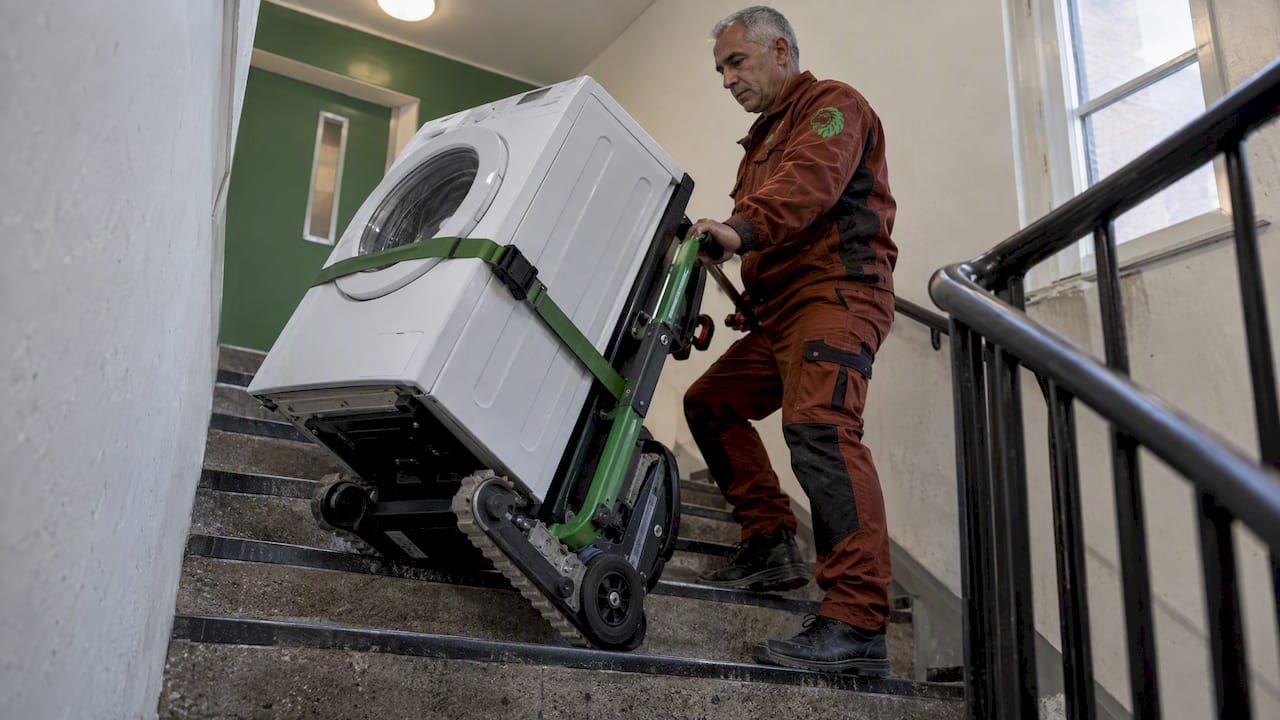
Professional teams sometimes use powered stair climbers for appliances and heavy boxes. Safety guidance from a UK lifting gear body says to use one only if its rated capacity covers the load and the stairs are sound, dry, clear, and wide and strong enough, and that trained operators should secure the load and move it slowly. This isn’t kit to hire and try for the first time on moving day, which is a good reason to leave the heaviest pieces to people who use it regularly.
Step 5: Plan for fragile and valuable items, part of stairs move planning
Fragile and valuable things need a slower, quieter kind of planning. A few habits make the difference:
- Carry them last in, first out of your mind. Move delicate items when the stairs are clear and nobody is rushing past.
- Give them their own wrap and box. Mirrors, glass tops, artwork and lamps do best in their own protective packing, labelled clearly. Our packing and wrapping guidance shows how.
- Take things apart where possible. Removing legs, shelves and glass shrinks the load and lowers the risk on the stairs.
- Ask about cover. Check what insurance applies to the items you value most before the day.
Pianos need a plan of their own
A piano is heavy, awkward and easy to damage, so stairs are a serious question, not a detail. The route matters as much as the instrument: every step, turn and doorway, from the pavement to the final spot. Our piano access assessment shows how to map the route so you can avoid last-minute surprises such as needing a crane. Don’t try to carry a piano with friends. Book a team that moves them for a living, tell them about every step and turn, and let them decide the method.
Step 6: Confirm access with your removal team, part of stairs move planning
Stairs aren’t the only access question. Before moving day, confirm where the van can stop, measure the route’s access points, note obstacles like narrow stairs, turns or low ceilings, and check whether a lift needs booking.
Here’s a checklist worth sending when you book:
- Number of floors at both addresses, and whether there’s a lift (and its size)
- Number of steps outside, and any narrow or winding sections
- Where the van or lorry can park, and how far that is from the door
- Any large or heavy items, with measurements
- Anything that may need disassembly, such as beds, wardrobes or a dining table
- Any rules from a landlord, building manager or council
Parking is part of the stairs story, because every extra metre between van and door is more carrying. Our guides on removal lorry access, parking for removals and narrow street access explain what to check and when to arrange permits or suspensions. If you’re planning the whole move, our step-by-step guide to moving house in the UK puts it in order.
Step 7: What if it simply won’t fit? Part of stairs move planning
It happens, and it’s not a disaster if you find out early. Measure first, then work through these options in order:
- Check for removable parts. Legs, feet, headboards, doors, cushions and shelves often come off, which can free up the few centimetres you need.
- Try a different entrance. A back door, patio doors or a wider window may offer a better route than the front stairs. The measuring guidance says to consider removable parts or another entrance when clearance is close.
- Disassemble and rebuild. Taking wardrobes and beds apart, then reassembling in the new room, is routine for a good removal team.
- Ask for specialist help. For very large or very heavy pieces, an access assessment by your removal team will tell you what’s realistic.
- Decide whether it should come at all. If an item can’t be moved safely, it may be better to sell, donate or replace it than to risk injury or damage to the property.
Even if you’re on a tight budget, it’s worth deciding before moving day. Some jobs also have waiting time: on our rates, waiting time is £24 per hour per man, so a long hold-up at a stuck staircase isn’t a cost you want to find out about later.
Moving a home or an office with stairs, part of stairs move planning
Home moves and office moves have different stair problems. In a house, it’s mostly about furniture on narrow domestic stairs. In an office, it’s heavier items, shared stairwells, lift booking and building rules. If you’re moving workplaces, our office move risk assessment helps you check the route and the people involved. If you’re delivering a single large piece, the guide to furniture delivery services explains what a delivery team needs from you.
It also helps to know what teams generally won’t carry. Our list of what movers won’t move in the UK is worth a glance before you start packing.
Our view: tell us about the stairs early
After more than 15 years in removals, we can say that the stairs rarely cause trouble because they’re hard. They cause trouble because nobody mentioned them. A customer who tells us about a narrow turn, a third-floor walk-up or a piano in the lounge gives us the chance to send the right people, bring the right protection and set aside enough time.
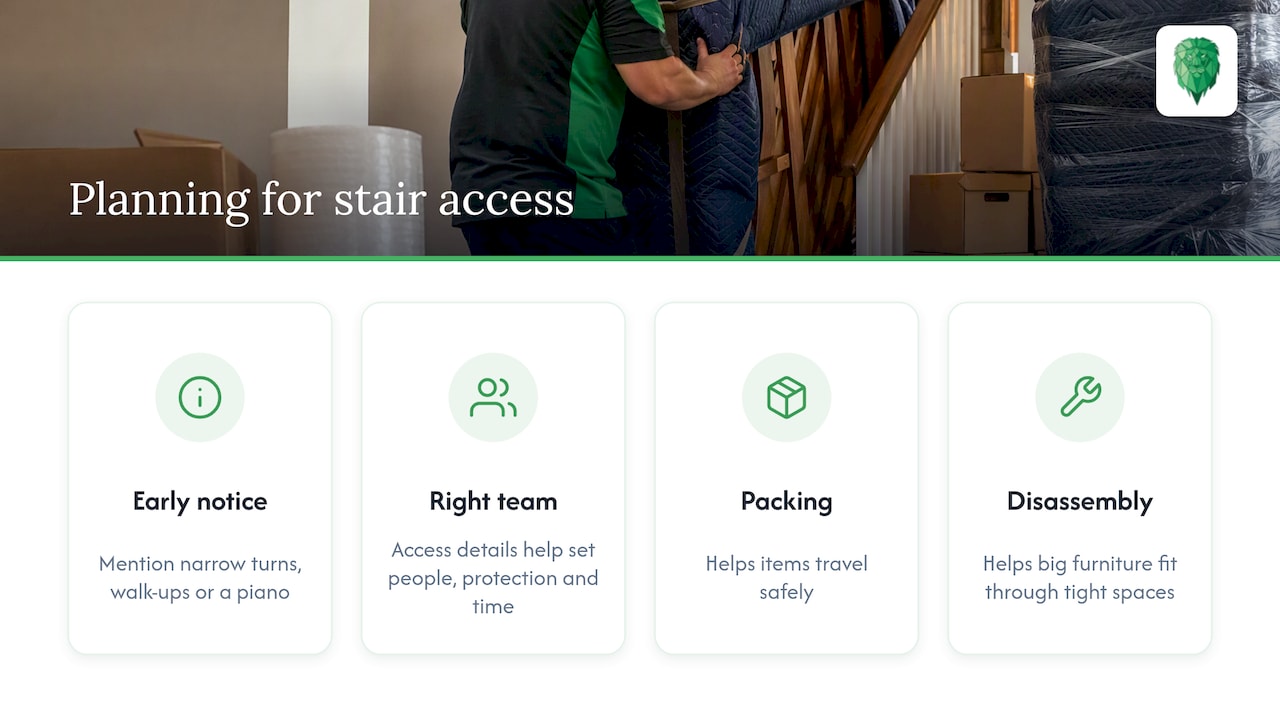
That’s why we always ask about access when we quote. Our teams handle large, fragile and valuable items, and our services are designed around exactly these situations: packing so that items travel safely, disassembly and assembly so that big furniture can get through tight spaces, and insured transport for peace of mind. If you’re not sure whether something will fit, send us the measurements. It’s much better to solve it on paper than on the landing.
One more tip: don’t be shy about asking. Moving is stressful enough without trying to be an expert in staircase geometry. That’s our job.
— Claudiu
Let us handle the stairs, part of stairs move planning
If you’d rather not carry a wardrobe down three flights yourself, we can help. We offer house removals with packing, disassembly, assembly, storage and unpacking as options, plus furniture and large item transport and piano removal. You can get an instant online quote on our website, and the more you tell us about your stairs, the more accurate it will be.
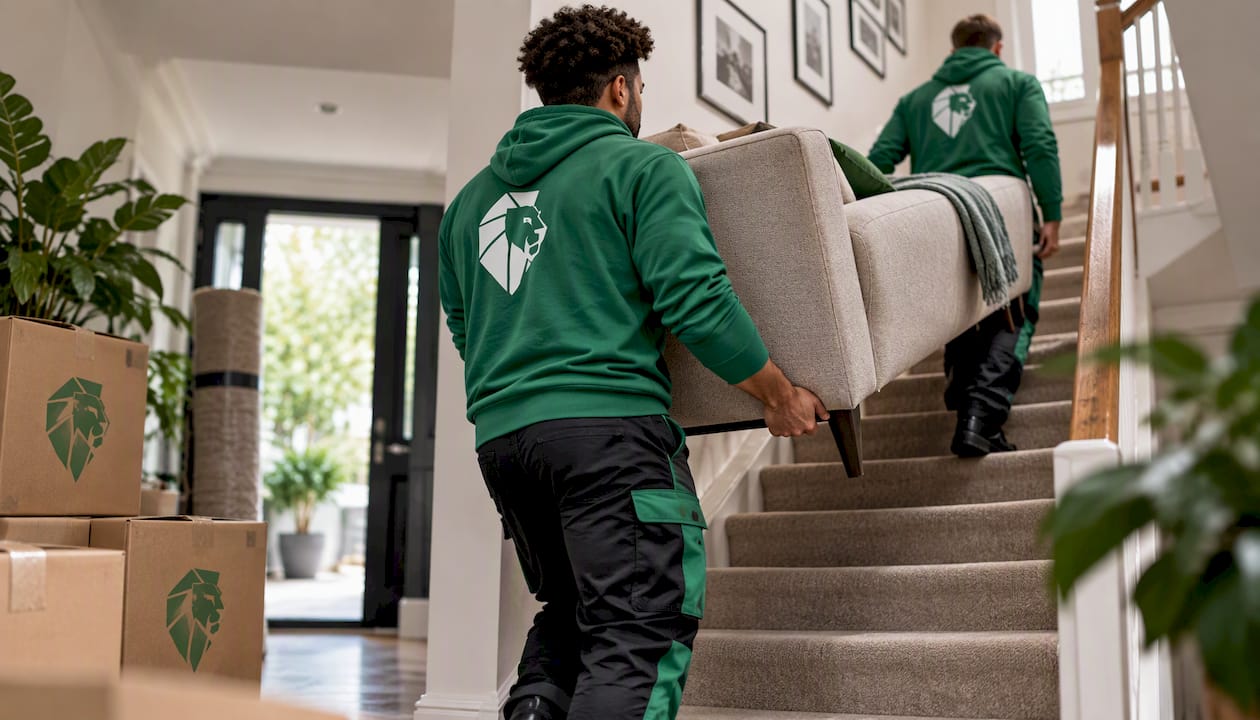
Got a particularly tricky staircase? Mention it when you book and we’ll plan for it.
FAQ
How much space should I leave when checking if furniture will fit up the stairs?
Leave at least 5cm spare at every point along the route, as one UK furniture guide recommends. Measure the narrowest point at each stage, including handrails, door frames and hinges. If the margin is smaller than that, plan to remove parts of the item or look for another route.
Do I need to tell my removal company about stairs?
Yes, always. Tell them how many floors there are, whether there’s a lift, how narrow or winding the stairs are and which items are large or heavy. It helps them send the right number of people and equipment, and it makes your quote more accurate.
Can I leave boxes on the landing in a block of flats?
It’s best not to. Official fire safety guidance for housing in England says communal escape routes, including stairwells, should be kept free of furniture, storage and obstructions. Carry items straight to the van or into your flat, and ask your building manager about their rules.
Are lifting straps or shoulder dollies safe to use on stairs?
They can reduce strain, but they should only be used by two people working in sync, and you should plan the route and remove obstructions first. For very heavy or awkward pieces, it’s safer to book a team with the training and equipment for the job.
What should I do if my sofa or wardrobe won’t go round the stair turn?
First check for removable parts such as legs, doors or cushions. Then consider another entrance, or having the piece taken apart and rebuilt in the new room. If none of that works, ask your removal team to assess the route before moving day.
Sources
- Will It Fit? Measuring Guide for Furniture, Woods Furniture
- Measuring for Furniture Delivery
- Furniture Sizing Guide, Dunelm
- How to Measure for Furniture: Doorways, Staircases, and Tight Turns
- Housing: Fire Safety guidance
- Manual handling at work: Good handling technique, HSE
- How to Move Heavy Furniture Safely
- Safe Use of Powered Stair Climbers