Clear communication is the single biggest factor separating a smooth relocation from a stressful, costly one. Whether you are moving house or coordinating an office relocation for your entire team, the role of communication in relocation shapes every outcome: timelines, costs, morale, and trust. In the moving industry, thousands of annual complaints are linked to poor communication rather than logistics failures.
That single fact tells you everything. Getting the information right, at the right time, to the right people is not a nice-to-have. It is the foundation of a successful move.
What are the core risks of poor communication in relocation?
Poor communication is the leading cause of relocation complaints, delays, and unexpected costs. The Federal Motor Carrier Safety Administration (FMCSA) receives thousands of complaints annually from people who experienced misunderstandings with movers, not mechanical failures or accidents. That pattern reveals a systemic problem: most relocation problems are preventable with clearer information exchange.
The financial and emotional costs stack up quickly when communication breaks down. A driver who arrives at a property without knowing about a narrow driveway or a low-access gate faces delays, additional fees, and a frustrated customer. A team member who hears about an office move through rumour rather than their manager arrives at the new site anxious and disengaged. Both scenarios share the same root cause: someone assumed the other party already knew.
Logistical changes escalate fast without clear updates. A rescheduled lift booking, a delayed packing crew, or a change in access times can derail an entire moving day if no one communicates the update promptly. The impact of poor communication on relocation is not just inconvenience. It translates directly into wasted time, extra charges, and damaged relationships.
- Verbal agreements with no written record lead to disputes over what was agreed
- Missing site details (parking restrictions, floor access, lift dimensions) cause on-the-day delays
- Employees who receive no updates during a workplace move report higher anxiety and lower trust in leadership
- Last-minute changes communicated poorly result in double-handling and rescheduling costs
Pro Tip: Write down every conversation you have with your removal company. Note the date, the name of the person you spoke to, and exactly what was agreed. This one habit prevents the vast majority of moving disputes.
How can you build effective communication strategies for a move?
Effective communication during relocation starts before the boxes are packed. The most important principle is timing: begin communicating as soon as the decision to relocate is confirmed. Waiting until the week before a move leaves people scrambling. Starting early gives everyone time to ask questions, raise concerns, and prepare properly.

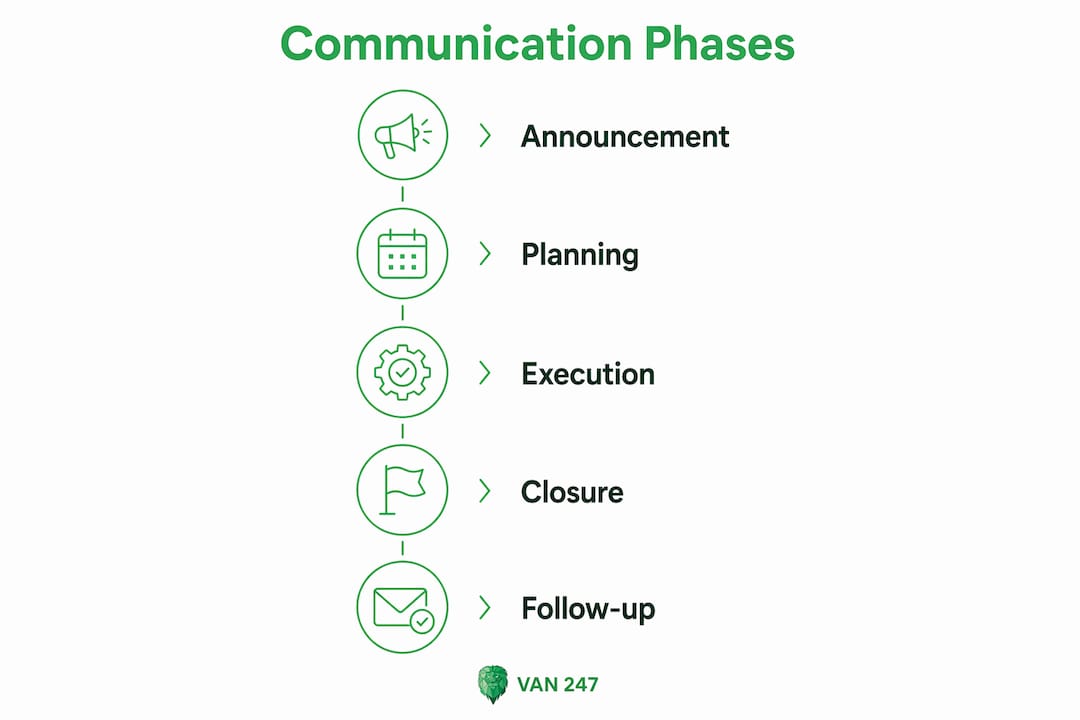
A phased approach works best for both individuals and businesses. Think of it in three stages: the initial announcement, regular progress updates, and a final pre-move briefing. Each stage serves a different purpose. The announcement sets expectations. The updates build confidence. The briefing confirms every detail is in place.
Communication Phases
For businesses, the tone of communication matters as much as the content. Empathetic and transparent messaging builds trust and reduces anxiety among employees. Telling your team “we know this is a big change and here is how we will support you” lands very differently from a dry memo listing dates and addresses. The human element is not optional. It is what determines whether your team arrives at the new site motivated or resentful.
A practical communication plan for relocation includes these steps:
- Announce early. Share the decision as soon as it is confirmed, even if all details are not yet finalised.
- Identify your channels. Use the communication methods your audience actually prefers, whether that is email, a team messaging app, or face-to-face briefings.
- Create a single source of truth. A centralised digital hub such as a shared intranet page or FAQ document prevents conflicting information from spreading.
- Schedule regular updates. Weekly or fortnightly check-ins keep everyone informed and give people a predictable moment to raise questions.
- Make leadership visible. Managers and directors who communicate directly about the move signal that the organisation takes the transition seriously.
- Confirm everything in writing. Send a summary after every key meeting or call with your removal company or building manager.
Pro Tip: The “Golden Rule” of relocation communication is to communicate in the way your audience prefers, not the way that is most convenient for you. Communicate in the assignee’s preferred way rather than defaulting to a single channel.
What role does technology play in relocation communication?
Technology has shifted relocation communication from reactive to proactive. The old model relied on email chains, phone calls, and manual follow-ups. The modern approach uses API-integrated portals that share real-time data across HR teams, removal companies, and the people being relocated. That shift eliminates the “did you get my email?” cycle entirely.
Automation handles the repetitive updates that previously fell through the cracks. Booking confirmations, access time reminders, and status notifications can all be triggered automatically when a milestone is reached. This reduces the administrative burden on HR teams and gives individuals a clear, consistent flow of information without anyone having to chase it manually.
Artificial intelligence adds another layer. AI tools can summarise long status threads, flag potential scheduling conflicts, and even translate communications for international relocations. For businesses moving teams across borders, this capability removes a significant barrier to clear communication.
| Communication approach | Key benefit | Best suited for |
|---|---|---|
| Manual email chains | Low cost, familiar | Small individual moves |
| Shared project management tools | Centralised updates, task tracking | Small business relocations |
| Automated portal platforms | Real-time sync, reduced follow-up | Corporate and multi-site moves |
| AI-assisted communication tools | Translation, summarisation, conflict flagging | International or complex relocations |
Pro Tip: Even if you are moving house rather than an entire office, a free shared document or group chat thread keeps all parties aligned. You do not need enterprise software to benefit from a single source of truth.
How to avoid common relocation pitfalls through better communication
The most avoidable relocation problems share a common thread: someone assumed the other party already had the information. Preventing that assumption is the practical work of good communication. It comes down to documentation, disclosure, and follow-through.
Documenting every exchange in writing dramatically reduces disputes. High-rated removal companies still face complaints when verbal agreements are not confirmed in writing. A simple follow-up message after a phone call, “Just to confirm, the team will arrive at 8am and the lift is reserved until midday,” removes ambiguity and creates a record both parties can refer to.
Disclosing site-specific details early is equally critical. Narrow driveways, parking permit requirements, floor access restrictions, and lift dimensions all affect how a removal crew plans their work. Sharing these details at the booking stage prevents costly surprises on moving day. The role of logistics in removals depends heavily on this kind of upfront disclosure.
Post-move communication is the step most people skip entirely. A closed-loop communication strategy that includes a post-move survey and transparent response to feedback builds long-term morale and demonstrates that people’s experiences genuinely matter.
- Assign one named point of contact for all queries, both internally and with your removal company
- Send a pre-move briefing document 48 hours before moving day covering timings, access details, and emergency contacts
- Use a checklist to confirm that every party has received and acknowledged key information
- Conduct a post-move debrief within two weeks and share what you have changed based on feedback
Key takeaways
Clear, timely communication is the single most effective tool for preventing relocation delays, disputes, and unnecessary costs for both individuals and businesses.
| Point | Details |
|---|---|
| Start communication early | Announce the move as soon as the decision is confirmed to give everyone time to prepare. |
| Document every agreement | Written records of all exchanges with movers and managers prevent disputes and speed up resolutions. |
| Create a single source of truth | A centralised hub or FAQ page stops conflicting information from spreading across teams. |
| Disclose site details upfront | Share access restrictions, parking limits, and physical constraints at the booking stage to avoid moving day delays. |
| Close the loop post-move | Post-move feedback and transparent responses build trust and improve future relocations. |
What I have learned about communication and relocation
After years of watching relocations go smoothly and watching others fall apart, the pattern is always the same. The moves that go wrong are almost never caused by bad logistics. They are caused by assumptions. Someone assumed:
1/the driver knew about the parking restrictions.
2/the employee had read the email.
3/the building manager had confirmed the lift booking.
The emotional dimension of relocation is consistently underestimated. For employees, a workplace move touches job security, commute time, and daily routine all at once. A single empathetic message from a senior leader, acknowledging that the change is significant and explaining the support available, does more for morale than a dozen logistical updates. Leadership visibility is not a soft extra. It is a practical tool for retention.
Technology helps, but it does not replace the human moment. I have seen businesses invest in sophisticated relocation portals and still lose employee trust because no one in leadership ever spoke directly about the move. The portal answered the “what” and “when.” Nobody answered the “why” and “how does this affect me.”
The most overlooked communication habit is the post-move debrief. Most organisations treat the move-in date as the finish line. The people who get it right treat it as a checkpoint. They ask what worked, what did not, and what they would do differently. That feedback loop is what turns a one-off stressful event into a repeatable, manageable process.
If you take one thing from this: write it down, send the confirmation, and ask how people are doing afterwards. Those three habits will prevent more problems than any technology platform.
— Claudiu
How Van-247delivery supports clear communication throughout your move
Reliable communication starts with choosing a removal partner who treats it as a priority, not an afterthought.
Van-247delivery has supported UK individuals and businesses with house removals and office moves for over 15 years, with a consistent focus on clear documentation, real-time updates, and transparent pricing. Every booking includes confirmation of timings, access requirements, and service details so nothing is left to assumption. Whether you are coordinating a single household move or a full corporate relocation, Van-247delivery’s team keeps you informed at every stage. Get an instant quote today and experience the difference that clear, reliable communication makes from the first call to the final delivery.
FAQ
Why does communication matter so much in relocation?
Poor communication is the leading cause of relocation complaints, delays, and unexpected costs. Clear, timely information exchange keeps all parties aligned and prevents the assumptions that cause most moving problems.
When should communication begin for a workplace relocation?
HR teams should begin communicating as soon as the decision to relocate is confirmed. Early communication reduces employee anxiety and gives people time to raise concerns and prepare.
What is the most effective communication strategy for a house move?
Document every agreement with your removal company in writing, disclose all site-specific details at the booking stage, and confirm timings 48 hours before moving day. These three steps prevent the majority of moving day disputes.
How does technology improve relocation communication?
Automated portals and shared digital hubs replace manual email chains, delivering real-time updates to all parties simultaneously. This eliminates follow-up cycles and ensures everyone works from the same information.
What should happen after a relocation is complete?
A post-move survey and transparent response to feedback closes the communication loop. Post-move feedback builds long-term morale and helps organisations improve future relocations.