Treadmill moving guide: most home treadmills can be moved by yourself if the route is clear and the machine folds or splits into console and base. Before you touch anything else, unplug it, pull out the safety key, and coil the power cord out of the way. If your route involves stairs, a non-folding commercial machine, or wiring you’re not confident about, book professional movers instead.
TL;DR:
- Moving a treadmill solo is feasible if it folds, separates into console and base, and the route has no stairs or narrow passages.
- Proper planning involves measuring the route thoroughly and testing fit with a taped cardboard template before disassembly.
- Disassembly should focus on creating two manageable pieces: the console assembly and the base deck, with bolts labeled and stored in separate bags.
- Moving techniques vary based on machine type, with foldable models rolled on wheels and non-folding machines secured with straps on a dolly; stairs require multiple helpers and careful planning.
- Hiring professional movers is advisable for heavy, high-end, or stair-restricted moves; they offer insured, specialist handling, disassembly, and reassembly to prevent damage or injury.
Table of Contents
- Your treadmill moving guide: tools and equipment you’ll need
- How do I measure and plan my treadmill’s moving route?
- Step-by-step treadmill disassembly for moving
- Moving techniques for the same floor: rolling, tilting and using a dolly
- How do you move a treadmill up or down stairs safely?
- Loading a treadmill into a van and securing it for transport
- How do I reassemble and test a treadmill after moving?
- When should you hire professional movers instead?
- Treadmill moving checklist for moving day
- A publisher’s view on DIY versus professional treadmill moves
- Get a quote for your treadmill move with Van-247delivery
- Sources
- FAQ
Your treadmill moving guide: tools and equipment you’ll need part of treadmill moving guide
Getting the right kit together before moving day saves you a frantic trip to B&Q halfway through disassembly. A treadmill moving guide worth following starts with the basics: most of these tools are already in a household toolbox, but a few are worth buying or hiring specially.
- Hand tools: a set of screwdrivers (flathead and Phillips), a socket set, Allen keys (most consoles use hex bolts), and a power drill with an adjustable clutch to avoid stripping bolt heads.
- Lifting and transport aids: a furniture dolly, ratchet straps, moving blankets, and corner protectors for doorframes.
- Protective gear: work gloves, non-slip shoes, and sturdy trainers rather than socks (treadmills are heavier than they look once tilted).
- Small essentials: labelled sandwich bags or a pill organiser for bolts, masking tape and a marker pen, and your phone charged and ready for photos.
If you don’t own a dolly, most UK hire shops and larger hardware chains rent them by the day for a modest fee, which is far cheaper than replacing a cracked deck panel.
How do I measure and plan my treadmill’s moving route part of treadmill moving guide?
Measuring first prevents the classic moving-day disaster: getting the machine to the door and discovering it doesn’t fit. Measure the treadmill’s width, length, and height both folded and unfolded, then compare those figures against every pinch point on your route.
- Measure doorways, hallway turns, stair landings, lift interiors, and the van’s tailgate opening.
- Check whether removing an internal door, its hinges, or a section of skirting board would buy you the extra inches you need.
- Test-fit with a taped cardboard template cut to the treadmill’s folded dimensions and walk it through the route before moving day.
- If any measurement comes up short by more than a couple of centimetres, plan for partial disassembly or reroute via a different door or lift.
Doing this properly takes fifteen minutes and it’s the single biggest reason DIY treadmill moves go smoothly rather than turning into a doorway standoff.
Step-by-step treadmill disassembly for moving part of treadmill moving guide
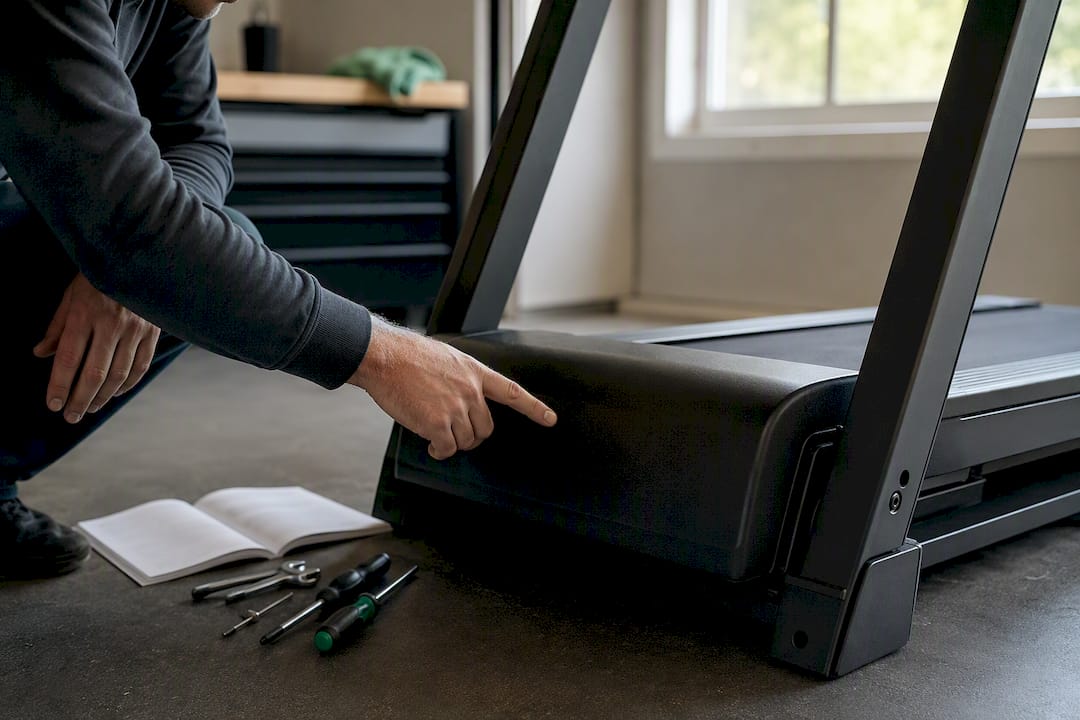
Treadmill disassembly for moving is less daunting than it looks once you accept one rule: you’re aiming for two manageable pieces, not a pile of forty parts. Reduce the machine into the upright console assembly and the base deck, and resist the urge to strip it further.
Before any tool touches a bolt: unplug the treadmill, remove the safety key, and leave it for a few minutes if the manual recommends it. Then work through this sequence.
- Photograph everything first. Photographing wire harness connections and labelling hardware by stage is the cheapest insurance you’ll ever buy against a botched reassembly.
- Detach the console. Remove the plastic shrouds around the base of the uprights, unplug the wiring harness (it usually clips out rather than pulling free), and zip-tie any loose cable so it doesn’t snag during transport.
- Free the uprights. Locate the bolts anchoring them to the base deck, usually two or four per side, and have a second person support the console’s weight as the last bolt comes out.
- Prepare the base deck. Secure the running belt with a strap or bungee cord so it can’t slide, and lower the incline to its flattest setting if the model allows it.
Pro Tip: Keep each stage’s bolts in its own labelled bag and tape that bag directly to the part it came from. A bag of unlabelled bolts in your coat pocket is how treadmills end up with a wobble that never quite goes away.
Avoid touching the motor housing or drive belt unless your manual specifically walks you through it. That’s technician territory, not a Saturday-afternoon job.
Moving techniques for the same floor: rolling, tilting and using a dolly part of treadmill moving guide
Once the machine is down to a manageable size, how you move it across a room matters almost as much as the disassembly itself.
- Tip and roll folding treadmills. Foldable treadmills with wheels can often be tipped onto those wheels and rolled rather than carried, provided the folding latch is locked.
- Use a dolly for non-folding machines. Tip the treadmill back onto the dolly, centre the weight over the axle, and strap it in place with at least two ratchet straps before moving an inch.
- Protect your floors. Lay moving blankets under the wheels’ path and use flattened cardboard as a runner across carpet or hardwood, taping seams down so nobody trips.
- Lift with a partner when there’s no dolly available. Grip the frame at its structural points (never the console arms), bend at the knees, and count “one, two, three, lift” out loud so you move together.
Choose dolly wheels rated for the flooring you’re crossing. Hard rubber wheels can mark laminate, so a moving blanket underneath is worth the extra thirty seconds.
How do you move a treadmill up or down stairs safely part of treadmill moving guide?
Stairs are where treadmill moves go wrong, and it’s not close. The combination of weight, an awkward centre of gravity, and a narrow landing turns a routine task into the highest-risk part of the entire job.
- Bring a minimum of two people, ideally three: one steadying the top, one bearing weight at the bottom, and a spotter watching the stairwell and calling out steps.
- Use a stair-climbing dolly where possible, and agree on clear verbal commands (“stop”, “tilt”, “hold”) before you start moving.
- Pause fully at every landing rather than trying to carry momentum around a turn. A treadmill that starts sliding on stairs is very hard to stop safely.
- Watch for the classic warning signs that this isn’t a two-person job: multiple flights, tight 90-degree turns, or a machine that weighs more than roughly 90kg.
Pro Tip: If you find yourselves debating whether the treadmill will actually make it around a stairwell turn, that hesitation is your answer. Book professional movers rather than find out the hard way.
Loading a treadmill into a van and securing it for transport part of treadmill moving guide
Getting the treadmill from your front door into the vehicle is where fatigue-related mistakes creep in, so slow down here even if the rest of the move went smoothly.
- Wheel the dolly-loaded treadmill up to the tailgate with one person guiding from inside the van and one pushing from outside, moving in short, controlled steps.
- Position it against the van’s bulkhead or a solid interior wall to keep the centre of gravity low and stop it toppling on corners.
- Use at least two ratchet straps, crossed if possible, and pad contact points with moving blankets to stop vibration scuffing the frame.
- Protect floors and doorframes with blankets and cardboard on the way out, and treat a long-distance transport differently from a short local move by checking your goods-in-transit insurance covers the machine’s replacement value.
Our guide on smart ways to move large items safely covers loading sequences for other bulky furniture if you’re tackling a full house move alongside the treadmill.
How do I reassemble and test a treadmill after moving?
Reassembly is disassembly in reverse, provided you kept your photos and labelled bags in order. Work from the frame outward: base deck first, then uprights, then console, then accessories.
- Reattach the uprights to the base deck first, tightening bolts evenly rather than fully tightening one side before starting the other.
- Reconnect the wiring harness using your photos as a reference, checking no cable is pinched between the console shroud and the upright.
- Refit the console and shrouds, then run a slow test at low speed, listening for grinding or clicking and watching for the belt drifting to one side.
- Stop immediately and call a qualified technician if you see an error code, hear a new noise, or notice the belt wobbling rather than tracking straight.
Belt tracking issues are one of the most common post-move problems, and they’re usually a sign of an uneven frame connection rather than a damaged belt itself. A five-minute test run at walking pace is worth doing before you trust the machine at running speed.
When should you hire professional movers instead part of treadmill moving guide?
Some treadmill moves simply aren’t worth doing yourself, and knowing the difference protects both your back and your machine.
- Multiple flights of stairs, narrow Victorian-terrace stairwells, or tight turns onto landings.
- Commercial or high-end machines exceeding roughly 100kg, which typically demand specialist lifting equipment.
- Missing manuals or wiring you don’t recognise, especially on treadmills with integrated screens or smart consoles.
- Any scenario where a repair bill would cost more than a professional move.
Professional gym-equipment movers typically offer inspection, safe dismantling, specialist packing, insured transport, and reinstallation as a single service, which removes the guesswork entirely. When you ask for a quote, confirm the insured value covers full replacement, check whether disassembly and reassembly are included, and ask whether the crew has handled fitness equipment before, not just general furniture. Van-247delivery’s house removals team builds these checks into every quote, the same specialist handling detailed in our piece on why piano carriers matter for safe moves.
Treadmill moving guide checklist for moving day
Keep this nearby on the day itself.
- Before you start: measure the route, unplug the machine, remove the safety key, and take reference photos.
- Packing: label every bolt bag by stage, wrap the console in a moving blanket, and strap the belt so it can’t shift.
- During the move: assign crew roles, stop and reset at every stair landing, and keep communication clear and calm.
- After the move: check bolt tightness, inspect wiring for pinches, run a slow test, and start any insurance claim promptly if damage occurred.
| Stage | Key action | Why it matters |
|---|---|---|
| Before | Measure route and remove safety key | Prevents doorway surprises and accidental starts |
| Packing | Label bolts and wrap console | Makes reassembly fast and accurate |
| Moving | Assign roles, pause on stairs | Reduces injury and drop risk |
| After | Test run and check belt tracking | Catches faults before they get worse |
A publisher’s view on DIY versus professional treadmill moves
Three quick rules of thumb cut through most of the second-guessing: check the route first, weigh the machine honestly, and be brutally realistic about the wiring. If any of those three raise doubts, that’s your answer.
Van-247delivery has spent over fifteen years handling exactly this kind of awkward, heavy, easily-damaged item across UK homes and businesses, and the pattern is consistent: readers underestimate stairs and overestimate their own tolerance for risk. Insured professional help isn’t an admission of defeat. It’s often the cheaper option once you price in a cracked console or a strained back.
— Claudiu
Get a quote for your treadmill move with Van-247delivery
Van-247delivery is the practical alternative to wrestling a treadmill down a stairwell yourself: insured man-with-a-van cover, specialist straps and dollies, and disassembly and reassembly handled as part of the job rather than left to you.

If stairs, tight corners, or a heavy commercial machine are part of your move, our team brings the same insured handling used across full house removals, so the treadmill travels with the rest of your belongings rather than as a separate headache. For a one-off local move, a man with a van booking covers exactly this job without the cost of a full removal service. When you request a quote, ask specifically about insured value, whether disassembly and reassembly are included, and what padding and strapping the crew brings. Get an instant quote today and let someone else worry about the stairs.
Sources
For model-specific instructions, always check your manufacturer’s own guidance, such as Peloton’s relocation instructions, before disassembling an unfamiliar console. For broader lifting and injury-prevention advice, Extraspace’s guide to moving a treadmill without injury covers stair technique in more depth, and our own guide on transporting furniture up and down stairs applies directly to treadmill moves too.
- How to Move a Treadmill Safely and Easily
- How to Dismantle a Treadmill Safely for Moving or Storage – Fitness Lume
- How to Move a Treadmill
- How to Move a Treadmill – North American Van Lines
FAQ
Can I move a treadmill by myself?
Yes, if it folds or separates into console and base and your route has no stairs or tight turns. Non-folding commercial machines or multi-flight moves are safer left to professionals.
Do I need to fully disassemble a treadmill to move it?
No. Most home moves only require splitting the machine into the console assembly and the base deck rather than removing every component.
How heavy is a treadmill to move?
Home treadmills often weigh up to roughly 90kg, while commercial machines can exceed 100kg, which is the point where a two-person lift becomes genuinely risky.
What’s the safest way to get a treadmill down stairs?
Use a minimum of two people, ideally three, pause fully at every landing, and consider a stair-climbing dolly rather than relying on momentum.
When should I book a professional mover for a treadmill?
Book professionals when your move involves multiple staircases, tight corners, a machine over roughly 90 to 100kg, or wiring you don’t recognise. Van-247delivery offers insured handling and disassembly as part of its house removal and man-with-a-van services for exactly these situations.