A comprehensive moving service, also called a full-service move, is an end-to-end relocation where professional movers handle everything from planning and packing through to transport, unpacking, and storage. You hand over the keys (metaphorically speaking) and the crew takes care of the rest.
At a glance, a full-service move typically covers:
- Pre-move survey and inventory
- Professional packing with specialist materials
- Furniture disassembly and reassembly
- Loading, transport, and secure unloading
- Unpacking and room-by-room placement at your new home
- Short- or long-term storage options
- Insurance and valuation cover
The difference between a full-service move and a partial or DIY option comes down to how much you want to hand off. A partial service might cover transport only, leaving you to pack and unpack yourself. A DIY move puts everything on you. With a comprehensive package, a single team manages the whole job, which is where the real value lies. Pricing in the UK varies considerably based on volume, distance, and access, and accessorial charges can add up quickly if you are not careful about what your quote actually includes.
Table of Contents
- What does a comprehensive moving service actually include?
- How UK movers price a comprehensive move
- What the moving process looks like from survey to unpack
- How to choose the right moving service for your needs
- Which specialist add-ons are worth considering?
- What the evidence says about full-service moves
- Key takeaways
- Why the cheapest quote is rarely the whole story
- Van-247delivery: full-service moves across the UK, done properly
- Useful sources
- FAQ
What does a comprehensive moving service actually include?
A full-service move is an end-to-end relocation solution where movers manage planning, professional packing and unpacking, furniture disassembly and reassembly, safe loading and transport, and commonly offer storage and insurance options. Here is what that looks like in practice.

Professional packing.
Movers pack every room using the right materials for each item type. That means acid-free tissue paper for fine china, foam padding for electronics, and custom timber crates for antiques or high-value pieces. This is not just putting things in boxes; it is systematic cataloguing, labelling, and protection.
Furniture disassembly and reassembly.
Beds, wardrobes, flat-pack units, and large sofas are taken apart at your current home and rebuilt at the destination. You do not need to find a screwdriver.
Loading, transport, and unloading. The crew manages all heavy lifting, vehicle loading, route planning, and delivery. Items are secured in the van to prevent shifting in transit.
Unpacking and room placement. At the other end, movers unpack boxes and place furniture in the rooms you specify. Some providers offer a white-glove service where they also dispose of all packing debris.
Storage options. Many full-service providers offer short- or long-term storage, including climate-controlled facilities for sensitive items such as artwork, wine, or antique furniture.
Specialist handling. Pianos, fine art, antiques, and vehicles require dedicated expertise. Reputable movers either handle these in-house or coordinate specialist subcontractors as part of the same package.
Inventory, valuation, and insurance. A proper comprehensive service includes a pre-move inventory, valuation declarations, and clear insurance options. This protects you if anything is lost or damaged.
| Service element | Included in full-service | Included in transport-only |
|---|---|---|
| Professional packing | Yes | No |
| Furniture disassembly/reassembly | Yes | Sometimes |
| Specialist item handling | Yes (or coordinated) | Rarely |
| Storage options | Yes | No |
| Insurance/valuation | Yes | Basic only |
| Unpacking and placement | Yes | No |
| Inventory and cataloguing | Yes | No |
Pro Tip: Ask your mover to confirm in writing whether unpacking and debris removal are included in the base price or quoted as extras. Many providers list them as optional add-ons.
How UK movers price a comprehensive move
Pricing for a full-service move in the UK is rarely a simple flat rate. Comprehensive service pricing is usually based on volume or weight, distance, and access complexity, and accessorial charges can materially change the final bill.
The main pricing factors are:
- Volume or weight: Most UK removals firms quote by cubic footage or the number of van loads. Larger homes cost more, regardless of distance.
- Distance: A local move within the same city is priced differently from a cross-country move from London to Edinburgh.
- Access complexity: Narrow streets, no parking, upper-floor flats without lifts, and long carries from van to front door all add cost.
- Specialist services: Piano moves, custom crating, and international customs handling carry separate fees.
- Timing: Weekends, bank holidays, and end-of-month dates (when tenancy agreements typically end) tend to attract a premium.
Watch out for accessorial charges. Long-carry fees apply when the van cannot park close to your property. Stair fees are added per flight when there is no lift. Shuttle charges come into play when a large removal lorry cannot access your street and a smaller vehicle is needed to ferry items. These costs are legitimate, but they should appear in your written quote, not as a surprise on the day.
Accessorial costs are frequently underestimated: long-carry fees, stair fees, and shuttle-service charges commonly appear as extras when the vehicle cannot reach a property directly. You can mitigate some of these in advance: arrange a parking suspension permit for the removal vehicle, or ask the crew to disassemble large items at the origin to reduce the carry distance.
A rough guide for UK moves: a one-bedroom local move with full packing typically costs less than a three-bedroom long-distance move with storage and specialist items. Always request an itemised, written estimate rather than a verbal ballpark. Industry experts warn that low-cost quotes often exclude packing materials, assembly labour, or specialist insurance, elements that are commonly included in genuine comprehensive packages.
What the moving process looks like from survey to unpack
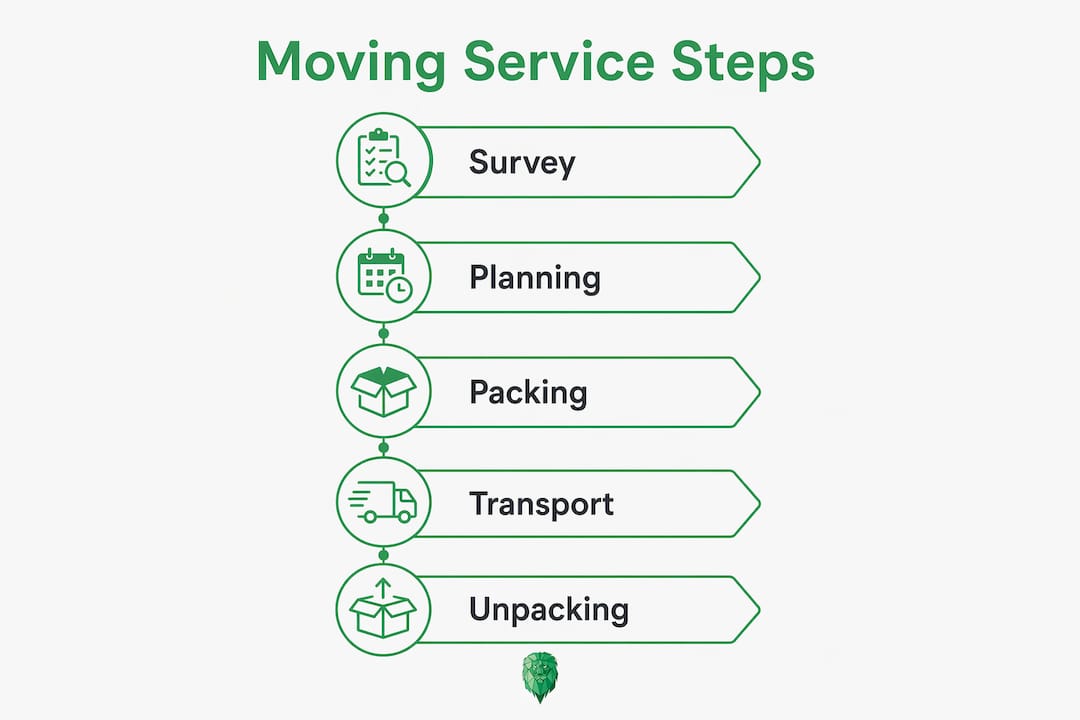
Understanding the timeline helps you plan your own schedule and know what to expect at each stage. Here is how a typical full-service move unfolds.
Step 1: The survey.
A reputable mover will carry out a pre-move survey, either in person or via video call. They assess the volume of your belongings, note any access challenges, and identify specialist items. Photos and video taken during the survey create a baseline inventory that protects both you and the mover if a dispute arises later. A binding, itemised written estimate and a pre-move inventory are important trust signals that clarify liability throughout the move.
Step 2: Move planning.
Once you accept the quote, the mover schedules packing dates, confirms the transport vehicle, and flags any contingencies (such as parking permits or lift bookings in your building). Good movers build buffer time into the schedule for access issues.
Step 3: Packing day.
The crew arrives with all materials and works room by room. Every box is labelled with its contents and destination room. An essentials box, labelled “open first”, is packed last and contains the things you will need immediately: kettle, phone charger, toiletries, documents, and a change of clothes.
Step 4: Loading and transport.
Items are loaded in reverse order of unloading. The crew secures everything in the vehicle and the driver plans the route. For longer moves, the mover should keep you updated on transit progress.

Step 5: Delivery, unpacking, and reassembly.
At your new home, the crew unloads, places furniture in the rooms you specify, and reassembles anything that was taken apart. If unpacking is included, boxes are emptied and packing materials removed.
Pro Tip: Keep a small bag with you on moving day containing your keys (old and new), ID, payment cards, and any documents you will need to sign. Do not let this bag go into the removal van.
How to choose the right moving service for your needs
Picking a mover is not just about price. Here is what to check before you sign anything.
Essential checks:
- Written, itemised quote: Never accept a verbal estimate. Your quote should list every service, material, and potential accessorial charge separately.
- Pre-move survey: Any reputable mover will survey your home before quoting. A quote given without seeing your belongings is a red flag.
- Insurance and valuation options: Confirm what level of cover is included and whether you can upgrade. Ask for proof of insurance in writing.
- Trade accreditation: Look for membership of the British Association of Removers (BAR) or similar trade bodies. BAR members follow a code of practice and offer a dispute resolution scheme.
- Carrier vs. broker: Reputable providers usually act as the primary carrier rather than a broker, offering a single accountable party for transit and insurance. If a company brokers your move to a third party, ask who is responsible if something goes wrong.
- Deposit and cancellation terms: Understand what you pay upfront, what happens if you need to rearrange, and whether the deposit is refundable.
Questions to ask before you book:
- Who will actually carry out the move: your crew or a subcontractor?
- What insurance cover is included, and what is the claims process?
- What is the cancellation policy and how much notice do you need?
- Are packing materials, disassembly, and unpacking included or extra?
- Do you hold BAR membership or equivalent accreditation?
Red flags to watch for:
- Verbal quotes only, with no written confirmation
- Pressure to pay a large deposit before a contract is signed
- No physical address or inconsistent contact details
- Unusually low headline prices with vague terms
- No survey offered before quoting
For a practical guide to choosing a mover in the UK, including a full checklist, it is worth reviewing the key criteria before you start collecting quotes.
| Check | Why it matters |
|---|---|
| Written, itemised quote | Prevents surprise charges on the day |
| Pre-move survey | Ensures accurate pricing and inventory |
| BAR membership | Provides a dispute resolution route |
| Proof of insurance | Confirms cover if items are lost or damaged |
| Carrier confirmation | Establishes who is accountable for your belongings |
| Signed contract with deposit terms | Protects you if the mover cancels or underdelivers |
Which specialist add-ons are worth considering?
Most comprehensive packages cover standard household goods, but some situations call for extras. Here is a quick guide to the most common specialist add-ons and when you genuinely need them.
UK removal companies routinely provide specialist add-ons such as custom crating, international customs documentation management, and move-in/move-out cleaning to help meet tenancy or property-sale requirements. These are not upsells for the sake of it; in the right circumstances, they are necessary.
| Add-on | When you need it | Typical trigger |
|---|---|---|
| Custom timber crating | Antiques, fine art, fragile sculptures | High-value or irreplaceable items |
| Piano or organ removal | Any upright or grand piano | Specialist equipment and crew required |
| Fine art handling | Paintings, prints, sculptures | Insurance and packing standards differ |
| Vehicle transport | Cars, motorbikes | Moving overseas or long-distance without driving |
| White-glove unpacking | Full placement and styling service | Busy professionals, elderly movers |
| End-of-tenancy cleaning | Rented properties | Tenancy agreement cleaning clauses |
| Climate-controlled storage | Wine, artwork, antiques | Temperature or humidity-sensitive items |
Add-ons are usually priced separately from the base move and scheduled in coordination with the main crew. For a detailed breakdown of value-added moving services available in the UK, it is worth checking what your mover includes as standard versus what carries an additional fee.
What the evidence says about full-service moves
The core appeal of a comprehensive package is straightforward. Full-service movers function as project managers: customers trade hands-on control for a single accountable supplier, which is the core source of the service’s value. You are not coordinating a packing crew, a van hire, and a storage facility separately. One team, one contract, one point of contact.
Industry sources consistently highlight two recurring pitfalls. The first is the gap between headline price and actual cost. Clients commonly misinterpret a low headline price; the fix is to insist on itemised terms and confirm that packing materials, labour for disassembly and reassembly, and insurance are all included. The second pitfall is broker confusion: some companies that market themselves as full-service movers are actually brokers who pass your job to a third-party crew, fragmenting accountability when something goes wrong.
Pro Tip: Before signing, ask your mover to confirm in writing whether they are the primary carrier or a broker. If they are a broker, ask for the name and insurance details of the company that will actually carry out the move.
A practical example: a customer moving a three-bedroom house from Manchester to Bristol books what appears to be a comprehensive package at a competitive price. On moving day, they discover the quote excluded packing materials, the stair fee for their first-floor flat, and the shuttle charge because the lorry could not park on their narrow street. The final bill is significantly higher than expected. Getting a written, itemised quote and asking specifically about accessorial charges before signing would have prevented every one of those surprises.
Key takeaways
A comprehensive moving service is worth it when you want a single, accountable team to manage the entire relocation, from survey to unpacking, with no logistical gaps.
| Point | Details |
|---|---|
| What is included | Planning, packing, transport, unpacking, storage, and insurance in one package. |
| Main pricing drivers | Volume, distance, access complexity, and accessorial charges (stairs, long carry, shuttle). |
| Red flags to avoid | Verbal-only quotes, large deposits without a contract, no survey offered before pricing. |
| Key trust signals | BAR membership, written itemised quote, proof of insurance, pre-move inventory. |
| Van-247delivery | Offers insured UK full-service moves with flexible booking, packing, and a dedicated coordinator. |
Why the cheapest quote is rarely the whole story
Moving is one of those situations where the gap between what sounds good and what actually works tends to show up on the day itself, not before. You book a low headline price, feel relieved, and then discover on moving morning that packing materials, the stair fee, and the shuttle charge were never in the quote. By that point, you have no leverage and no time.
The real value of a comprehensive package is not the convenience of having someone else carry your sofa. It is the single point of accountability. When one team owns the whole job, from the survey through to the last box being unpacked, there is no ambiguity about who is responsible if something breaks or goes missing. That clarity is what you are actually paying for.
The BAR membership question is one that many people skip because it feels bureaucratic. It is not. BAR members are bound by a code of practice and, critically, offer an independent dispute resolution scheme. If your mover is not a member of any trade body, you are relying entirely on their goodwill if something goes wrong.
One more thing worth saying plainly: the survey is not a formality. A mover who quotes without seeing your home is guessing, and that guess will be revised upward on the day. Insist on a survey, in person or by video, and treat any company that skips it as a red flag.
Van-247delivery: full-service moves across the UK, done properly
Moving house is stressful enough without worrying whether your mover has the right cover, the right crew, or the right equipment for your specific situation.
Van-247delivery has been handling UK removals for over 15 years, offering insured transport, professional packing, furniture disassembly and reassembly, and flexible storage options. Every move comes with a dedicated coordinator who manages the job from survey to delivery, so you have one person to call if anything needs adjusting. Whether you are moving a one-bedroom flat across town or a family home from one end of the country to the other, the team is equipped to handle it, including specialist items like pianos and fragile antiques.
Get an instant quote for your house removal today and see exactly what is included before you commit to anything.
Useful sources
- British Association of Removers (BAR): The UK’s leading trade body for removal companies. Check whether your mover is a member and understand the dispute resolution process.
- BBB: Choose the best option for your move: A clear breakdown of full-service, container, and DIY moving options with practical guidance on what each covers.
- Types of moving companies and pricing structures (FreightWaves): Explains how movers price jobs, including accessorial charges and the difference between carriers and brokers.
- 14 essential types of moving services (Nelson Westerberg): Detailed explainer of packing standards, specialist handling, and the range of services professional movers offer.
- Van-247delivery house removals: Van-247delivery’s primary service page for UK home removals, including instant quote functionality.
- Relocation home sale process: a homeowner’s guide: Useful if you are coordinating a move around a property sale and need to align timelines.
FAQ
What does a full-service moving company actually do?
A full-service moving company handles every part of your relocation: packing, disassembly, loading, transport, unloading, unpacking, and reassembly. You manage nothing on the day except telling the crew where you want things placed.
What are the red flags to watch for in movers?
The main red flags are verbal-only quotes with no written confirmation, pressure to pay a large deposit before a contract is signed, no survey offered before pricing, and unusually low headline prices with vague terms about what is included.
What is the cheapest day for removals in the UK?
Midweek dates, particularly Tuesday to Thursday, tend to be cheaper than weekends or end-of-month dates, when demand peaks because most tenancy agreements end on the last day of the month.
How do I know if a mover is the carrier or a broker?
Ask directly before you book. A carrier employs the crew and owns the vehicles; a broker passes your job to a third party. If your mover is a broker, ask for the name and insurance details of the company that will actually carry out the move, so you know who is accountable.
Is a comprehensive moving service worth the cost?
If you want a single accountable team managing the whole job with no logistical gaps, yes. The cost is higher than a transport-only or DIY option, but you are paying for professional packing, insurance, specialist handling, and the removal of day-of coordination stress.