Large item transport is the specialised shipping and handling of goods that exceed standard parcel weight or size limits, requiring dedicated equipment, permits, and logistics to move safely. Most parcel carriers cap standard shipments at 150 lbs, and anything heavier or bulkier falls into the category the industry calls oversized freight transport.
This distinction matters enormously. Whether you are moving a sofa across town or shipping industrial machinery across the country, the rules, costs, and risks are fundamentally different from sending a standard parcel. This guide covers the main methods, costs, safety practices, and regulatory requirements you need to know.
What is large item transport and which methods are available?
Large item transport covers any shipment that surpasses the size or weight thresholds set by standard parcel carriers. The most common professional solution is Less Than Truckload (LTL) freight, where your goods share space on a truck with other shipments. LTL typically delivers within 3–7 business days and costs less than booking a full vehicle. It suits businesses sending pallets, machinery parts, or large retail goods regularly.
For extremely heavy or awkwardly shaped loads, specialised carriers use flatbed trailers, lowboy trailers, or step-deck vehicles. These are the right choice for construction equipment, large sculptures, or industrial plant. Standard parcel carriers do handle some oversized packages, but they apply strict rules and additional fees the moment your item crosses their thresholds.
Other transport modes also come into play depending on distance and urgency:
- Road freight: The most flexible option for UK domestic moves, covering door-to-door delivery with no transhipment.
- Rail freight: Cost-effective for very heavy loads over long distances, though it requires road transport at each end.
- Sea freight: The standard choice for international large item shipping, particularly for full container loads or shared container (LCL) shipments.
- Air freight: Fast but expensive, reserved for high-value or time-critical oversized goods.
When your load exceeds legal road dimensions, you will also need special permits before the vehicle can move. Permit requirements vary by region and transport mode, so factor in the application lead time when planning your shipment.
Pro Tip: If you are shipping large items internationally, read up on professional courier procedures for oversized cargo before booking. Regulations differ significantly between countries, and missing a document can hold your shipment at customs for days.
How much does large item transport cost?
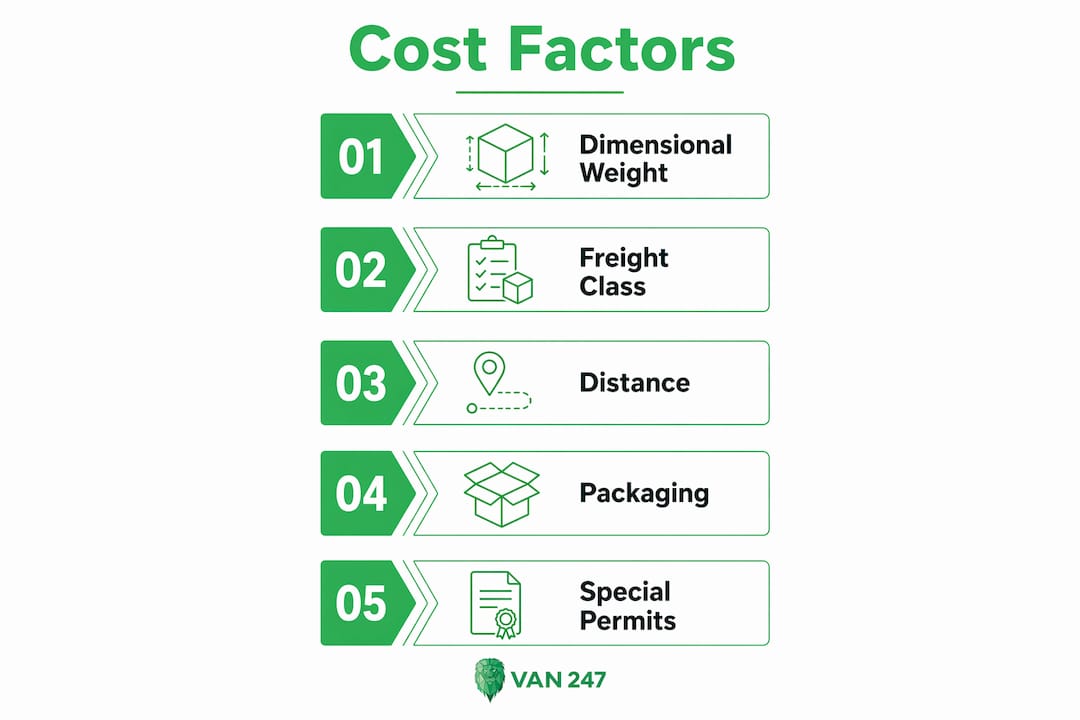
The cost of large item transport depends on several factors working together, and understanding each one helps you budget accurately. Carriers do not simply charge by weight. They use dimensional weight (DIM weight), which calculates a theoretical weight based on the package’s volume. If your item is large but light, you will often pay for the space it occupies rather than its actual mass.
Oversized surcharges from standard carriers typically run from £30 to £50 per item, and that figure rises sharply if you underreport dimensions. Accurate measurement is not optional. It is the single most effective way to avoid surprise invoices.
| Cost factor | What drives the price |
|---|---|
| Dimensional weight | Carriers charge whichever is higher: actual weight or DIM weight |
| Oversized surcharges | £30–£50+ per item when size or weight thresholds are exceeded |
| Freight classification | Higher-risk or fragile goods attract premium rates |
| Packaging and crating | Pallets, custom crates, and protective wrapping add to the total |
| Distance and route | Longer routes and restricted roads increase fuel and permit costs |
| Permits | Required for loads exceeding legal dimensions; fees vary by region |
Freight classification also affects your bill. Carriers assign a class to each shipment based on density, fragility, and handling difficulty. A dense, easy-to-stack item costs less to ship per kilogram than a fragile, awkwardly shaped one of the same weight.
Pro Tip: Always get at least three quotes from different large item shipping services before committing. Prices for the same route can vary by 30% or more depending on the carrier’s current capacity and your item’s freight class.
Packaging costs catch many people off guard. A bespoke wooden crate for a piece of machinery or antique furniture can add hundreds of pounds to your total. Factor this in from the start, not as an afterthought.
How to transport large items safely: practical tips
Safe handling starts before anyone lifts a finger. Accurate measurement of both the item and every passage it must travel through is the most critical and most frequently skipped step. Measure doorways, hallways, stairwells, and lift dimensions before you plan anything else. A sofa that is 5 cm too wide for a doorframe cannot be forced through without causing damage.

Once you have your measurements, consider whether disassembly is possible. Taking a wardrobe, bed frame, or shelving unit apart reduces its bulk dramatically. It also lowers the risk of damage during transit and makes it far easier to navigate tight spaces. Disassembly is one of the most effective but underused strategies in both DIY moves and professional removals.
Equipment that makes a real difference
The right tools transform a dangerous lift into a manageable task:
- Furniture sliders: Place these under heavy items to glide them across floors without scratching surfaces or straining your back.
- Moving dollies: A flat dolly or an upright appliance dolly lets one or two people move items that would otherwise require four.
- Lifting straps: These shift the strain from your arms and back to your legs and core, where your body is strongest. They are particularly useful on stairs.
- Stair-climbing dollies: Motorised or manual versions handle heavy loads on staircases far more safely than manual carrying. Read more about moving items on stairs before attempting a staircase move.
- Packing materials: Bubble wrap, moving blankets, and corner protectors prevent surface damage during loading and transit.
When to call in the professionals
Items heavier than 300 lbs on stairs should not be attempted as a DIY move, even with two people and lifting aids. Beyond that threshold, the injury risk rises sharply and the chance of damaging the item or the property increases significantly. Professional movers carry the right equipment and insurance to handle these situations safely.
For anything involving heavy furniture, a professional service is worth the cost when the alternative is a trip to A&E or a damaged staircase. The rule of thumb: if you are unsure whether you can move it safely, you probably cannot.
Pro Tip: Before any move, photograph every item and every tight passage. If damage occurs during transit, photographic evidence supports any insurance claim you need to make.
What are the regulatory challenges in large item transport?
Regulatory compliance is the part of oversized freight transport that most individuals and small businesses underestimate. Permits and route planning are not optional extras for very large loads. They are legal requirements, and moving without them risks fines, vehicle seizure, and significant delays.
The key regulatory considerations include:
- Oversize permits: Required when a load exceeds legal width, height, or length limits. In the UK, loads wider than 2.9 metres typically need a permit and may require an escort vehicle.
- Route surveys: Planners must check for low bridges, weight-restricted roads, and narrow lanes before the vehicle moves.
- Lead times: Permit applications can take several days to process. For complex loads, allow at least a week.
- Escort requirements: Very wide or long loads often require police or private escort vehicles, which add cost and require advance coordination.
- Time restrictions: Some local authorities restrict oversized vehicle movements to specific hours, particularly in urban areas.
The difference between shipping heavy machinery and moving household goods is largely one of complexity. Route planning for machinery must account for road restrictions that a standard removal van never encounters. A professional logistics provider handles this planning as a matter of course. For individuals or businesses doing this for the first time, the paperwork alone can be daunting.
Compliance also affects your insurance. A shipment moved without the correct permits may not be covered if something goes wrong. Always confirm your carrier’s documentation before the vehicle leaves.
Key takeaways
Large item transport requires specialised equipment, accurate measurement, and regulatory compliance to move oversized goods safely and cost-effectively.
| Point | Details |
|---|---|
| Know the weight threshold | Standard parcel carriers cap shipments at 150 lbs; anything heavier needs freight or specialist handling. |
| Understand DIM weight | Carriers charge based on dimensional weight, so a large but light item can cost as much as a heavy one. |
| Measure everything first | Accurate measurement of items and all access routes prevents costly failed attempts and damage. |
| Disassemble where possible | Breaking large items down reduces bulk, lowers damage risk, and cuts transport costs. |
| Get permits early | Oversized loads need permits that can take days to process; apply well before your move date. |
Why I think most people get large item transport wrong
by Claudiu
After years of working in UK logistics and removals, the pattern I see most often is this: people focus entirely on the destination and forget about the journey. They book a vehicle, they arrange a date, and then on moving day they discover the wardrobe will not fit through the front door, or the lorry cannot access the street because of a low bridge two miles away.
The two biggest mistakes are skipping the measurement stage and underestimating weight. A piece of furniture that looks manageable in a showroom can weigh 150 kg once it is fully assembled. Most people have no idea what their items actually weigh until they try to lift them.
Disassembly is the single most underrated tool in large item transport. I have seen professional teams save hours on a job simply by spending 20 minutes taking a bed frame apart. The time investment pays back immediately in easier handling, lower damage risk, and faster loading.
My honest advice: if your item weighs more than you can comfortably lift with one other person, or if it needs to travel up or down stairs, book a professional service. The cost is almost always less than the cost of an injury or a damaged item. Van-247delivery has handled large and bulky removals across the UK for over 15 years, and the jobs that go smoothly are always the ones where the client planned ahead and communicated clearly.
Technology is also changing this space. Online quote platforms and logistics marketplaces now make it easier than ever to compare large item shipping services and find the right carrier for your specific load. Use them. The days of ringing round for quotes are largely behind us.
— Claudiu
Van-247delivery: large item transport made straightforward
Moving something big does not have to mean a stressful day of guesswork and sore backs. Van-247delivery offers house removal services across the UK, with specialist handling for large, bulky, and heavy items including furniture, appliances, and fragile goods. For businesses, the pallet transport service provides a reliable, insured option for heavy or awkwardly sized commercial shipments.
Every booking includes flexible scheduling, insurance cover, and the option to add packaging and disassembly support. Get an instant online quote and let Van-247delivery’s experienced team take the weight off your hands, literally.
FAQ
What counts as a large item for transport purposes?
An item is generally classed as large when it exceeds 150 lbs or surpasses the size limits set by standard parcel carriers. At that point, it requires freight services or specialist handling rather than a standard courier.
How long does large item shipping take in the UK?
LTL freight services typically deliver within 3–7 business days for domestic UK shipments. Specialist or oversized loads may take longer if permits or route surveys are required.
What is the cost of large item transport in the UK?
Costs vary by weight, size, distance, and freight class. Standard carriers apply oversized surcharges of approximately £30–£50 per item, with additional costs for permits, crating, and specialist vehicles.
Do I need a permit to transport oversized goods?
Yes, loads exceeding legal road dimensions in the UK require a permit before the vehicle can move. Permit applications can take several days, so plan well in advance of your move date.
Is it safe to move heavy furniture without professional help?
Two people can safely manage most items up to around 300 lbs on flat ground with the right equipment. Beyond that weight, or on stairs, professional movers and specialist equipment are the safe choice.