Moving an antique clock is very doable, and most of the work happens before the van arrives. Stop the clock, take off the pendulum and weights, secure anything that could swing or slip, then wrap each part separately and carry the case upright with two people. At the other end, level it, rehang the parts and let it settle. Here is the whole process, step by step, with the points where a specialist is worth having.
TL;DR
- Remove the pendulum and weights before the clock moves an inch, and wrap each one on its own.
- Secure cords, cables or chains following the clock’s own drive type, and never improvise with parts you do not recognise.
- Two people lift, nobody drags, and the case travels upright and padded in the van.
- At the new home, check the clock is level and steady on the wall, then restart it gently.
- If the clock is valuable, fragile or unfamiliar, get a clockmaker or a careful removals team involved before you start.
Table of Contents
- Why antique clocks need their own plan
- What you need before you start
- Step 1: Work out how your clock is driven
- Step 2: Stop the clock and remove the pendulum
- Step 3: Remove and wrap the weights
- Step 4: Secure the movement and the case
- Step 5: Wrap the case
- Step 6: Lifting and loading
- Step 7: Setting up in your new home
- When to call a specialist
- Our perspective
- Moving a clock with the rest of your home
- Need help moving a clock?
- FAQ
- Sources
Why antique clocks need their own plan
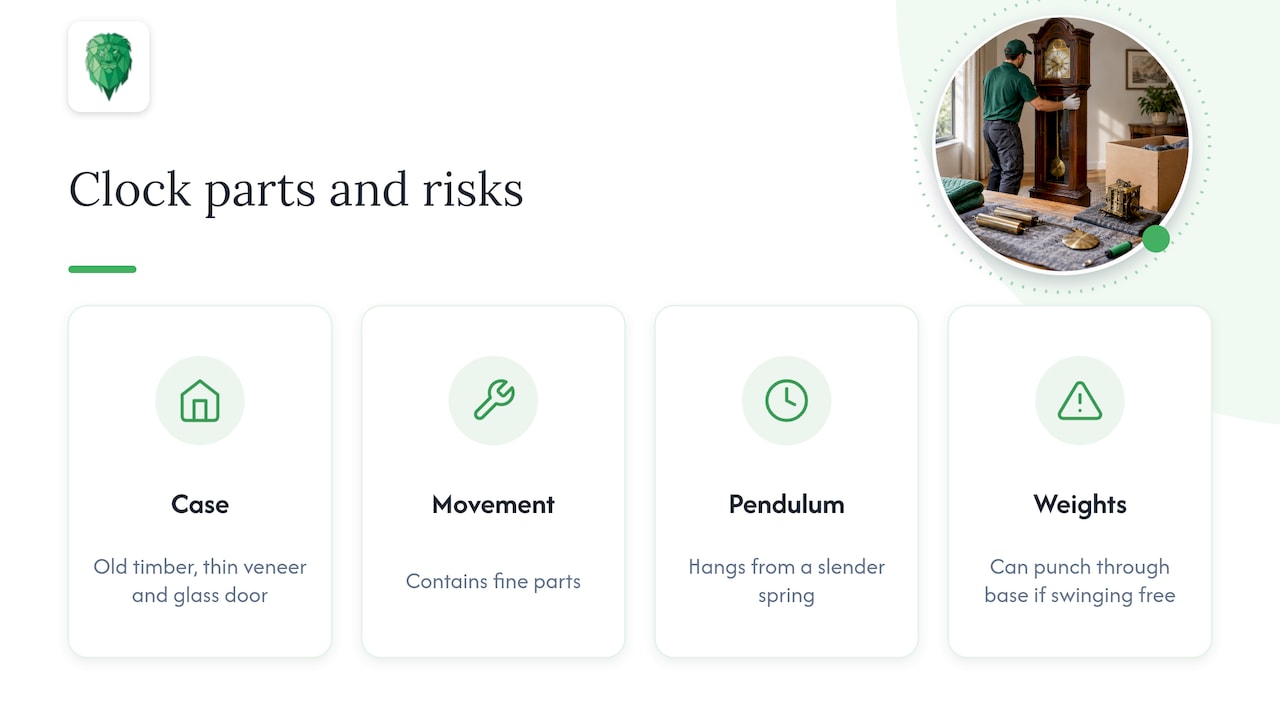
A tall case clock is part furniture, part precision instrument. The case is often old timber with thin veneer, delicate mouldings and a glass door. Inside sits a movement with fine parts, a pendulum hanging from a slender spring, and heavy weights that can punch through the base if they swing free.
That mix is why a standard “wrap it in a blanket” approach is not enough. The case needs the care you would give a fine piece of furniture. The movement needs the care you would give a watch. If you are anxious about it, that is a sensible instinct, and the steps below are designed to take the worry out.
If you are moving the whole house, the clock is only one item on a long list. Our guide to how to move fragile items safely covers the wider picture, and you can plan the clock alongside everything else.
What you need before you start
Gather everything first, so you are not hunting for tape halfway through. You will need:
- Cotton gloves or a soft, clean cloth for handling parts
- A phone or camera
- Acid-free tissue or soft cloths, plus bubble wrap
- Strong cardboard tubes or long boxes for the pendulum
- Small boxes or padded pouches for weights and keys
- Soft ties or cloth strips (not sticky tape) for case doors
- Moving blankets and a few padded corner protectors
- A second pair of hands
- Soft foam blocks if your clock is cable driven
- Thin wire or string if your clock is chain driven
Take photos of the clock from every angle before you touch anything. Photograph the weights hanging in place, which weight sits on which side, and how the pendulum hangs. Those pictures become your reassembly guide. A specialist guide to moving antique clocks from Antique Guides makes the same point: photograph the arrangement before removing the movement.
Step 1: Work out how your clock is driven
Before removing weights, look at how they are suspended. This decides how you secure the clock.
| Drive type | What you will see | How to prepare |
|---|---|---|
| Cable driven | Steel cables running over pulleys | Insert foam blocks above the pulleys and wind the weights fully before removing them |
| Chain driven | Chains hanging with a weight on each | Thread wire or string through about six links below each sprocket and secure it |
| Line or cord driven | Gut or cord lines, common on older clocks | Do not rethread anything yourself; ask a clockmaker |
The first two rows come from the manufacturer’s own instructions. Howard Miller’s UK support guide to preparing a floor clock to be moved says cable-driven clocks need foam blocks above the cable pulleys and the weights wound fully before removal. For chain-driven clocks, it says to thread wire or string through roughly six chain links below each sprocket and secure it so the chains cannot come loose.
That guide is written for that maker’s clocks, so treat it as a sound general principle rather than a rule for every antique. If your clock is older, unmarked or has an arrangement you cannot identify, the safest step is to stop and ask a specialist. One conservator-led guide on moving a grandfather clock suggests you should not pull a chain, rethread a line or release a click as improvised preparation if the arrangement is unclear.
Step 2: Stop the clock and remove the pendulum
The pendulum goes first. It hangs from a very thin suspension spring, and that spring is one of the easiest parts to damage in a move.
- Open the trunk door and gently stop the pendulum swinging.
- Lift the pendulum bob or the whole pendulum off its hook or suspension, using gloves or a soft cloth.
- Keep it straight and do not bend or twist the leader (the thin strip at the top).
- Set it aside somewhere safe, away from the working area.
David Bond, a UK clock repairer, says the pendulum bob must be removed before moving because it can damage the suspension spring, and that the leader should not be held against its movement limit. Howard Miller’s guidance agrees that accessory parts, including the pendulum and weights, should be removed and packed properly, and that you should use cotton gloves or a soft cloth when handling them.
Step 3: Remove and wrap the weights
Weights are heavy, often brass-cased or lead-filled, and they can crack a base board or scratch the inside of the case if left in place.
- Support each weight with both hands as you unhook it.
- Note which one came from which position. Weights are often slightly different, so label them with a small paper tag (left, centre, right) tied loosely, not stuck on.
- Wrap each weight separately in tissue, then a layer of bubble wrap.
- Pack them low in a small, sturdy box, with padding so they cannot knock together. Do not put them in a large box with other things on top of them.
Antique Guides recommends wrapping each dense weight separately and wrapping the pendulum along its whole length while keeping it straight. A long cardboard tube is ideal for the pendulum: it holds it straight and gives crush protection.
Step 4: Secure the movement and the case
Some clocks have a movement that can be lifted out, and a specialist will often do this for a long journey. If you are not confident, leave the movement in the case. Do not try to remove a movement you have not seen removed before.
If the movement does come out:
- Keep it upright at all times.
- Never carry it by its plates or wheels.
- Pad it on all sides so it cannot shift.
Those three points come from the same Antique Guides advice. If the movement stays in the case, close and secure the hood and trunk door with soft ties or cloth strips. The same guide recommends soft ties rather than tape on old timber, because sticky tape can pull at old finish and veneer.
Two more habits help:
- Take off the hood if it lifts away easily, wrap it separately and carry it on its own.
- Remove any loose items from inside the case, including the winding crank, keys and any loose dial parts.
Winding keys, small brass screws and other tiny parts are easy to lose. Keep them together in one padded pouch, labelled and kept with you rather than on the van. If you want ideas for keeping small valuables safely together on moving day, this guide on securing small valuables during a move has a sensible approach that works just as well for clock keys. For packing delicate loose parts so they do not rattle or scratch, the principles in this guide to shipping mineral specimens translate neatly: snug, separate, cushioned, nothing touching.
Step 5: Wrap the case
Once the inside is empty and secured, wrap the outside:
- Cover the glass door and dial with a layer of soft cloth, then bubble wrap. Do not tape across the glass.
- Wrap the whole case in a moving blanket, tucked in at the corners.
- Add padded corner protectors at the base and the hood top.
- Fix the blanket with stretch wrap around the blanket only, never touching the wood.
If your clock has fragile carved finials or a pediment, wrap them with extra tissue first. Our guide to packing valuable goods goes through the materials in more detail.
Step 6: Lifting and loading
This is where most accidents happen, so slow down.
- Two people minimum. Conservators advise lifting tall case clocks with two people and never dragging them, according to the guide drawing on The Henry Ford’s advice.
- Clear the route. Move rugs, open doors fully and check stairs and turns. Measure the clock and the narrowest point before you lift.
- Keep it upright and lifted, not tilted. Carry it close to your body with your knees bent. Never drag it across the floor.
- Use a trolley with straps for long runs, with the case padded and secured.
- In the van, stand the clock upright against the side wall, strap it to a fixed point with padding between strap and wood, and put nothing heavy against it.
If the clock is very tall, has a steep staircase to leave by or is simply too valuable to risk, this is a sensible moment to bring in a team that does this every week. Our team handles large, fragile and valuable items as part of our furniture and large item removals, and you are welcome to mention the clock when you ask for your quote so the crew arrives with the right padding and straps.
Step 7: Setting up in your new home
You have made it. The clock is in the new house, and the hardest part is over. Do not rush the last stage.
Choose a good spot
Pick a wall that is solid and reasonably free from draughts, away from radiators and direct sun. Floors matter too. Horologica, a specialist clock site, explains that longcase clocks can lean on fitted carpet or uneven floors, which lets the pendulum or weights rub the case and stop the clock. The same page recommends anchoring the clock to the wall, as slight side-to-side sway can create a sympathetic vibration that stops it.
Reassemble in order
The Glenbryde guide to setting up a longcase clock gives a clear sequence:
- Check that the supports are level and the cords and pulleys hang freely.
- Attach the correct weights, then the pendulum.
- Wind a small amount, gently push the pendulum and listen for an even tick.
- Set the time by moving the minute hand clockwise, allowing the strike to finish.
That last point matters: if the clock strikes, move the hands forward slowly and pause at each hour so the strike can complete. Use your photos to confirm which weight goes where.
Also make sure the pendulum bob is fully seated on its hook. David Bond notes that a wobble can affect timekeeping or even stop the clock.
Listen to the beat
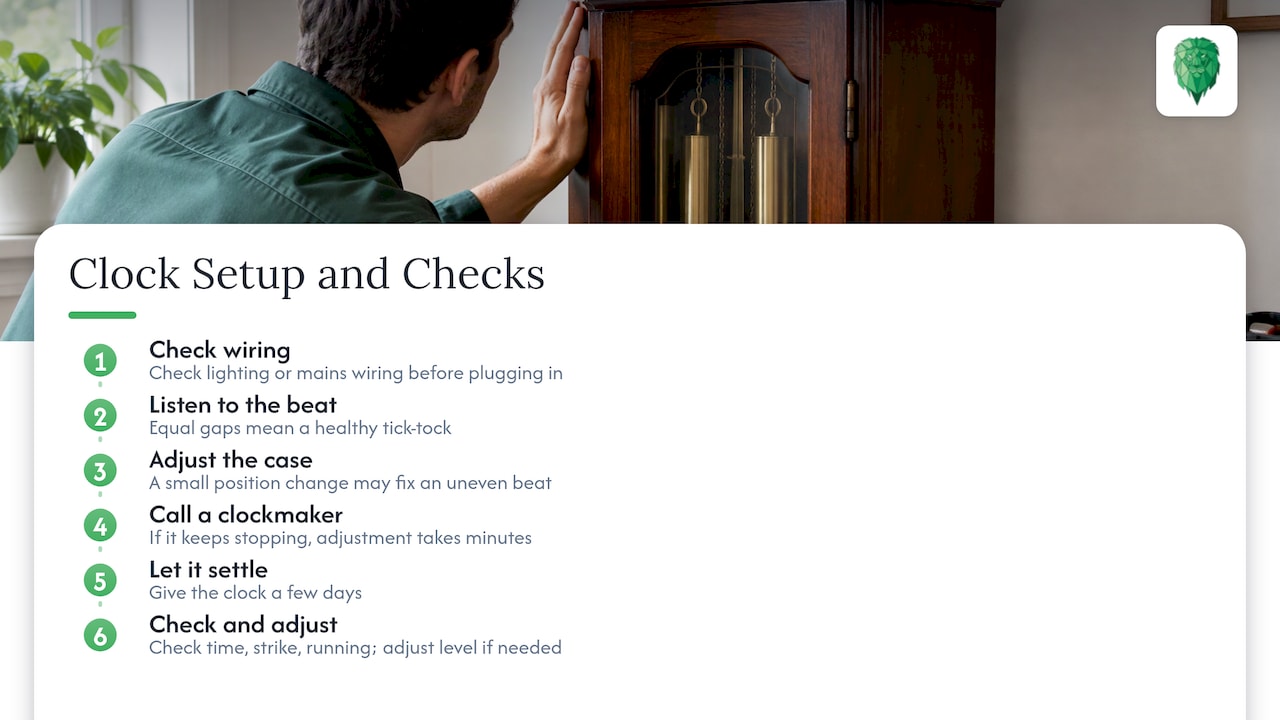
A healthy clock has an even “tick, tock” with equal gaps. If it sounds lopsided, the clock is probably out of beat. That often sorts itself with a small adjustment of the case position, but if it keeps stopping, a clockmaker can adjust it in minutes.
A small note for clocks with electrical features: Tic Toc Clock Repairs mentions that unusually old clocks or ones with custom wiring may need advice from a qualified electrician when set up in the new home. If your clock has lighting or any mains wiring, have it checked before you plug it in.
Give the clock a few days to settle. Check the time, the strike and that it is still running, then adjust the level slightly if needed.
When to call a specialist
Doing it yourself is realistic for a modern or well-understood clock, but it is wise to bring in help first if:
- The clock is valuable, fragile, unfamiliar or unstable.
- You cannot tell how the weights are suspended.
- The movement needs to come out and you have never done it.
- The route has tight stairs, narrow turns or several floors.
- The clock has an insurance valuation attached.
The advice in this guide to moving a grandfather clock is to involve a clockmaker or specialist mover before work begins in those cases, and to have someone familiar with the movement check the reassembly, weight placement, beat and clearance afterwards.
A good split is this: a clockmaker looks after the movement, and a careful removals team looks after the case, the lifting, the van and the route. They complement each other nicely.
Our perspective
After more than 15 years of moving homes and offices across the UK, we have learned that clocks are rarely difficult because of weight alone. They are tricky because they are fragile in several different ways at once: tall, top-heavy, glass-fronted and full of tiny moving parts.
That is exactly the kind of job where a calm plan beats speed. We think of it the way we think of a piano: measure the route, protect the piece, lift with enough people and secure it so it cannot shift. If you are curious how we approach that kind of job, our write-up on protecting a piano in transit shows the same thinking.
Our crews are used to large, fragile and valuable items, and we offer packing, assembly and disassembly as part of a move, along with insured transport. Our advice is simple: tell us about the clock early, share a photo and the route, and let us plan around it. You keep the movement in the hands of a clock specialist if it needs one, and we take care of getting the rest there safely.
Moving day is a marathon, not a sprint, and a clock that arrives ticking is a lovely way to finish the first evening in a new home.
Claudiu
Moving a clock with the rest of your home
Most people do not move a clock on its own. It travels with the dining table, the books and the rest of the house. A few tips to keep it all in order:
- Move the clock last out of the house or first onto the van, so it is never buried or squeezed.
- Pack books and heavy boxes away from it. If you collect old volumes, our guide on packing antique books is a handy companion.
- Keep the small parts box with you, not in the van, so you can set the clock up the same evening.
- Reassemble early. A clock left in pieces for weeks is easier to mislay a part from.
If you are comparing options for a bigger relocation, our house removals service covers packing, storage and unpacking as well as the move itself.
Need help moving a clock?
If you would rather not carry a family heirloom down the stairs yourself, we can help. We handle furniture, large and fragile items, and full house moves across the UK, with insured transport and optional packing, disassembly and assembly.

Tell us about the clock, the stairs and the distance, and we will plan the right padding, people and van for it. You can get an instant quote through our Van-247 delivery site or go straight to our furniture and large item removals page.
FAQ
Can I move a grandfather clock without taking it apart?
It is not a good idea. The pendulum and weights should come off before the case moves, as they can damage the suspension spring and the case. Leave the movement in place unless you or a clockmaker know how to lift it out safely.
Should I wind the clock before I move it?
It depends on the drive. Howard Miller’s guidance for cable-driven clocks is to wind the weights fully before removing them. For other clock types, or if you are unsure, ask a clockmaker before you wind anything.
How many people do I need to carry a tall case clock?
At least two, and more if the route is tight or the stairs are steep. The case should be lifted and never dragged. Keep it upright and padded the whole way.
Why has my clock stopped after the move?
The usual causes are an uneven floor or soft carpet making the case lean, a pendulum rubbing the case, or a bob not fully seated on its hook. Level the case, check the clearance and anchor it to the wall. If it still stops, a clockmaker can check the beat.
Do I need a specialist to move an antique clock?
For a valuable, fragile or unfamiliar clock, yes, it is wise to involve a clockmaker or specialist mover before you begin. For a clock you know well, careful preparation and two people may be enough.
Sources
- How to prepare a floor clock to be moved (Howard Miller support)
- Mechanical clock repair (David Bond Clock Repairs)
- How to Move an Antique Clock Without Damaging It (Antique Guides)
- How to Move a Grandfather Clock Without Damaging It (Horology Atlas)
- A guide to setting up a Longcase clock (Glenbryde)
- Problems after moving a Grandfather clock? (Horologica)
- Secure Jewelry During a Move: 6 Steps
- Shipping mineral specimens: a collector’s guide