No parking move day: if your street has “no parking” rules on moving day, you need one of two council permissions: a parking suspension, which reserves a bay for your van, or a dispensation, which lets a specific vehicle load and unload on restricted lines. Apply to your local council as soon as you have a moving date, or ask your removals firm to handle it, and check the notice period, because it varies by area.
TL;DR:
- A large removal lorry needing a guaranteed bay for several hours usually needs a suspension; a small van loading continuously may use a dispensation.
- Apply early: some councils require at least 10 working days for a resident bay suspension, and weekends and bank holidays generally do not count.
- Councils commonly ask for exact dates, times, vehicle registrations, and bay count; estimate roughly five meters per bay and check vehicle eligibility.
- A suspension does not guarantee an empty bay; photograph obstructions beside official signage and call council enforcement immediately, because private cones have no legal force.
- If your removals company applies, get the council reference and verify the listed registration matches the van; a mismatch can invalidate permission.
Table of Contents
- Parking suspension or dispensation: which one do you need?
- How to arrange council permission for your move
- What councils need on your application
- Handling moving day itself if the bay is taken
- Can a removals company arrange your parking permission?
- Our field-tested moving day parking checklist
- Telling your neighbours and building management in advance
- Loading and unloading safely without a parking suspension
- Looking at private lots and temporary loading zones nearby
- A practical note on planning ahead
- Getting help with parking permissions and your move
- FAQ
- Sources
Parking suspension or dispensation: which one do you need? Part of no parking move day
These two permissions solve different problems, so it helps to know which one fits your move.
A parking suspension reserves a specific bay, or several bays, by temporarily lifting the normal parking controls so only authorised vehicles can use the space. A dispensation (sometimes called a waiver) works differently: it is tied to a named vehicle and allows that vehicle to park somewhere usually restricted, such as a single yellow line, while it is continuously loading or unloading, according to North Somerset Council’s guidance.
Which one suits you depends on the job:
- A large removal lorry that needs a guaranteed space for several hours is better served by a suspension.
- A smaller van doing a quick, continuous loading run from a yellow line often only needs a dispensation.
Dispensations do not reserve general parking. They only cover the vehicle and purpose named on the notice, so you cannot use one to hold a space open before the van arrives.
How to arrange council permission for your move, part of no parking move day
Most councils handle these applications through their parking or streets pages, usually with an online form you complete before your move date. Search your council’s website for “parking suspension” or “parking dispensation” and you should find the relevant form along with guidance on costs and timing.
Notice periods differ significantly between boroughs:
- Some councils ask for at least 10 working days’ notice for a resident bay suspension.
- Others accept shorter notice if you pay a premium, though this is discretionary rather than guaranteed.
- Weekends and bank holidays generally do not count towards the notice period, according to Kensington and Chelsea’s suspension FAQs.
Some councils waive the space charge for the initial day of a domestic house move, up to a small number of spaces, which can make a real difference to your overall moving costs, according to Camden Council. Fees and short-notice surcharges vary by borough, so it is worth checking your own council’s page rather than assuming a flat national rate. If you are moving in or out of a borough with heavy demand for suspensions, book earlier rather than later to avoid last-minute complications that can increase costs or lead to refusal.
For more on getting your move-day paperwork in order generally, our removal day paperwork checklist covers the other documents worth having ready alongside your parking permission.
What councils need on your application, part of no parking move day
Getting the details right the first time saves you a frustrating back-and-forth with the council, and possibly a refused application close to your move date. Most forms ask for the same core information:
- The full address of the property, including flat or unit number where relevant.
- A clear description of the bay location, often with a map reference or nearby street number.
- The exact dates and times you need the suspension or dispensation to run.
- The number of bays required, calculated at roughly five metres per bay.
- The registration number of every vehicle that will use the space.
Vehicle eligibility matters too. Vans, lorries and trucks are usually accepted for suspensions, but some councils exclude cars and minibuses from this type of permission, so check the form’s wording before you submit it, as Ealing Council’s parking suspension page sets out. Payment is typically taken at the point of application, and if your move runs over, most councils let you request an extension rather than starting a fresh application from scratch. Make sure you note your expected finish time clearly, since some boroughs charge by the day regardless of how many hours you actually use.
Handling moving day itself if the bay is taken, part of no parking move day
Even with a suspension confirmed, councils do not promise you an empty bay the moment your van arrives. Enforcement teams do not patrol in advance to clear the space, so if another vehicle is parked there when you turn up, the responsibility to report it sits with you.
- Photograph the obstructing vehicle and the official suspension sign together, with a visible timestamp if possible.
- Call the council’s enforcement team straight away rather than waiting to see if the vehicle moves on its own.
- If there is a real risk of a penalty charge notice, move your own vehicle to a legal space while you sort things out.
- Keep a written or photographic record in case you need to dispute a charge later.
Only official suspension signage gives enforcement officers the authority to issue penalty charge notices to vehicles parked illegally in your reserved bay. Putting out your own cones or handwritten “no parking” signs has no legal standing and will not get an unauthorised vehicle moved, as North Somerset Council explains.
Pro Tip: Keep the council’s enforcement number saved in your phone before move day, so you are not searching for it while a van full of boxes sits idling outside.
Can a removals company arrange your parking permission? Part of no parking move day
Many professional removal companies will handle the suspension or dispensation application as part of their service, but this is not universal, so always confirm in writing who is submitting the form and who is paying the fee before move day, as Ealing Council notes for people hiring a removal firm.
- If your removals firm arranges it, ask for the council’s confirmation reference, the exact vehicle registration numbers listed, and the precise suspension dates and times.
- If you arrange it yourself, pass the written confirmation to your removals team before the day and make sure any required waiver notice is displayed on the vehicle.
- Either way, double check the confirmed vehicle registration matches the van that actually turns up, since a mismatch can invalidate the permission.
Our field-tested moving day parking checklist, part of no parking move day
Years of coordinating UK removals have taught us where parking permissions tend to go wrong, so here is the sequence we recommend to clients:
- Apply for your suspension or dispensation as early as your move date allows, and gather every vehicle registration number in advance.
- Confirm the number of bays needed and the approximate length of your van, and ask about any first-day concessions your council offers.
- Two days before the move, confirm the council’s approval has come through and share copies with your removals team.
- On the day, photograph the official signage, call enforcement immediately if the bay is occupied, and log start and finish times in case of a dispute.
Pro Tip: Save the council’s confirmation email and the photograph of the suspension sign in the same place, so you have both to hand if a dispute comes up weeks later.
Telling your neighbours and building management in advance, part of no parking move day
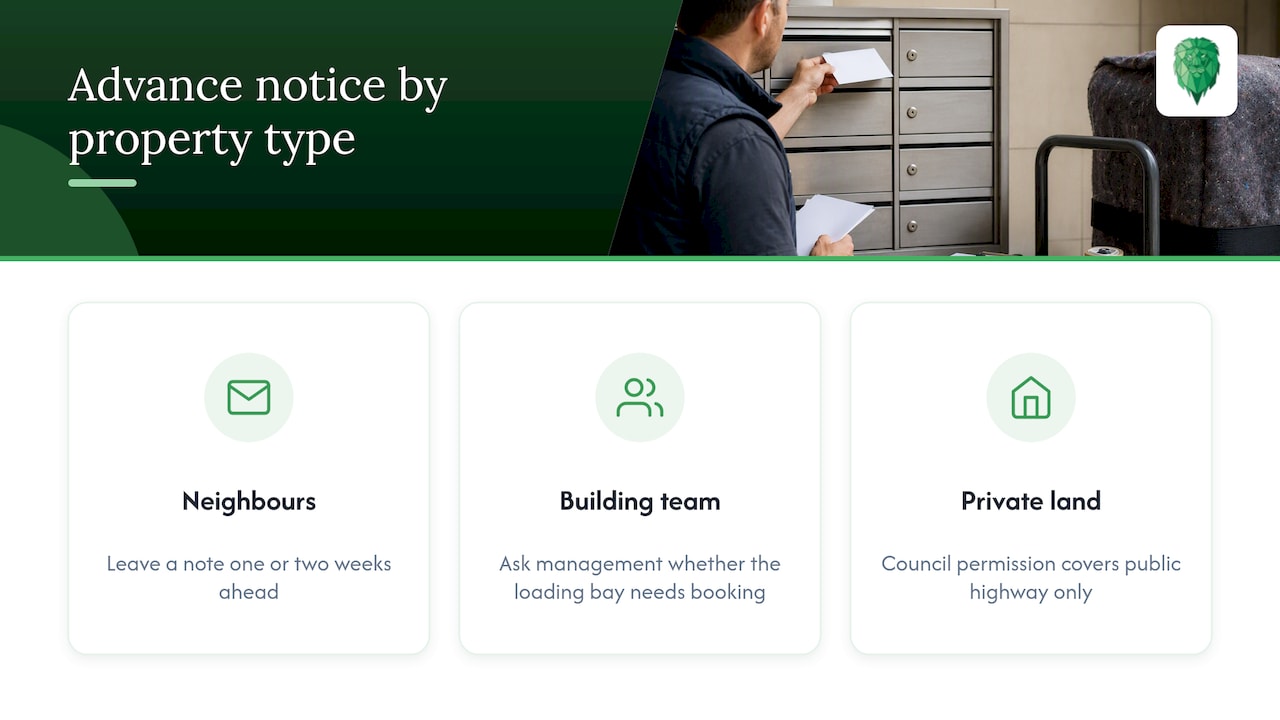
A quiet word before moving day prevents most of the awkward moments that come from someone finding their usual spot cordoned off with no explanation. If you live on a residential street, a simple note through a few neighbours’ doors a week or two ahead, explaining the dates and times the bay will be suspended, tends to smooth things over far more than a sign appearing overnight.
Flats and managed buildings need a slightly different approach. Speak to the building management or your managing agent directly, since they often control access to shared driveways, loading bays or visitor parking that your removal van might need. Ask whether there is a booking system for the loading bay, and whether other residents need advance notice if your van will block a shared access route even briefly.
For terraced streets where access is already tight, it is worth reading up on how narrow streets affect move timing. Our guide to avoiding fines on narrow-street removals covers the kind of access issues that often overlap with parking suspension planning.
Where you share a driveway or a private road with neighbours, confirm with them directly rather than assuming your council permission covers private land, since a suspension or dispensation only applies to public highway, not to privately owned parking areas.
Loading and unloading safely without a parking suspension
Sometimes a suspension does not come through in time, or your council does not offer one for your street. That does not mean you have to risk a fine or block traffic badly; it means you need a tighter plan.
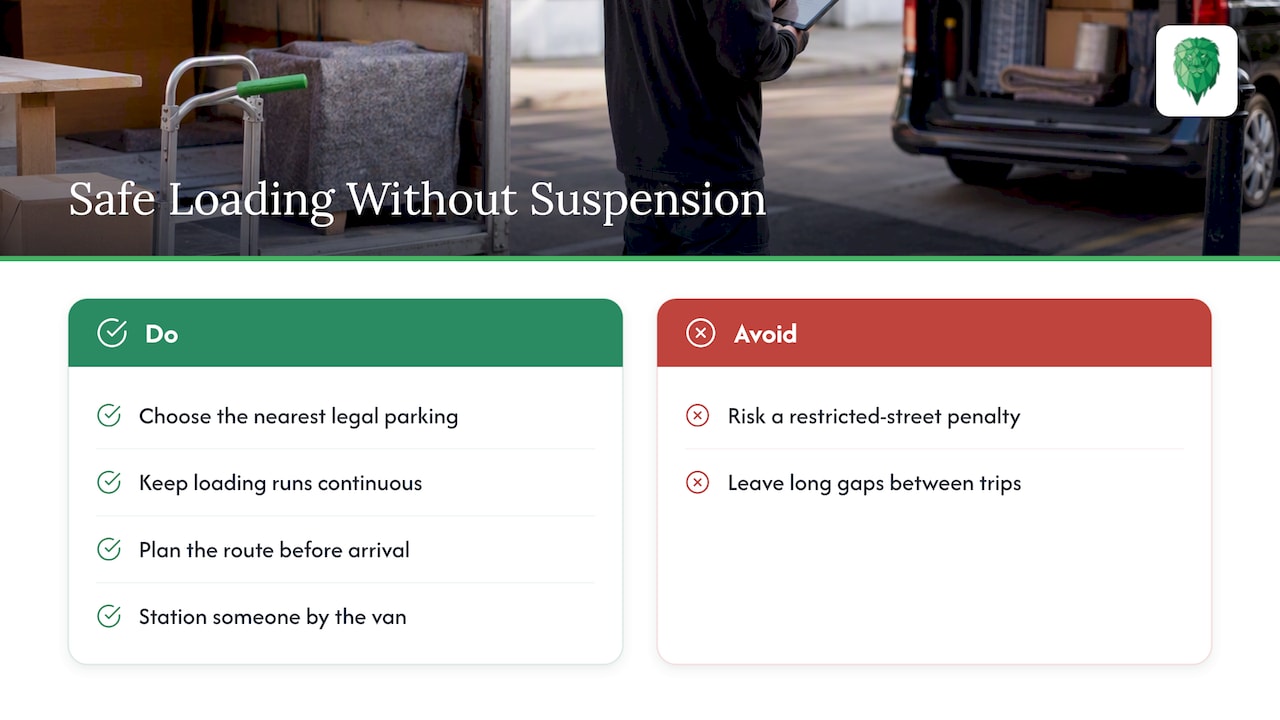
Look for the nearest legal parking that still gives your crew a short carrying distance, even if it is not directly outside the door. A pay-and-display bay a short walk away is often safer and cheaper than risking a penalty on a restricted street.
Keep loading runs as short and continuous as you can. If you are relying on a dispensation rather than a suspension, remember the permission only holds while the vehicle is actively loading or unloading, as Bexley Council sets out, so long gaps between trips can put you at risk of a ticket.
Plan your route through the property before the van arrives, so boxes move in a steady flow rather than stopping and starting while someone works out the best path. This cuts the total time your vehicle needs to sit on a restricted section of road, which matters most when you have no suspension to fall back on. Where possible, have one person stationed by the van to watch for traffic wardens or returning residents while the rest of the team carries items inside.
Looking at private lots and temporary loading zones nearby
When the street itself offers no good options, it is worth checking what sits just beyond it. Many town centres and residential areas have short-stay private car parks or supermarket loading bays within a few minutes’ walk that allow enough time for a determined unloading run, provided you check the signage for maximum stay limits first.
Some local authorities also designate temporary loading zones for specific events or developments, separate from the standard suspension system, so it is worth asking your council’s streets team whether anything of that kind already exists near your new address. If you are moving somewhere with heavy on-street parking demand, such as central London, this kind of alternative can be the difference between a smooth day and a stressful one. Our guide to moving vans in London covers some of the borough-specific quirks that make advance planning worthwhile there.
If your new building has a private car park or a dedicated loading bay, confirm with the managing agent whether you can book it for your move window, since many of these spaces sit unused for most of the day and are simply never offered unless you ask directly.
A practical note on planning ahead
We have seen plenty of UK moves where the hold-up was not the packing or the van, it was a parking permission sorted too late. Confirming details early with your council and your removals company removes most of that risk before it becomes a problem on the day.
— Claudiu
Getting help with parking permissions and your move
We offer house removals and man-and-van services across the UK, and we can take on the parking permission application for you when you ask us to at the time of booking. Just mention it when you get your quote, and we will confirm exactly what we need from you, including vehicle details and your preferred dates.
If you prefer to have comprehensive assistance throughout your move, including packing and parking logistics, consider contacting moving service providers for a quote to discuss options that best fit your needs.
FAQ
How long can a car stay parked without moving in the UK?
There is no single UK-wide time limit that applies everywhere; rules depend on local parking restrictions, permit zones and whether the vehicle is on a public road or private land. Check your specific council’s parking pages or any signage on your street for the rules that apply to your location.
What are the new parking laws in the UK?
Parking rules are set and updated locally by individual councils rather than through a single nationwide law, so changes tend to appear on a council-by-council basis. For moving day specifically, the relevant rules are the suspension and dispensation processes run by your local authority, which you should check directly on their website.
Can you put a no parking sign in front of your house in the UK?
A handwritten or private “no parking” sign has no legal standing and will not stop someone from parking there or allow enforcement action against them. Only an official council-issued suspension or dispensation notice gives enforcement officers the authority to act against unauthorised vehicles.
Can I put no parking cones outside my house?
Putting out your own cones does not create a legally enforceable parking restriction, even outside your own home. If you need guaranteed space for a moving van, you need to apply to your local council for a parking suspension rather than relying on cones, as North Somerset Council confirms.
Sources
- Parking waivers, suspensions and dispensations (North Somerset Council)
- Parking suspension guidance (Ealing Council)
- Parking bay suspensions (Camden Council)