Transit insurance excess: your transit insurance excess is the fixed amount you pay towards any claim, made up of the compulsory excess your insurer sets plus any voluntary excess you choose. You normally pay it even when the damage is not your fault, unless your insurer recovers it. A higher voluntary excess usually lowers your premium, but it leaves you with a bigger bill on claim day.
TL;DR:
- Goods in transit policies may set separate excesses for transit, storage, or liability, and wording can apply charges per person, item, claim, or event.
- Commercial excesses are tailored; household policies commonly cite £50 to £250, so check your schedule rather than relying on a general benchmark.
- A higher voluntary excess can lower premiums, but choose it only if you can pay the full combined amount immediately without borrowing.
- You usually pay even for damage caused by someone else; your insurer may seek recovery, but it can fail and leave the excess with you.
Table of Contents
- What is an excess, and how do compulsory and voluntary excess differ?
- How does excess work on goods-in-transit policies?
- What are typical excess levels, and what do the numbers look like?
- Who pays the excess on a non-fault transit claim?
- How do excess levels affect premiums, and how should you choose?
- How do you read your policy schedule and avoid excess surprises?
- How does excess apply to fragile, high-value and palletised goods?
- Is the excess charged per claim, per item or per transit event?
- How does excess affect claim speed and complexity?
- Can you buy back or waive your transit insurance excess?
- What do real claims scenarios look like with an excess?
- How do you choose the right voluntary excess for your transport risk?
- Our view: how we reduce excess friction on claims
- How can we help with insured transport?
- FAQ
- Sources
What is an excess, and how do compulsory and voluntary excess differ? Part of transit insurance excess
An excess is the part of every claim that you agree to cover yourself before the insurer pays anything. MoneyHelper describes it as the fixed portion of a claim the policyholder pays, and it usually has two layers.
- Compulsory excess: set by the insurer and normally non-negotiable. It reflects how risky the insurer thinks your cover is.
- Voluntary excess: an extra amount you choose to take on, in exchange for a lower premium.
- Total excess: the two added together. If your compulsory and voluntary excesses add up to a substantial amount, you pay that combined amount towards a claim.
Why does this matter? Because insurers often expect the money at the point of repair or settlement, so you need to be able to find the full total quickly. Think of the two layers as one number that sits on your claim, not two separate bills.
How does excess work on goods-in-transit policies? Part of transit insurance excess
Goods-in-transit (GIT) policies rarely have one simple excess. A removal or courier policy is often split into sections, such as transit, storage and public liability, and each section can carry its own figure. Specialised transit and removal wordings can also apply an excess per person or per section, which surprises people who expect one flat amount.
Here is how that tends to look in practice:
- Per section: the transit section might carry a different excess from storage, so a claim for goods damaged in the van is treated differently from goods damaged in a warehouse.
- Per person: where several people own the goods in a shared move, the wording can charge an excess for each person’s contents claim.
- Paid at settlement: many insurers ask for the excess at repair or settlement, so budget for it before you start the claim.
For businesses, this means the excess on a pallet load may not match the excess on a house move. Read the wording for the cover you are actually using, not the one you assume you have.
What are typical excess levels, and what do the numbers look like? Part of transit insurance excess
Consumer guidance gives a useful baseline. MoneyHelper notes that excesses on standard household policies are commonly cited between £50 and £250, while commercial policies, goods in transit included, can carry significantly higher, tailored levels.
Commercial excess levels are tailored, not fixed: MoneyHelper says commercial and goods-in-transit policies can have significantly higher excesses than the household range, so always check your own schedule.
Say a pallet of goods is damaged and the repair or replacement costs a substantial amount. These examples are illustrative, not market data.
- Low excess, higher premium: with a lower total excess, the insurer pays more of the claim and you pay less. You have paid more each year in premium for that comfort.
- High excess, lower premium: with a higher total excess, the insurer pays less and you pay more. Your premium was lower, but more of the claim cost falls to you.
Neither choice is wrong. The right one depends on what you can comfortably pay on the day. The exact figures always come from your policy and your insurer, so check the schedule rather than trusting a rule of thumb.
Who pays the excess on a non-fault transit claim? Part of transit insurance excess
Usually you do. The Financial Ombudsman Service explains that an excess is due whether or not you were at fault, because it is a basic part of the contract rather than a penalty. That feels unfair when someone else caused the damage, and the Ombudsman acknowledges as much.
Your insurer may try to claw the money back from the person responsible, but it does not have to succeed. If recovery fails, the excess stays with you. The Ombudsman has also accepted that insurers can make reasonable commercial decisions about whether to keep pursuing recovery, provided they act fairly. An excess is often simply an uninsured loss, and insurers are not obliged to recover it for you.
While recovery is attempted, expect to:
- Pay the excess first, so the claim can move forward.
- Hand over photographs, inventories, delivery notes and any third-party details.
- Wait for an outcome that can take longer than the claim itself, and may end with nothing returned.
How do excess levels affect premiums, and how should you choose? Part of transit insurance excess
A higher voluntary excess usually lowers your premium, because you are carrying more of the risk. The catch is affordability. Consumer guides warn that treating a big voluntary excess as risk-free is a mistake: unless you have the cash to pay the combined total up front, it is a dangerous gamble.
Work through these checks before you choose:
- Cash reserves: could you pay the full combined excess tomorrow without borrowing?
- Claim history: have you claimed before, and how often do your loads get damaged?
- Value and frequency: how valuable are the goods, and how many journeys do you make?
- Security measures: are vehicles locked, alarmed and parked somewhere sensible?
- Alternative cover: would a different policy structure suit you better than a bigger excess?
Pro Tip: You can often cut your premium without raising your excess: pack goods properly, secure your vehicles, and keep a documented inventory of every load.
How do you read your policy schedule and avoid excess surprises? Part of transit insurance excess
Your policy schedule is the document that counts. The Ombudsman has upheld unusually high excesses, such as an “all sections” excess, when they were clearly documented, even where the customer said they had not noticed. Look in three places: the schedule, the product information document and your welcome pack.
Watch for these common surprises:
- An unusually high “all sections” excess that overrides the lower figures you expected.
- Per-person excesses, which the policy wording decides, as one Ombudsman decision on multiple excesses shows.
- Different excess amounts for transit and storage.
- Recovery procedures that are described vaguely or not at all.
Before you book a transit, ask your insurer or broker a few direct questions. What is the total excess for this exact job? Does it apply per claim, per item or per person? When must I pay it? Written answers beat verbal ones.
How does excess apply to fragile, high-value and palletised goods? Part of transit insurance excess
The excess on your policy does not change with the type of goods, but the way it bites does. A fixed excess takes a much bigger bite out of a small claim than a large one, so the nature of your load shapes how much the excess really costs you.
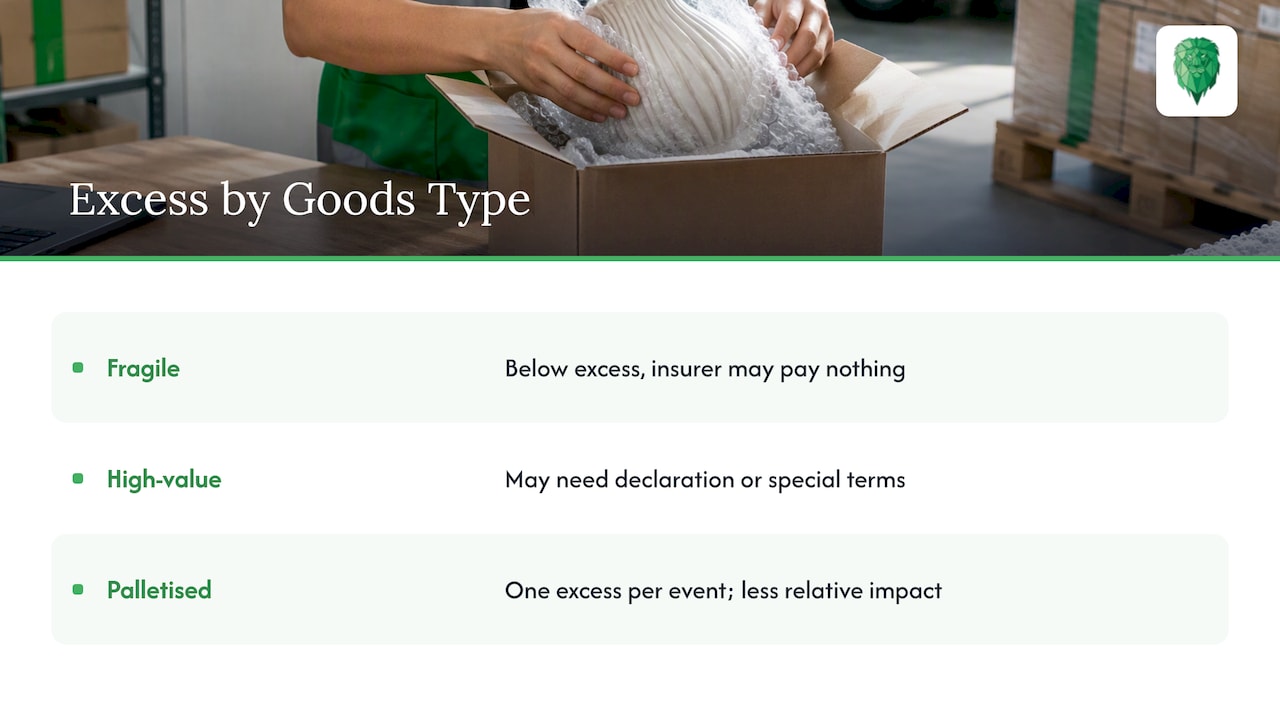
Fragile items such as glassware, mirrors and ceramics are the likeliest to break, and a single breakage can be modest in value. If a vase is smashed and its value is below your total excess, the insurer may pay nothing, leaving you to cover the loss. For people moving lots of small, delicate items, a low excess usually makes more sense than a cheaper premium.
High-value items such as antiques, artwork or electronics may need specific declaration or special terms, and some policies set a different excess for them. Always confirm the wording before you assume they sit under the standard figure.
Palletised goods are different again. A pallet is one unit but holds many items, so one drop can damage the whole load. The excess usually applies once to the event, yet the claim value can be large, so the excess matters less proportionally. Cover limits also deserve a look: our guide to pallet insurance limits explains why typical per-kilo limits can leave valuable pallets short.
The practical lesson is simple. Match your excess to the usual size of your claims, not to the size of your biggest imaginable one.
Is the excess charged per claim, per item or per transit event? Part of transit insurance excess
There is no single answer, which is exactly why the wording matters. Whether an excess applies per claim, per item or per transit event depends on the policy wording and schedule.
Think of the three possibilities this way:
- Per claim: the policy may apply one excess to a claim, but check whether its wording also allows other excesses to apply.
- Per item: each damaged item attracts its own excess. This can add up quickly on a load of small items, so it is worth spotting before you sign.
- Per transit event: check the wording to see how the excess applies to a journey.
There is also the per-person layer discussed earlier. The Ombudsman has confirmed that policy wording decides whether multiple excesses apply to a single event, so two co-owners could face two charges where you expected one.
If your wording does not make this clear, ask the insurer to confirm in writing before you travel. A short email now is far easier than a dispute later, and it gives you something concrete to point to if a claim arises.
How does excess affect claim speed and complexity? Part of transit insurance excess
The excess does not usually slow a claim down on its own, but it adds a step that can. Insurers often want the excess paid at the time of repair or settlement, and consumer guides advise that it is often requested up front. If the money is not ready, the claim can sit waiting.
Here is where the extra complexity tends to creep in:
- Small claims near the excess: if the loss is only slightly above the excess, the paperwork may cost you more time than the payout is worth.
- Recovery attempts: when your insurer chases a third party, the excess question can stay open long after the repair is done.
- Multiple excesses: per-section or per-person structures mean more figures to check and more room for misunderstanding.
- Admin faults: one Ombudsman case shows an insurer accepting administrative failings but still upholding the excess as owed, alongside modest compensation for the service problems.
To keep things moving, gather your evidence early: photographs, the inventory, delivery notes and a clear account of what happened. Have the excess amount ready, and keep a record of every conversation with your insurer. Good paperwork is the quickest way to shorten the process, whatever your excess level.
Can you buy back or waive your transit insurance excess? Part of transit insurance excess
Some insurers and brokers offer ways to reduce or remove an excess, often called excess waivers or buy-back options. The idea is simple: you pay a little extra upfront so that you pay less, or nothing, when you claim. Whether one is available depends entirely on the insurer and the policy, and many goods-in-transit policies are tailored, so do not assume it will be offered.
If you are interested, here is what to ask:
- Is an excess waiver or buy-back available on this policy?
- Does it cover transit only, or storage and other sections too?
- Are there exclusions, such as certain goods or certain causes of loss?
- How much extra will it add to the premium, and does it make financial sense against the excess it removes?
Be careful with separate, standalone excess products. They are a different contract, and they only help if their terms match your main policy. Read what they reimburse, how quickly, and what proof you must supply.
Remember that a waiver only matters if you actually claim. If your loads rarely suffer damage, paying more every year to remove an excess you seldom use may not pay off. If you move valuable or fragile goods often, it may be well worth pricing up. Since availability is not guaranteed, treat it as a question for your broker rather than something to expect.
What do real claims scenarios look like with an excess?
Numbers make the excess easier to picture. These examples are illustrative, with made-up figures, to show how the arithmetic usually plays out.
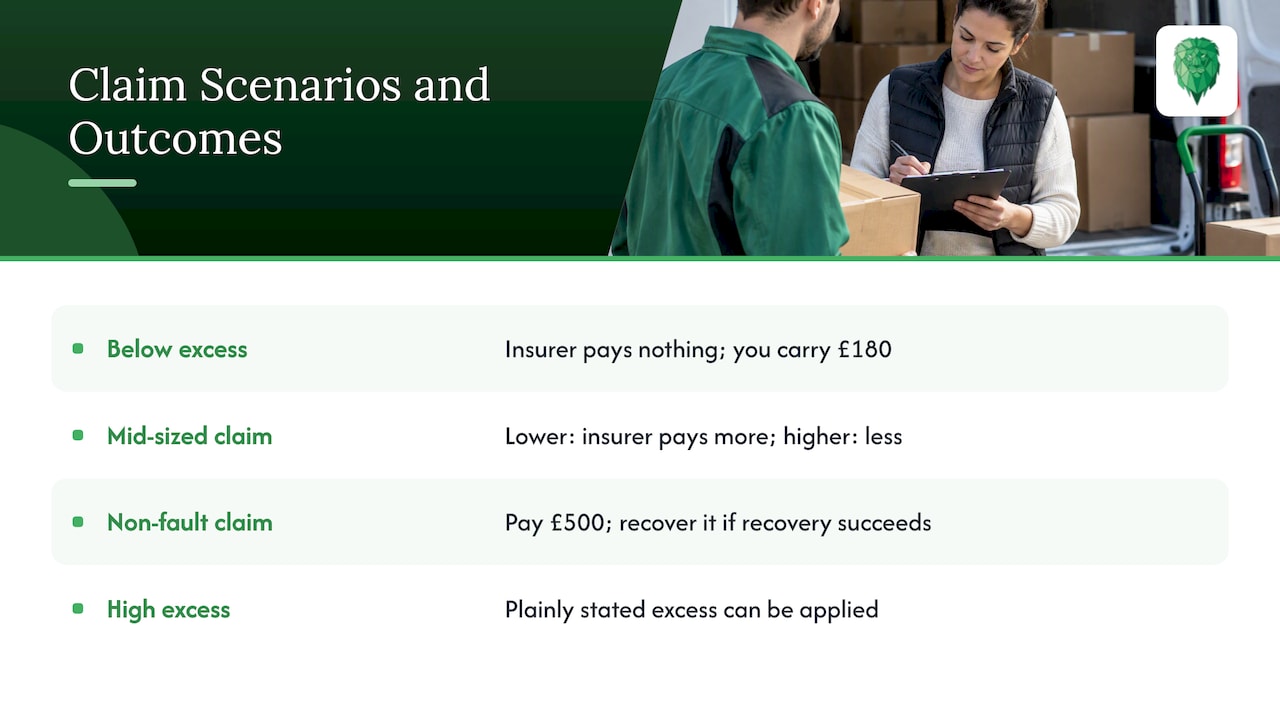
Scenario 1: damage below the excess. A box of crockery breaks in the van, and its value is below your total excess. The loss is smaller than the excess, so the insurer pays nothing and you carry the full £180. Claiming would not have helped.
Scenario 2: a mid-sized claim. A wardrobe is damaged during loading. With a lower total excess, the insurer pays more and you pay less. With a higher total excess, the insurer pays less and you pay more. Same damage, very different outcome.
Scenario 3: a non-fault claim. A third party’s vehicle damages your loaded van while it is parked. The damage costs a substantial amount, and your excess is also substantial. You pay £500 first, and your insurer may try to recover it from the other party. If recovery succeeds, you get it back. If it fails, it is your loss, as Ombudsman guidance makes clear.
Scenario 4: a clearly documented high excess. A customer claims they never noticed a high “all sections” excess. If the schedule stated it plainly, the Ombudsman has upheld that the insurer can apply it.
The pattern across all four is the same: the schedule sets the rules, and your preparation decides how smoothly it goes.
How do you choose the right voluntary excess for your transport risk?
Start with your own situation, not the cheapest premium. A voluntary excess is a trade: you accept more risk to save money each year, so the right level depends on how much risk you can honestly absorb.
Use this simple approach:
- Check your cash. Could you pay the full combined excess immediately, from savings, without strain? If not, lower it.
- Look at your claim pattern. Frequent small claims favour a low excess. Rare, large claims can tolerate a higher one.
- Weigh the goods. Fragile, high-value or irreplaceable items argue for a lower excess, because even small damage matters.
- Count your journeys. The more often you move goods, the more chances for something to go wrong, so the less sensible a high excess becomes.
- Consider your controls. Good packing, secure vehicles and clear inventories reduce claims, which supports a slightly higher excess.
For a household making a single move, a modest excess is usually the comfortable choice, because one unexpected bill on a stressful day is the last thing you want. For a business shipping steady volumes, a higher excess can work if you hold a cash buffer and manage risk well. If you are unsure, our guide to goods in transit versus liability cover helps you decide what protection you need before you pick an excess.
For firms that run vehicles, strong records also help any recovery effort. Fleet-tracking material such as this guide to fleet damage claims shows how good data supports evidence, although it reflects the Italian market, so read it for the principle rather than the rules.
Our view: how we reduce excess friction on claims
Most arguments about excess are not really about the number. They are about surprise. In our view the fix is transparency and evidence, not a cleverer policy. Tell people what the excess is at the point they book, in plain words, and a claim becomes a process rather than a row.
On the evidence side, these habits make the biggest difference:
- Photograph items before loading, with timestamps and clear condition notes.
- Keep a written inventory signed at collection.
- Agree a clear handover at delivery, and note any damage on the spot.
- Pack fragile goods securely, because a claim that never happens costs nobody an excess.
Insurers can only pay what they can verify, so good records speed up almost every outcome.
— Claudiu
How can we help with insured transport?
When you book a professional mover, there are fewer chances for the handling mistakes that lead to claims and excess payments. We handle the loading, securing and delivery, and we can talk you through your cover options before you commit.
What we can move for you:
- Household moves: our house removals service covers packing, transport and unpacking.
- Bulky items: furniture and large items collected and delivered with care.
- Freight: pallet delivery across the UK.
- Business moves: office relocation, including server relocation.
Get an instant quote on our website and ask us what is covered, so you know exactly what you would pay if something went wrong.
This article is general information, not a substitute for advice from a qualified financial advisor. Consult a qualified financial professional about your own circumstances before acting on anything here.
FAQ
How much is goods in transit insurance in the UK?
The price depends on the value and type of goods, how far they travel, and how often you ship. There is no single flat rate, so you need a quote based on your actual loads. A higher voluntary excess usually lowers the premium, but you will pay more if you claim.
What does excess mean in travel insurance?
It means the same as in other policies: the amount you pay towards a claim before the insurer pays the rest. In some specialised policies it can apply per person or per section, so a group claim can carry more than one excess. Check your schedule for the exact structure.
Do you pay the excess if the damage is not your fault?
Usually, yes. The Financial Ombudsman Service says an excess is normally payable regardless of fault. Your insurer may try to recover it from the responsible party, but recovery is not guaranteed.
Is a high voluntary excess a good idea?
It can be, but only if you could pay the full amount immediately. A large voluntary excess lowers your premium, yet it becomes a dangerous gamble if you lack the cash when a claim arises. Choose a level you can afford without borrowing.